Atlanta Access Controls: A Business Owner’s Guide
Think about all the tasks you’ve streamlined in your business. You’ve likely adopted software for accounting, project management, and customer relationships because it makes work more efficient and secure. So why are you still managing building access with a ring of metal keys? Handing out keys is inefficient and leaves you with security blind spots. You can’t be sure who has made copies, and you can’t easily revoke access when an employee leaves. Modern Atlanta access controls replace that outdated process with a centralized, digital system. You can issue or cancel access rights with a click, create detailed entry logs, and set time-based permissions, giving you complete oversight and peace of mind.
 When it comes to keeping your business and your employees safe, a reliable and trustworthy security system should be the first thing that enters your mind. While a standard alarm system is effective as an all-round solution, savvy business owners in Atlanta are looking to access control systems from American Alarm. We provide a higher level of security as well as employee management, data management, intellectual property protection, and employee productivity.
What is an Access Control System?
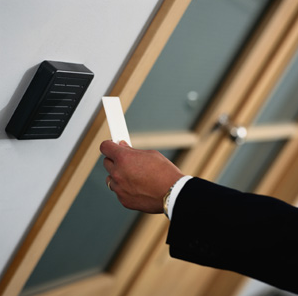
Access control systems are physical systems using locking mechanisms on doors and turnstiles. These are designed to control who is able to access the building or certain areas of a building. The easiest example of physical access control systems would be a door with a magnetic lock limiting people to enter that particular room or building unless that person has a card or fob that allows entrance. Access control systems can be as little as one door or as many as hundreds or even thousands of doors. The main purpose of Atlanta access control systems is to prevent unauthorized access. The card or fob proximity system is the most popular. The card or fob is held up to the reader. If authorized, the readers relays the signal to the controller to release the magnetic lock or door strike to momentarily open the door. Facilities that require higher security, such as laboratories, may also integrate a card control system in which the magnetic cards do double duty as identification for personnel. For even higher levels of security, some government, medical, research and development, and other buildings may use biometrics to govern entry from an employee or person.
The Core Security Process: How It Works
At its heart, every access control system follows a simple, three-step process to determine who gets in and who stays out. Think of it as a digital gatekeeper that asks and verifies three essential questions before opening the door. This process happens in a split second every time someone presents a credential, like a key card or fob. Understanding these steps helps clarify how these systems provide such effective and granular control over your property, ensuring that only the right people have access to the right places at the right times. Let’s break down exactly what happens during that quick interaction.
Identification
The first step is all about answering the question, “Who are you?” This is the identification phase. When an employee holds their key card up to a reader or enters a username, they are presenting their identity to the system. The system’s job is to recognize that unique credential and associate it with a specific person in its database. It’s the initial handshake, where the user makes a claim about who they are. This is a crucial first step because without a clear identity, the system can’t proceed to the next stages of verification and permission-granting.
Authentication
Once a person has identified themselves, the system needs to verify that claim. This is authentication, and it answers the question, “Can you prove it?” This step confirms that the person is who they say they are. It might involve a password, a PIN entered on a keypad, or even biometric data like a fingerprint or facial scan. According to security experts at Delinea, this process involves checking their ID, much like a bouncer checking a driver’s license. This second layer of security prevents someone from gaining access with just a lost or stolen key card.
Authorization
After the system has confirmed a person’s identity, the final step is authorization. This part answers the question, “What are you allowed to do?” Just because an employee is authenticated doesn’t mean they should have access to every room in the building. Authorization involves the system checking the person’s permissions and granting them only the specific access they need to do their job. For example, an office manager might be authorized to enter the main office and supply closet, while an IT specialist has access to the server room.
Physical vs. Logical Access Control
When we talk about access control, it’s helpful to distinguish between two main types: physical and logical. Logical access control deals with the digital world—things like computer networks, files, and sensitive data. It’s what your IT department manages to make sure you can only open the files relevant to your work. On the other hand, physical access control methods are what we specialize in at American Alarm. These are the systems that control who can physically enter a building, a specific room, or a secure area. This includes everything from key card readers on office doors to sophisticated biometric scanners at research facilities, all designed to protect your tangible assets and, most importantly, your people.
Why Access Control is a Smart Investment for Atlanta Businesses
For any Atlanta business owner, investing in security is about more than just installing locks on the doors; it’s about creating a secure, efficient, and compliant operational environment. An access control system is a strategic tool that offers a powerful return on investment by addressing several key business challenges at once. It provides a modern solution to protect your assets, streamline employee access, and safeguard sensitive information. From reducing the risk of theft and data breaches to ensuring you meet industry regulations, the benefits extend far beyond a simple security upgrade. It’s a proactive step toward building a more resilient and professionally managed business that is prepared for modern challenges.
Mitigate Significant Financial Risks
One of the most compelling reasons to implement an access control system is to protect your bottom line. Unauthorized access can lead to theft of equipment, inventory, or intellectual property, resulting in direct financial losses. Furthermore, as noted by the compliance experts at Sprinto, a major benefit is that it helps keep sensitive data safe, reducing the risk of costly data breaches. By ensuring only authorized personnel can enter areas where valuable assets or data are stored, you create a powerful deterrent against both internal and external threats, safeguarding your company’s financial health and reputation in the community.
Meet and Maintain Compliance Standards
Many industries, such as healthcare, finance, and government contracting, are subject to strict regulatory requirements for data protection and privacy. Standards like HIPAA, SOC 2, and ISO 27001 mandate that businesses implement robust controls to protect sensitive information. An access control system is a fundamental component of meeting these compliance standards. It provides a clear, auditable record of who accessed secure areas and when, demonstrating due diligence in protecting critical data. Failing to comply can result in hefty fines and legal consequences, making access control not just a best practice but a business necessity.
Address Local Safety Concerns
In a bustling metropolitan area like Atlanta, ensuring a safe environment for your employees and customers is paramount. Access control systems are incredibly effective at securing all types of commercial spaces, from offices and warehouses to retail stores and schools, by letting only authorized people inside. This control helps prevent workplace violence, theft, and vandalism. By managing who can enter your facility, you create a safer, more controlled environment. At American Alarm, we design customized solutions that address the specific security challenges faced by businesses right here in our community, giving you and your team greater peace of mind.
Implement the Principle of Least Privilege
A core concept in modern security is the “principle of least privilege.” This principle states that users should only be granted the minimum levels of access—or permissions—needed to perform their job functions. An access control system is the perfect tool for enforcing this. You can easily program the system to grant an employee access only to the specific doors they need during their designated work hours. This greatly reduces security risks by limiting the potential for both accidental errors and intentional misuse of access, ensuring that sensitive areas of your business remain secure.
Maintain Detailed Audit Trails
Should a security incident occur, knowing who was where and when is critical for a swift and effective investigation. Access control systems automatically create detailed, traceable logs of every access attempt—both successful and denied. According to the team at iS3 Tech, these logs are a significant benefit for overall security. This audit trail provides indisputable evidence that can help resolve internal disputes, aid law enforcement, and identify security vulnerabilities. These reports also offer valuable business insights, helping you understand traffic patterns and space utilization within your facility, which can inform operational improvements over time.
Other Options for Atlanta Access Control Systems
Depending on the various levels of security needed, and the size of the organization, we are able to either standardize or customize the access control system. An example would be individual access points that are separately controlled. These can be programmed so that certain individuals have access to some rooms but not to others. The program can also be grouped by departments. For example, the accounting department employees can get in the accounting area but not in the research and development area. We can control access privileges in a few different ways. This is done by programming an individual’s card or by grouping a card with an already defined group. The same grouping and programming can be done with scheduling. For example, a group can enter from six am to six pm. However, their cards will not release the locking mechanism outside of the programmed hours. The system is designed so that updates are done instantly. This is more convenient than having to revoke or grant privileges by giving out or taking away individual cards.
Common Access Control Models
Not all access control systems operate the same way. The logic that determines who gets in and who stays out is based on different models, each suited for different security needs. Think of these models as the “operating system” for your building’s security. Understanding the basic types can help you decide which approach makes the most sense for your Atlanta business, whether you’re securing a single office or a multi-building campus. The right model ensures that your system is not only secure but also manageable for your team.
Role-Based Access Control (RBAC)
Role-Based Access Control, or RBAC, is one of the most common models for businesses. With this approach, access permissions are assigned based on a person’s job title or role within the company. For example, everyone in the “accounting” department gets access to the finance office, while only those in the “IT” department can enter the server room. This method simplifies administration because instead of managing permissions for each individual employee, you manage them by role. When a new accountant is hired, you simply assign them to the “accounting” group, and they automatically get the right access.
Rule-Based Access Control
Rule-Based Access Control adds another layer of customization. Here, access is granted or denied based on a set of rules created by an administrator. These rules are often situational. For instance, you could set a rule that employees can only access the main office building during business hours, from 8 a.m. to 6 p.m. If someone tries to use their access card at 10 p.m., the system will deny them entry based on this time-based rule. This model provides granular control that can be adapted to your company’s specific operational policies.
Discretionary Access Control (DAC)
In a Discretionary Access Control model, the owner of a resource—like a specific file, room, or piece of equipment—gets to decide who has access to it. Imagine a lab manager who has the authority to grant or revoke access to their research area for specific team members. While this offers a high degree of flexibility, it also places a lot of responsibility on individual resource owners. For DAC to be effective, it requires careful and consistent management to avoid security gaps or inconsistencies across different departments.
Mandatory Access Control (MAC)
Mandatory Access Control is the most restrictive and secure model. In a MAC system, a central authority classifies all resources and users with security labels (like “Confidential” or “Top Secret”). Access is granted only if the user’s security level matches or exceeds the resource’s classification. Users cannot change these permissions themselves; only a system administrator can. Because of its rigidity and complexity, MAC is typically used in environments where security is paramount, such as government agencies and military facilities.
Attribute-Based Access Control (ABAC)
Attribute-Based Access Control is a highly flexible and dynamic model that is gaining popularity. Instead of just looking at a user’s role, ABAC makes decisions based on multiple attributes. These can include attributes of the user (job title, department, training certifications), the resource they’re trying to access (sensitivity level, location), and the environment (time of day, location of the user). This allows for incredibly nuanced and context-aware security rules, making it a powerful choice for complex organizations.
Modern System Features and Technology
Today’s access control systems have evolved far beyond a simple card and reader at the door. Technology has made these systems smarter, more convenient, and more integrated than ever before. Modern features allow for remote management, seamless integration with other security tools, and advanced capabilities that provide a comprehensive layer of protection for your business. These advancements mean you can have a system that not only controls entry but also actively enhances your overall operational security and efficiency. Exploring these features can help you find the perfect fit for your needs.
Cloud-Based and Mobile Management
One of the biggest game-changers for access control is the move to cloud-based platforms. This allows you to manage your entire system from anywhere with an internet connection, without needing a dedicated server on-site. Even better, this technology extends to your smartphone. With mobile management, you can grant or revoke access, check activity logs, or even initiate a building-wide lockdown directly from an app on your phone. This level of convenience and control means you can respond to situations instantly, whether you’re in a meeting across town or out of the office entirely.
Integration with Other Security Systems
Modern access control systems don’t operate in a silo. Their true power is unlocked when they are integrated with other security components. For example, you can link your access control system with your commercial camera systems so that every time a door is accessed, the corresponding camera records a short video clip. You can also connect it to your alarm system, so that an unauthorized entry attempt automatically triggers an alarm. At American Alarm, we specialize in creating these unified security solutions, ensuring all your systems work together to provide stronger, more intelligent protection.
Advanced Capabilities for Enhanced Protection
Beyond just opening doors, today’s access control systems offer a suite of advanced features designed to handle a variety of situations. These capabilities provide greater control over who moves through your facility and give you the tools to respond effectively during an emergency. From managing visitors to securing elevators and gates, these systems offer a complete solution for controlling every entry point. This comprehensive approach ensures that your security protocols are robust, consistent, and easy to manage across your entire property.
Emergency Lockdown
In a critical situation, every second counts. Modern access control systems include emergency lockdown features that allow you to secure an entire building or specific zones with a single click or tap. This can be initiated remotely from a mobile app or from a central security desk. This capability is invaluable for a wide range of facilities, including offices, warehouses, and schools, as it allows you to quickly restrict movement and protect people inside during an emergency until help arrives.
Visitor Management Solutions
Managing guests, contractors, and delivery personnel can be a challenge, but modern systems simplify the process. Visitor management solutions can integrate with your access control system to issue temporary credentials, track visitor movements, and ensure they only access approved areas. Some systems even incorporate video intercoms, allowing you to see and speak with a visitor from any device before granting them entry. This not only enhances security but also provides a professional and streamlined experience for your guests.
Expanded Coverage for Gates, Elevators, and More
Access control isn’t just for the front door. A truly comprehensive system secures all potential entry points. Modern solutions can be extended to control access to parking gates, elevators, and even individual server racks or storage cabinets. By securing elevators, you can restrict access to certain floors based on a person’s credentials. This ensures that your security perimeter covers your entire facility, from the parking lot to the most sensitive areas inside. If you’re ready to design a system tailored to your property, you can contact us to discuss your options.
Find the Right Access System for Your Business
American Alarm offers a variety of customizable solutions for Atlanta access control systems. Whether you are looking for a simple front door lock system or a more complicated multi-level access system, we have what you need. Support and technical assistance is always available 24/7. The satisfaction of the customers we serve is our top priority. It is our aim to provide solutions that clients are confident about. Customers who would like to learn more about the way that these systems work can either call or visit our access control page. Our security specialists will gladly answer any questions that you may have. What are you waiting for? Get in touch with us today for more information and pricing.
The Importance of Ongoing Maintenance
Installing an access control system is a fantastic first step, but it’s not a one-and-done deal. To ensure your system remains effective and secure for the long haul, ongoing maintenance is absolutely essential. Think of it like the regular upkeep on a company vehicle; you need it to perform reliably every single day. Regular system updates and checks not only keep the hardware and software functioning smoothly but also protect your business against new and evolving security threats. At American Alarm, we help Atlanta businesses ensure their security services are always operating at peak performance, giving you consistent peace of mind.
Part of this maintenance involves conducting regular audits of your access controls. This is just a simple way of making sure everything is working as intended. For example, you can verify that former employees no longer have access and that current employees only have permissions for the areas they truly need. These checks allow you to update rules and technology as your business needs change. Furthermore, maintenance ensures that your access control system integrates seamlessly with other security components, like cameras and alarms, creating a unified and stronger security setup. Investing in professional maintenance isn’t just about compliance; it’s about actively safeguarding your business, your assets, and your team. If you have questions about maintaining your system, our experts are here to help. Just reach out and we can walk you through it.
Frequently Asked Questions
What happens if an employee loses their key card? Is my building no longer secure? Not at all, and this is one of the biggest advantages over traditional keys. If a key card or fob is lost or stolen, you can instantly deactivate it from the system using your computer or even a mobile app. The lost credential becomes useless immediately, and your building remains secure. There’s no need to worry about who might find it or pay a locksmith to change all the locks.
Do I need a dedicated IT person to manage an access control system? While these systems are technologically advanced, they are designed to be incredibly user-friendly. Most modern systems, especially the cloud-based ones we recommend, have intuitive interfaces that you can manage right from your web browser or smartphone. You can easily add or remove users, change permissions, and check activity logs yourself without needing specialized IT knowledge.
Can this system do more than just control who opens doors? Absolutely. A modern access control system can serve as the central hub for your entire security setup. We can integrate it with your commercial camera system to automatically record video whenever a door is used, giving you visual confirmation of who is coming and going. It can also be linked to your alarm system to trigger an immediate alert in case of an unauthorized entry attempt, creating a smarter, more responsive security environment.
What happens if the power goes out? Will everyone be locked out or locked in? This is a critical safety consideration, and professional systems are built with this in mind. They include battery backups to keep the system running during a power outage. Additionally, the locks can be configured to either “fail-safe” (unlocking automatically so people can exit safely) or “fail-secure” (remaining locked to keep the area protected), depending on the door’s location and local fire codes. We’ll help you determine the right setup for each entry point.
My business is growing. Will I have to replace the whole system in a few years? No, you won’t. Access control systems are designed to be scalable. You can start with the doors that are most critical to your business right now and easily expand the system as your company grows. Whether you’re adding a new office, expanding your warehouse, or just want to secure more interior doors down the line, the system can grow with you, making it a smart, long-term investment.
Key Takeaways
- Go Beyond Basic Locks: An access control system is a proactive business tool that mitigates financial risk, helps you meet important compliance standards, and provides a detailed audit trail for total accountability.
- Implement Smarter Access Rules: Easily define who can enter specific areas and when. By assigning permissions based on roles or schedules, you enforce the principle of least privilege and significantly reduce internal security risks.
- Leverage Modern, Integrated Technology: Today’s systems offer cloud-based management from your phone and can be connected with your cameras and alarms, creating a single, powerful security solution that gives you instant control.
