Top 10 Fire Alarm Manufacturers | Atlanta Buyer Guide
Choosing among the top 10 fire alarm manufacturers is only one part of planning a dependable system. For an Atlanta business, the right choice also depends on the building, applicable requirements, existing equipment, and who can inspect and service the system over time. A familiar name is a starting point for questions, not proof that a particular panel or device fits the property.
Call (770) 645-0061 to discuss a commercial fire alarm assessment.
What should you compare when reviewing fire alarm manufacturers?
A sound comparison begins with the building’s life-safety needs and the authority having jurisdiction’s requirements. Then compare specific systems that qualified professionals can design, install, test, and maintain for that application.
Answer capsule: Assess system scale, compatible equipment, local service resources, documentation, and ongoing support before narrowing the manufacturer list. The model and project scope matter more than the brand name on its own.
- System fit: Check whether the proposed product family can support the building’s size, use, and required detection and notification design.
- Compatibility: Ask how the proposed equipment works with installed devices and whether a phased upgrade is technically and operationally sensible.
- Serviceability: Confirm who can inspect and repair the exact equipment, and how replacement components will be sourced.
- Records: Find out what drawings, test results, programming details, and maintenance records will be provided.
- Lifecycle plan: Compare how faults, alterations, future expansions, and ongoing inspections will be handled.
Local requirements can vary with occupancy and hazards. The Cobb County Fire Marshal’s information on special-hazard occupancies is one example of project considerations that may apply to particular properties. Confirm the rules for your project with the local authority having jurisdiction.
Which manufacturers are commonly considered?
The ten names below are an orientation list of established manufacturers with commercial fire alarm product families. It is not a ranking, technical endorsement, or claim that every product from each company suits every building. Availability, ownership, compatible devices, and local service arrangements can differ by model and region.
| Manufacturer | What to investigate | Question for the project |
|---|---|---|
| Honeywell | Product family, system scale, and device options | Which exact platform meets the design criteria? |
| Johnson Controls | Integration scope and the proposed support arrangement | Who supports the installed models locally? |
| Siemens | System configuration and compatible devices | Can existing equipment be retained where appropriate? |
| Bosch | Availability for the application and support resources | What inspection and service plan is included? |
| Carrier | Applicable product family and system scope | Which models satisfy the approved project design? |
| Edwards | Panel, device, and communication compatibility | How will testing and future service be documented? |
| Notifier | Configuration options and project scale | What design records will be handed over? |
| Fire-Lite | Panel capacity and building needs | Does the configuration suit this occupancy? |
| Potter | Device range and area service availability | Who can support this specific installation? |
| Gamewell-FCI | System requirements and lifecycle support | How will changes and later maintenance be managed? |
Use the table to build a shortlist, then request model-level details. A manufacturer’s catalog may include several distinct systems, each with different capacities and compatible devices. Ask the proposer to identify panel and device models, explain why they fit the site, and state any limits or dependencies. Product names and portfolios can change, so confirm current details rather than relying on a general brand description.
How do system types affect the choice?
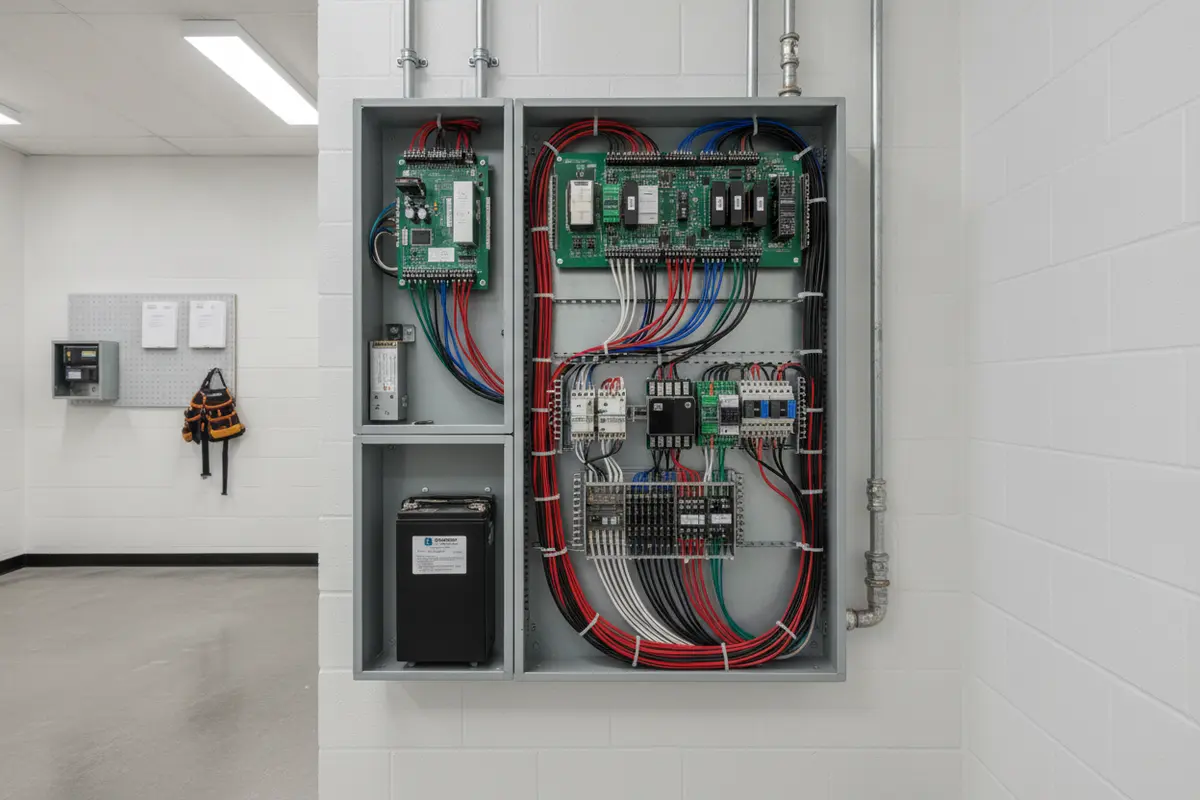
Commercial systems are not interchangeable just because they come from familiar brands. Their configuration should reflect the property’s size and use, required coverage, existing infrastructure, and approved design. For a plain-language starting point, see this overview of commercial fire alarm panel types.
- Conventional configurations: Devices report through circuits or zones. Ask whether the available location information is useful for staff and responders, and whether the number of zones fits the layout.
- Addressable configurations: The system can identify individual devices more specifically. Check device compatibility, programming needs, and who can maintain the installed configuration.
- Networked arrangements: Multiple panels or areas may communicate when a design calls for it. Clarify how communication paths, annunciation, and fault reporting work across the site.
- Special applications: Some properties have environmental or operational conditions that affect device selection and system design. The design professional should identify those needs rather than assume a standard package will work.
These labels alone do not determine performance or compliance. Two proposals described with the same system type can differ in device selection, circuit layout, notification strategy, programming, and testing. Ask the provider to connect each major design choice to a stated building requirement. If the proposed system includes interfaces with other building functions, clarify which party is responsible for specifying, testing, and documenting each interface.
What should Atlanta businesses confirm before selecting a system?
Manufacturer comparisons are most useful after the property and existing equipment have been assessed. Gather available records and ask the project professional to explain how each recommendation addresses the site’s actual conditions.
- Describe the occupancy: Record how the space is used, the layout, operating hours, and any areas with special hazards or distinct notification needs.
- Inventory the installed system: Note the panel model, device types, known trouble conditions, available drawings, and service history. Do not assume that two devices are compatible because they look similar.
- Confirm governing requirements: Coordinate with the authority having jurisdiction and establish applicable code, permit, and review requirements for the project.
- Compare complete scopes: Review design, equipment, installation, testing, handoff documents, training, and ongoing maintenance instead of comparing a panel price alone.
- Plan work sequencing: If the system must be altered while the business operates, agree on sequencing, impairment procedures, temporary measures, and required notifications before work begins.
- Set acceptance expectations: Establish what testing will occur, who will witness it if required, how deficiencies will be resolved, and what records will be delivered.
For related local context, review this guide to NFPA 72 considerations for Atlanta businesses. A guide cannot replace project-specific direction: confirm details with the responsible design professional and authority having jurisdiction.
How do installation and long-term service shape the decision?
A manufacturer’s label does not ensure that a system will be dependable. Design, installation, commissioning, inspections, repairs, and accurate records all contribute to whether the installed system continues to serve its intended purpose.
Before choosing a proposal, ask who is responsible for each stage. A complete scope should make clear who verifies the design, installs and programs equipment, tests circuits and devices, records results, explains system operation, and provides service after handoff. If responsibilities are split among several firms, request a written explanation of how coordination will work.
Ask how the provider handles a fault after installation. Clarify how a business reports trouble conditions, what information helps diagnose them, and how the provider documents corrective work. Also ask how planned changes to walls, room uses, occupancy, or other building systems may affect fire alarm coverage. A change that appears minor to the business may still require a review of device placement or documentation.
American Alarm provides commercial fire alarm services in the Atlanta area. Review its security and fire alarm service options or read about commercial fire alarm repair when considering support needs. For local service-area information, see areas served by American Alarm.
How can you compare proposals fairly?
When proposals use different product lines, a side-by-side comparison helps separate equipment names from the actual work being offered. Ask each provider to respond to the same project brief and use the same assumptions about building conditions, existing devices, work hours, and testing.
- Normalize the scope: Check whether both proposals cover the same areas, device functions, interfaces, and installation responsibilities.
- Identify exclusions: Look for items described as by others, optional, or subject to field verification. Ask what could change after a site survey.
- Separate initial and continuing work: Identify installation and acceptance work separately from future inspections, repairs, and monitoring arrangements.
- Compare handoff: Confirm that drawings, device schedules, test records, operating instructions, and training are included or clearly assigned.
- Check future flexibility: Ask what is required to expand or modify the system later, including compatibility limits and access to programming or records.
For example, imagine two proposals for a business with an older panel. One offers a lower initial figure but does not state whether existing devices will be tested or which records are included. Another identifies the panel and device models, outlines compatibility checks, lists testing and documentation, and describes how work will be sequenced. The second proposal is easier to evaluate even before comparing totals because its assumptions and responsibilities are visible. The business can then request clarification or a revised scope on equal terms.
Do not treat a lower upfront amount as proof of better value, or a well-known brand as proof of suitability. Compare the work required to meet the approved design and keep the system serviceable. If an assumption is unclear, ask for the answer in writing and retain it with the project records.
What questions should you ask a fire alarm provider?
These questions help make manufacturer proposals easier to compare and clarify responsibilities before work begins. A provider should be able to explain recommendations in plain language and connect them to the building and project requirements.
- Design basis: Which occupancy, code provisions, site conditions, and authority requirements informed this proposal?
- Equipment detail: What are the exact panel, detector, notification, and communication models, and why were they selected?
- Existing equipment: Which devices may remain, and what inspection or compatibility findings support that decision?
- Work boundaries: What is included, what is excluded, and which tasks are assigned to the owner or another contractor?
- Testing and records: What testing, drawings, operating documents, and staff instruction are included at handoff?
- Service plan: Who responds to faults, how are repairs coordinated, and how are routine inspections recorded?
- Future changes: What information should the owner retain to support a later alteration or expansion?
Use the answers to compare the provider’s process as well as the manufacturer’s equipment. The Atlanta fire alarm inspection guide offers related preparation context. Keep proposal versions, approved plans, test results, and service records together so that future work can start from an accurate history.
As a practical exercise, create one row per proposal and one column for each responsibility: design basis, equipment schedule, existing-device assessment, permits and coordination, installation, testing, documentation, staff handoff, and continuing service. Mark each cell as included, excluded, or unclear. An unclear entry is not necessarily a reason to reject a bid, but it is a prompt to obtain a specific answer before selection. This simple review often reveals why apparently similar totals do not represent the same scope.
Consider a multi-area business planning a phased remodel. A useful proposal should state which areas are in the first phase, what temporary impairment arrangements are needed during each work window, and how the final system configuration will be tested and recorded. The owner can then compare not just the equipment platform but also the sequence, responsibilities, and handoff. If a later phase changes room use or adds space, the retained drawings and device schedule help the next review begin with reliable information.
Where proposals disagree about retaining existing devices, ask each provider to list the equipment in question and explain the findings behind its recommendation. A general statement that equipment is reusable is not as useful as an identified model, inspection status, compatibility basis, and stated limitation. Similarly, if a panel is proposed for future expansion, ask what capacity is reserved and what changes would require another design review. Documenting assumptions now can prevent misunderstandings during later work.
Explore American Alarm’s fire alarm service options.
Frequently asked questions
Is one manufacturer best for every commercial property?
No. The appropriate choice depends on building needs, the approved design, compatible equipment, and support available for the installed models. Compare a specific system and project scope rather than selecting by name alone.
Can a business keep its existing fire alarm equipment?
Sometimes. Condition, compatibility, inspection findings, and project requirements must be evaluated first. A qualified professional can identify which components may remain and document the basis for that decision.
Should initial price decide the manufacturer?
Price is one factor, but compare the full scope, including design, devices, installation, testing, documentation, and future support. Ask for exclusions and assumptions so you can compare proposals on the same basis.
How can an Atlanta business prepare for a system review?
Gather available drawings, panel and device information, service records, and notes about known issues or planned building changes. Request a site-specific review and confirm project requirements with the local authority having jurisdiction.
A careful comparison helps Atlanta businesses choose based on documented needs, clear responsibilities, and practical support over the life of the system.


Leave a Reply
Want to join the discussion?Feel free to contribute!