

Hardwired vs Wireless Commercial Security Systems
Choosing a commercial security system in Atlanta is not simply a matter of selecting the newest equipment. A finished office, warehouse, medical facility, or multi-building property may have very different cable access, signal conditions, occupancy patterns, and plans for future expansion. Those details affect installation disruption, maintenance, connectivity, and long-term ownership.
Schedule a commercial security consultation. Call (770) 645-0061 or contact American Alarm online.
The right hardwired vs wireless commercial security systems decision depends on the property’s layout, existing infrastructure, installation conditions, communication path, maintenance plan, and expansion needs. Hardwired and wireless designs can both be professionally planned for commercial use, but the better fit is the one that provides appropriate coverage and serviceability for the building.
American Alarm begins with the property layout and identified vulnerabilities, then develops the design, programs devices and zones, integrates monitoring, trains users, and tests the completed system. Understanding what each architecture involves makes it easier to evaluate the tradeoffs before comparing installation and lifecycle considerations.
What Hardwired and Wireless Mean in a Commercial System
Hardwired systems connect field devices to the control panel through low-voltage cable. Wireless systems communicate with the panel by radio and use local batteries at the devices. Neither architecture is automatically right for every Atlanta business. The practical choice depends on the building’s infrastructure, finished surfaces, device locations, and plans for future changes.
How hardwired security devices are installed
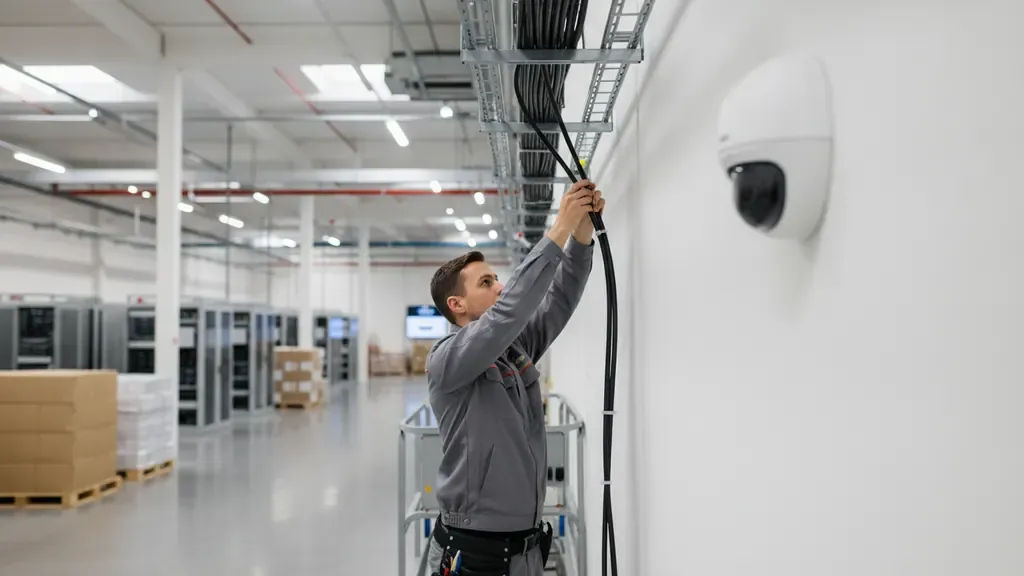
A hardwired sensor sends its signal through a dedicated low-voltage circuit back to the control panel or an expansion module. The cable carries the device connection and, depending on the equipment, may also support power. A commercial installer must plan routes through ceilings, walls, utility spaces, and protected areas while keeping the wiring serviceable and organized. One industry comparison describes wired sensors as commonly using low-voltage wire, often 22-gauge. Learn more about low-voltage wiring in security systems.
Routing is usually simplest when walls and ceilings are open during construction or renovation. In a finished commercial property, adding cable can require access above ceilings, careful drilling, or fishing wire through concealed spaces. Those conditions can increase disruption and place more emphasis on neat routing. American Alarm describes its professional installation approach as clean and minimally invasive, with designs tailored to the property’s infrastructure and aesthetic preferences. The goal is not merely to connect devices, but to place them for useful coverage without creating avoidable visual or maintenance problems.

How wireless security devices are installed
Wireless sensors transmit their status to a compatible receiver or control panel instead of using a cable between each device and the panel. Because each device has its own power source, battery condition becomes part of ongoing system care. Batteries can be practical where cable routes are difficult, where a business occupies a finished space, or where devices may need to be added without opening walls. They do not eliminate design work. The installer still evaluates radio paths, construction materials, device placement, supervision, panel location, and the communication path to the monitoring service.
A professional design also separates the local device connection from the monitoring connection. A system may use cellular, internet, another supported path, or a combination for communication beyond the property, depending on the selected equipment and service. American Alarm designs and installs both hardwired and wireless options, then programs zones, integrates the system with its monitoring center, trains the customer, and tests the completed installation. This structured process helps align the architecture with the actual building rather than treating wireless or hardwired as a universal answer.
For commercial fire and life-safety systems, architecture alone does not establish compliance. NFPA 72 design, testing, documentation, commissioning, and coordination with the authority having jurisdiction must be evaluated separately from the security system’s wiring method.
How Building Layout Changes the Best System Choice
The right architecture depends on how a commercial property is built, occupied, and expected to change. Layout, existing infrastructure, installation conditions, communication path, maintenance needs, and expansion plans all matter more than choosing hardwired or wireless by rule.
New construction and open access
New construction or a major renovation usually gives an installer better access to ceilings, walls, pathways, and equipment rooms. That access can make a hardwired design practical when the property needs many consistently placed devices or a structured zone layout. It also allows cable routes to be planned before finishes are closed. This is preferable to adding them around an operating business.
Even with an open construction environment, device placement should follow the property’s vulnerabilities and movement patterns. Entrances, restricted areas, loading points, interior corridors, and remote spaces may need different detection approaches. The design process should map those conditions first, then determine which devices and wiring methods provide useful coverage.
Finished interiors and occupied retrofits
An occupied office, retail location, medical facility, or institutional building introduces a different tradeoff. Routing new cable through finished walls and ceilings may affect appearance, access, and daily operations. Wireless devices can reduce some routing demands, while a carefully planned hardwired installation may still fit where accessible pathways or existing infrastructure are available.
Professional installation should be clean and minimally invasive, but that does not remove the need to evaluate the building. Existing wiring, ceiling construction, tenant improvements, and areas that are difficult to reach can all influence the design. American Alarm tailors wireless and hardwired options to the property’s infrastructure and aesthetic preferences.
Warehouses and multi-building properties
Warehouses often combine broad floor areas, high ceilings, storage aisles, dock doors, offices, and restricted zones. Device placement must account for coverage across those different environments, including locations that are hard to reach for service. A multi-building campus adds separation, exterior pathways, and communication considerations between structures.
For these properties, the question is not simply how many devices can be installed. It is whether the selected architecture can be inspected, tested, monitored, and supported across the entire site. A commercial security planning checklist can help organize questions about entrances, vulnerable areas, access control, fire requirements, and daily operating conditions before design begins.
Future expansion matters
Businesses add rooms, change workflows, reconfigure partitions, and acquire neighboring space. A system that works today should leave a practical path for additional devices or zones. During design, discuss likely construction changes and whether the control equipment, pathways, and monitoring integration can support them. American Alarm’s process includes installation, programming, monitoring-center integration, training, and full system testing, helping connect the initial layout decision to long-term operation.
Which Is More Reliable for Atlanta Commercial Properties?
Neither architecture is automatically more reliable for every Atlanta commercial property. Reliability depends on power continuity, the signal path, building conditions, installation quality, monitoring integration, testing, and the plan for service as the property changes.
For a useful comparison, separate the connection between each device and the control panel from the connection between the alarm system and the monitoring center. A hardwired sensor has a physical circuit back to the panel or an expansion module. A wireless sensor communicates by radio and depends on battery health, signal strength, and a properly engineered radio environment. Either design can be dependable when it matches the building and is installed, programmed, and tested correctly.
| Hardwired | Wireless | Practical takeaway |
|---|---|---|
| Uses a physical connection between the sensor circuit and the panel or wired expansion module. | Uses supervised radio communication and battery-powered devices. | Choose the path that can be installed and maintained consistently across the property’s layout. |
| Can develop open circuits, ground faults, or other wiring-related trouble conditions that require diagnosis. | Can be affected by battery condition, device placement, construction materials, or radio interference. | Supervision helps identify trouble, but every trouble signal still needs prompt attention. |
| Often fits properties with accessible pathways or suitable existing infrastructure. | Can reduce cable-routing demands in finished spaces and support changes where new pathways are difficult. | Installation conditions matter as much as the technology selected. |
Power and signal path matter more than the label
Both architectures require a dependable power strategy. A control panel, communicator, and other critical equipment need appropriate standby protection and regular testing. Wireless devices add distributed battery locations, while hardwired systems concentrate more of the circuit infrastructure in the cable paths and control equipment. A maintenance plan should account for inspections, functional testing, battery replacement, cleaning, software updates, deficiency tracking, and documentation.
The monitoring path is a separate design decision. Depending on the system and site conditions, alarm communication may use cellular, internet, another supported path, or a combination. American Alarm supports landline and cellular options, along with smartphone control and real-time email and text alerts. Review the available alarm connectivity options rather than assuming that a hardwired alarm must use one communication method or that a wireless alarm is limited to another.
Interference, testing, and ongoing service
Wireless reliability requires a site survey and thoughtful device placement. Encryption and resistance to interference are different protections. A secure radio signal should not be treated as proof that the environment is free of interference. Hardwired reliability requires accurate termination, protected cable routes, and troubleshooting when a circuit develops a fault. In both cases, system design should begin with the property’s layout and vulnerabilities. That process includes zone programming, monitoring-center integration, training, and full system testing.
American Alarm provides 24/7 monitoring and technical support through a UL-certified monitoring center. That monitoring service supports the response process, but it does not replace local testing and maintenance. For an Atlanta business, the most reliable choice is the architecture that provides complete coverage, a resilient communication path, manageable service requirements, and room for future expansion.
How to Choose Hardwired vs Wireless Commercial Security Systems for Total Ownership
Ownership extends beyond installation day. A commercial security system must remain serviceable as batteries age, wiring develops faults, communication technology changes, and the property adds rooms, tenants, or operating requirements. The right comparison considers the ongoing maintenance plan, monitoring connection, documentation, and ability to adapt.
Wireless service includes batteries and supervision
Wireless devices reduce the need for cable routing, but they do not eliminate maintenance. Each battery-powered device becomes another service point. A practical program should track battery condition, test device communication, inspect mounting and detection areas, and respond to trouble signals rather than treating supervision as a substitute for service. Cleaning, functional testing, software updates, and deficiency tracking are part of responsible maintenance. These activities are included in the broader inspection and documentation practices described by American Alarm for alarm systems: inspection, testing, and maintenance documentation.
Battery replacement intervals vary by device, settings, environmental conditions, and manufacturer guidance. They should be scheduled from service records and system notifications, not assumed from a generic lifespan. Wireless deployment may affect lifecycle costs differently across settings, but no generalized cost conclusion should be applied to every Atlanta commercial alarm project. Installation conditions, building layout, device selection, and operating requirements still control the result. Building layout and operating conditions still control the result.
Hardwired systems shift the service question
Hardwired systems typically avoid distributed sensor batteries, but wiring, terminals, power supplies, panels, and communicators still require testing. Intermittent faults, damaged cable, ground faults, or changes to finished spaces can make troubleshooting more involved. Existing wiring should be evaluated rather than discarded solely because it is older. When a fault occurs, clear zone labels, accurate drawings, event history, and documented repairs can reduce diagnostic time. For practical examples of panel errors, battery issues, and other service concerns, see commercial alarm troubleshooting.
Control panels and communicators may also need upgrades as communication networks and equipment platforms change. A well-maintained wired system can remain useful while its active components are modernized, provided the design remains compatible with the property’s needs.
Plan monitoring and future changes together
Total ownership includes the monitoring service and its communication path, not just field devices. Monitoring integration should be tested after installation, service work, and material system changes. Future expansion may favor a compatible receiver or hybrid control panel, allowing wireless devices to extend an existing wired installation in areas where new cable routes are disruptive. That possibility is design-dependent, so confirm compatibility before assuming an expansion path.
For Atlanta businesses comparing hardwired vs wireless commercial security systems, the strongest long-term choice is the architecture that can be inspected, documented, supported, and expanded as the property changes. American Alarm designs and installs both options, with system planning based on infrastructure, vulnerabilities, maintenance needs, and future use rather than installation format alone.
When Does a Hybrid Security System Make Sense?
A hybrid commercial security system combines hardwired zones with wireless devices where each approach fits the property best. It can be practical when a business wants to preserve usable existing wiring, add protection in difficult-to-reach areas, or expand in phases without treating every part of the building the same way.
Start with the existing wired infrastructure
Many commercial properties already have alarm wiring in place, particularly when a building is replacing an older control panel or updating an established system. If that infrastructure can be evaluated and incorporated into a compatible platform, hardwired zones may continue serving areas where cable routes are accessible and device locations are stable. A hybrid control panel or compatible receiver can also allow wireless expansion alongside those existing wired zones. The available equipment and condition of the current installation must be confirmed during design. American Alarm designs and installs both wireless and hardwired security system options, rather than assuming one architecture fits every property.
Use wireless devices where routing cable is difficult
Wireless additions can be useful in finished offices, remote rooms, high-ceiling spaces, or other areas where reaching the device location would create unnecessary disruption. They may also help when a tenant occupies only part of a larger building and protection needs to grow as operations change. The goal is not to use wireless devices everywhere. It is to place each device where it can provide appropriate coverage while respecting the building’s infrastructure, appearance, access conditions, and future plans. Professional design should account for the complete layout and identified vulnerabilities before devices are installed, programmed, tested, and connected to the monitoring service.
Keep security architecture separate from fire alarm compliance
A hybrid approach to an intrusion security system does not automatically establish compliance for a commercial fire alarm system. Fire and life-safety design must be evaluated separately under the applicable NFPA 72 requirements, including device placement, testing, documentation, commissioning, and coordination with the authority having jurisdiction. The selected architecture alone is not an approval. Review NFPA-compliant fire alarm design and maintenance for the distinct planning and inspection considerations that apply to those systems.
For a mixed building layout or phased expansion, the strongest design is the one that connects practical installation decisions with long-term serviceability. A qualified assessment can determine which zones should remain wired, where wireless additions are appropriate, and which fire alarm requirements must be handled independently.
A Practical Decision Framework for Atlanta Businesses
The right commercial security architecture follows the property, not a sales preference. Use the questions below to compare hardwired and wireless options against the building’s conditions, operating needs, and long-term service plan.
- Map the property and its vulnerabilities. Review entrances, interior zones, loading areas, restricted spaces, and hard-to-reach locations. System design should begin with the layout and identified vulnerabilities, with device placement planned for meaningful coverage. A commercial alarm system assessment in Atlanta can turn that walkthrough into a documented design.
- Inventory the existing infrastructure. Identify usable pathways, panels, power availability, network conditions, and equipment that may be retained. Hardwired and wireless designs can both be tailored to existing infrastructure and aesthetic preferences. The best fit may vary from one building or zone to another.
- Define acceptable installation disruption. Consider whether the property is occupied, recently finished, undergoing renovation, or difficult to access after business hours. Cable routing can influence the practical scope of a hardwired installation, while a professionally planned installation should remain clean and minimally invasive where conditions allow.
- Choose the communication path separately from device architecture. A system’s sensors may be hardwired, wireless, or mixed, while its monitoring connection is a separate design decision. Review available landline and cellular options, alert needs, and remote control requirements. This distinction helps owners evaluate connectivity without assuming that one sensor type determines monitoring performance.
- Write the maintenance plan before installation. Assign responsibility for inspections, functional testing, battery replacement where applicable, cleaning, software updates, deficiency tracking, and documentation. Ask how service records will be maintained and how faults will be diagnosed as the system ages.
- Plan for expansion and operational change. List likely additions such as new doors, remodeled areas, expanded workspaces, or additional buildings. A design that works today should leave a practical path for future devices, programming changes, and monitoring integration without forcing an unnecessary redesign.
- Confirm monitoring, training, and testing. Professional deployment should include device and zone programming, monitoring-center integration, customer training, and full system testing. American Alarm provides 24/7 monitoring and technical support through a UL-certified monitoring center, so confirm how alarms, notifications, service requests, and after-hours events will be handled.
- Separate security decisions from fire alarm compliance. Commercial fire alarm design, testing, documentation, commissioning, and AHJ coordination are separate compliance considerations. Neither hardwired nor wireless architecture is automatically code-compliant. Review NFPA-compliant fire alarm design and maintenance with the applicable requirements in mind.
American Alarm brings NICET IV leadership, more than 30 years of low-voltage fire and security experience, and unlimited low-voltage licenses in Georgia. Its team serves more than 24 Metro Atlanta and North Georgia cities, supporting locally grounded planning from initial design through ongoing service.
Frequently Asked Questions
Is a hardwired or wireless system better for a commercial property?
Neither is automatically better. The right choice depends on the building layout, existing infrastructure, installation conditions, communication path, maintenance plan, and expected expansion. A new construction project may make cable routing practical, while a finished or occupied facility may benefit from a less invasive wireless design. A professional assessment should evaluate coverage, access points, equipment locations, and future changes together.
Are wireless commercial security systems reliable?
Wireless systems can be reliable when devices are correctly placed, the signal environment is evaluated, and the monitoring path is properly designed. Connectivity may use cellular, internet, landline, or a combination of supported paths. American Alarm supports landline and cellular options, smartphone control, and real-time email and text alerts. Its UL-certified monitoring center also provides 24/7 monitoring and technical support. See the commercial alarm connectivity options for more detail.
Can a commercial security system be expanded later?
Many systems can be expanded, but the available options depend on the control equipment, communication architecture, building conditions, and compatible devices. A hybrid design may combine hardwired zones in accessible areas with wireless devices where new cabling would be disruptive. Planning expansion during the initial design helps avoid coverage gaps and unnecessary replacement work.
What maintenance does each system require?
Both architectures require regular inspection, functional testing, and documentation. Wireless devices commonly require attention to battery condition, while hardwired systems may require troubleshooting for wiring, power, or component faults. Commercial maintenance can include battery replacement, cleaning, software updates, deficiency tracking, and historical documentation, as outlined by American Alarm’s inspection and maintenance guidance. Security-system maintenance should also be distinguished from NFPA 72 requirements for commercial fire and life-safety systems.
Schedule a Commercial Security Assessment
The right system depends on your building layout, existing infrastructure, connectivity, and plans for expansion. A site-specific assessment can help you compare hardwired, wireless, or hybrid options before installation decisions are made.
Schedule your commercial security assessment. Call (770) 645-0061 or contact American Alarm online.


Leave a Reply
Want to join the discussion?Feel free to contribute!