Fire Marshal Deficiency Repair Atlanta Guide
Fire marshal deficiency repair in Atlanta starts with the written notice. After an Atlanta fire marshal identifies a deficiency, the safest response is not a rushed part replacement. A deficiency can involve a device, circuit, notification appliance, power supply, monitoring path, record, or difference between an installed system and approved plans. The plan should protect occupants, follow the responsible authority having jurisdiction, and show how each item was repaired and tested.
Atlanta-area requirements vary by jurisdiction, occupancy, adopted code, local amendments, approved plans, and the instructions of the AHJ. The Atlanta Fire Rescue Department describes the fire marshal function as enforcing state minimum fire safety standards, national fire codes, and City of Atlanta ordinances. County and municipal authorities may use different forms, deadlines, contacts, and reinspection procedures.
Schedule a fire alarm deficiency consultation. Contact American Alarm online.
How does fire marshal deficiency repair Atlanta property owners need to begin?
Answer: Preserve the complete notice, identify every cited item, clarify unclear language with the responsible AHJ, and arrange a qualified evaluation. Prioritize conditions that may affect detection, occupant notification, emergency communication, monitoring, or system reliability. Repair the cited conditions, test the affected functions, document the results, and confirm the reinspection process before presenting the property as ready.
A deficiency notice is a correction roadmap, not a substitute for an onsite evaluation. Use the notice as the index for the project, then connect each correction to a test result and supporting record.
Start by saving the notice in its original form. Keep every page, attachment, photograph, email, and written instruction from the fire marshal or other AHJ. Note the property address, inspection date, inspector or office, response deadline, cited locations, and any instruction about occupancy, impairment, access, or temporary measures.
Do not rely on a verbal summary from an employee, tenant, previous vendor, or property representative when the official document is available. A paraphrased item can omit the location, system function, or condition that controls the repair. If the language is unclear, ask the responsible office for clarification before changing the scope.
Next, create a correction register. Give every deficiency its own line or record. Include the original wording, location, responsible person, status, diagnosis, repair, test result, and remaining question. Useful statuses include open, scheduled, corrected and tested, awaiting documentation, awaiting AHJ direction, inaccessible, and ready for reinspection.
Keep the AHJ in control of the acceptance decision. A contractor can evaluate, repair, test, and document a system, but cannot guarantee that an authority will approve a correction. The written notice and the responsible local office remain the controlling sources for property-specific requirements.
How should Atlanta property owners prioritize fire marshal deficiencies?
Prioritize a deficiency by its possible effect on life safety, emergency response, signal transmission, and system reliability. Then address documentation and scheduling issues that could delay a safe, traceable correction.
Not every cited item has the same operational effect. A missing report and a disabled notification circuit both require attention, but they may require different first steps. A qualified professional should evaluate how the listed condition affects the complete fire alarm or life-safety system rather than treating the visible symptom in isolation.
| Priority lens | Questions to ask | Planning response |
|---|---|---|
| Occupant protection | Could detection, notification, emergency communication, or a required release function be impaired? | Follow the AHJ’s instructions, notify responsible parties, and arrange prompt evaluation. |
| Signal transmission | Are alarm, supervisory, and trouble signals reaching the required receiving point? | Coordinate a controlled test with the monitoring contact and record the result. |
| System reliability | Are power, batteries, wiring, circuits, devices, or control equipment creating repeated trouble? | Diagnose the cause and test the repaired function, not only the replacement part. |
| Documentation | Are reports, approved plans, labels, permits, or service records missing? | Gather the records and ask the AHJ what must be recreated, reviewed, or submitted. |
If a notice identifies an immediate hazard, follow the AHJ’s directions about interim measures, restricted use, notification, or other occupancy decisions. Do not invent a temporary procedure based on a generic online article. Ask the responsible authority what it expects, record who gave the instruction, and document when the property acted.
- Protect occupants first: Treat any condition that may reduce alarm initiation, notification, emergency communication, or required system operation as urgent.
- Protect the monitoring path: Confirm whether signals are reaching the required receiving point and whether the system can be tested and restored correctly.
- Protect the evidence: Preserve the notice, inspection report, photographs, service tickets, and prior test records before work begins.
- Protect the schedule: Ask early about access, parts, permits, monitoring test windows, and the AHJ’s reinspection process.
What information should you collect before fire alarm repair?
Collect the deficiency notice, inspection history, system details, approved design records, monitoring information, and site access requirements before a technician arrives. A complete information set reduces repeat visits and keeps the repair tied to the cited condition.
Create one property file for the correction project. Include the full notice, not only the page that mentions the fire alarm. Related building or life-safety observations can affect access, sequencing, permits, or the AHJ’s acceptance process.
- Save the official notice: Record the inspection date, address, responsible office, contact information, correction language, and stated deadline or reinspection instructions.
- Identify the system: Record the control panel manufacturer and model, communicator type, monitoring account information, system age if known, and recent modifications.
- Gather inspection records: Collect recent inspection and testing reports, deficiency logs, service tickets, acceptance documents, and unresolved trouble records.
- Locate design records: Find approved plans, permit documents, sequence-of-operation information, battery calculations, device lists, and other available system records.
- Plan site logistics: Confirm keys, escorts, tenant schedules, locked rooms, ceiling access, lift needs, alarm test windows, and authorized decision-makers.
- Confirm monitoring contacts: Identify who can place the system on test, receive test results, coordinate signal transmission, and restore normal monitoring.
Missing documents do not automatically mean that the property must start over. They do mean the professional and AHJ may need to determine what can be verified from current conditions, what must be recreated, what must be resubmitted, or what must be documented through another approved process.
American Alarm’s NFPA fire alarm service information describes design, plan review, installation, testing, commissioning, inspection, and documentation as connected parts of a compliant program. That connected view matters after a deficiency because a device-level repair may not resolve a design, power, monitoring, or documentation issue.
Which conditions commonly require fire marshal deficiency repair?
A fire marshal deficiency may involve initiating devices, notification appliances, control equipment, power, circuits, monitoring, labels, records, or field conditions that differ from approved plans. The notice and professional diagnosis determine the correct correction.
A notice may identify a visible condition, but the visible condition is not always the root cause. For example, a recurring trouble signal could involve a device, circuit, power supply, wiring fault, programming issue, or communication problem. Replacing a component without testing the related circuit may leave the underlying deficiency unresolved.
- Initiating devices: Evaluate cited smoke detectors, heat detectors, manual stations, waterflow devices, and other alarm-initiating equipment.
- Notification appliances: Evaluate horns, strobes, speakers, synchronization, audibility, visibility, and coverage in the affected areas.
- Control equipment: Diagnose panel troubles, programming conflicts, circuit faults, annunciation issues, and control-unit conditions.
- Power and batteries: Evaluate primary power, secondary power, charging, battery condition, voltage, and documented power requirements.
- Circuits and pathways: Check wiring, supervision, terminations, labels, pathway conditions, and damage or modifications noted in the report.
- Monitoring and signals: Coordinate alarm, supervisory, and trouble signal tests with the receiving station or required monitoring contact.
- Records and labels: Correct missing device labels, zone descriptions, test records, drawings, panel information, or other documentation.
- Approved-plan differences: Compare current conditions with the approved design and ask the AHJ how a field change should be documented or approved.
American Alarm’s commercial fire alarm repair resource explains why a qualified provider should diagnose the full system rather than treat one symptom in isolation. The service record should identify the observed condition, work performed, test method, result, and any remaining limitation.
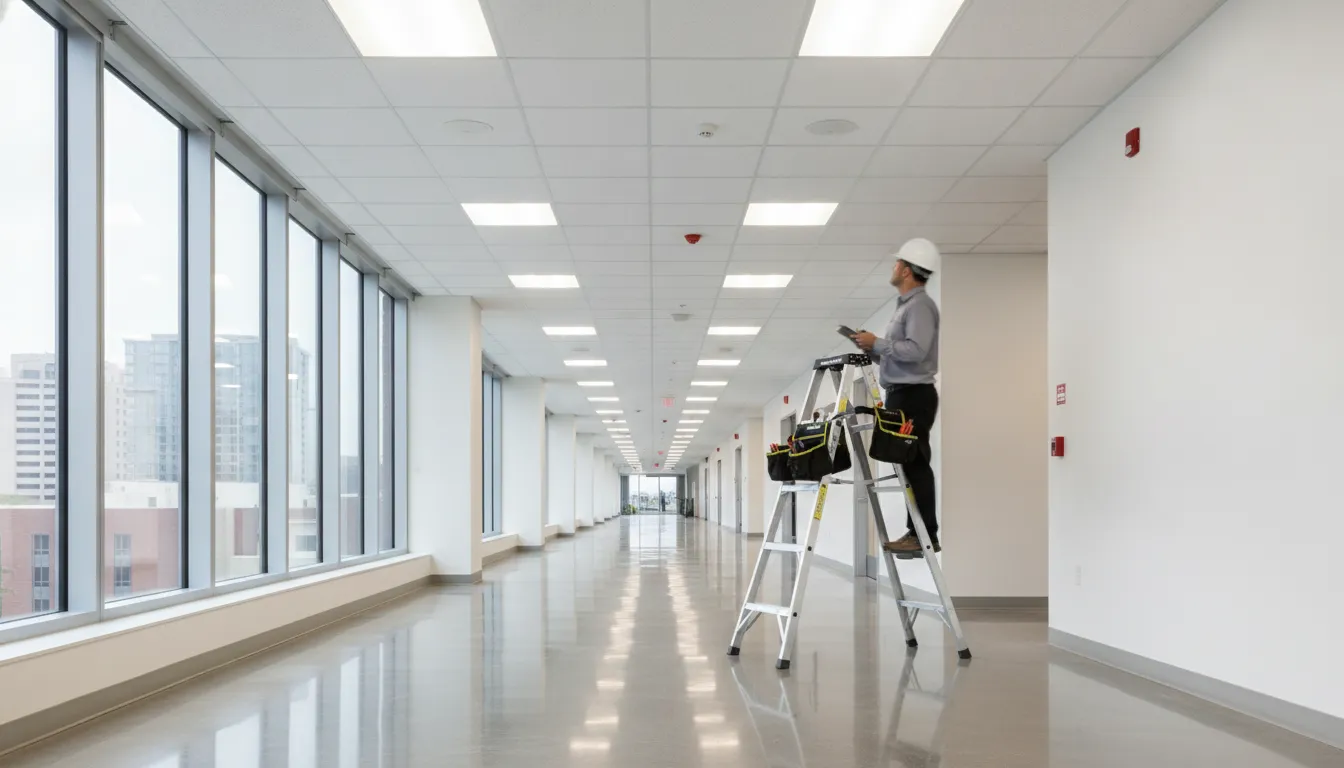
Request commercial fire alarm repair support. Call (770) 645-0061 or contact American Alarm online.
How should repairs be tested and documented?
Before reinspection, test each corrected function and document the result in a record that connects the original deficiency to the work performed. Include locations, identifiers, dates, test conditions, technician information, monitoring coordination, and any remaining issue.
Use the original deficiency list as the index for the repair record. Do not mark an item complete merely because a part was replaced or a trouble light disappeared. Completion should reflect the test or verification that supports the correction and the scope the AHJ identified.
| Record element | What it should show |
|---|---|
| Original deficiency | The notice language, item number, location, and date of the finding. |
| Diagnosis | The observed cause or condition, including related system impact. |
| Correction | The repair, adjustment, replacement, label, record, or coordination performed. |
| Test result | The function tested, conditions, result, date, and person completing the test. |
| Open item | Any limitation, inaccessible area, AHJ decision, permit issue, or follow-up action. |
When testing affects a monitored system, coordinate the window with the monitoring contact and responsible property staff. Confirm that test signals were received as expected, that the system was restored to normal, and that notifications required by the property’s procedure were completed.
Keep technical records separate from assumptions. If a technician could not access an area, say so. If the installed system differs from approved plans, identify that difference and ask the AHJ what process applies. A transparent open item is more useful than an unsupported claim that everything is corrected.
American Alarm’s guide to fire alarm testing versus inspection in Atlanta provides useful context for separating those activities. Testing demonstrates operation under defined conditions. Inspection reviews the system and its records against applicable requirements. A property may need both a sound technical test record and an AHJ-directed response.
How can you prepare for an Atlanta fire marshal reinspection?
Prepare a reinspection packet that follows the order of the notice, confirm site access, and make sure the system is in normal operating condition unless the AHJ directs otherwise. Schedule the appointment through the responsible jurisdiction, and do not assume a private test replaces it.
Reinspection preparation is more than placing an invoice in a folder. The inspector should be able to see how each cited item was addressed and what evidence supports the correction. Organize the packet in the same order as the deficiency notice when possible.
- Notice and correspondence: Include the original notice and relevant written instructions from the AHJ.
- Correction register: List every item, its location, status, repair date, and supporting record.
- Service documentation: Include diagnosis, work performed, parts or equipment involved, and limitations.
- Test documentation: Include functional tests, signal tests, battery or power records, and applicable inspection forms.
- Plan comparison: Include approved plans or explain what documents were reviewed when the deficiency involved layout or field conditions.
- Monitoring confirmation: Include test coordination and restoration confirmation without exposing unnecessary account credentials.
- Access plan: Make authorized staff, keys, escorts, ladders, lifts, locked rooms, and tenant access available.
- Open questions: Identify items needing AHJ direction instead of presenting an unresolved assumption as a completed repair.
Before the appointment, walk the property using the notice and correction register. Confirm that each location is accessible, required panels and rooms are unlocked, the system shows normal status, and the people responsible for the building can answer questions. If another trade must complete work, verify that it is finished before scheduling the inspection.
The Georgia Office of the Commissioner of Insurance and Safety Fire provides state information about inspections, permits, and plans. The responsible local AHJ may still apply jurisdiction-specific procedures, so use state information as context and follow the instructions for the property.
When should you call a qualified fire alarm professional?
Call a qualified fire alarm professional when a deficiency involves system operation, life-safety functions, monitoring, power, circuits, approved-plan differences, or a condition you cannot verify safely. Early evaluation can clarify the scope before a rushed repair creates another inspection issue.
Professional support is especially important when the notice references a system-wide impairment, repeated trouble signals, failed notification, missing monitoring signals, inadequate records, or work that may require design or plan review. These conditions can involve more than one device and may require coordination among the owner, monitoring provider, AHJ, and other contractors.
American Alarm has served Metro Atlanta since 1995. Founder Scott Gilkey provides NICET IV fire alarm engineering leadership, and the company maintains unlimited Georgia low-voltage credentials. Those credentials do not replace the AHJ’s authority, but they support a disciplined process for evaluating commercial fire alarm repairs, documentation, and testing.
Ask a provider how it will map the work to the deficiency notice, what access it needs, how testing will be coordinated, and what documentation it will return. A clear answer should distinguish confirmed facts from items that require an AHJ decision or an onsite finding.
FAQs: Fire Marshal Deficiency Repair Atlanta
These answers address common questions after an Atlanta-area fire marshal identifies a fire alarm or life-safety deficiency. The written notice and responsible AHJ remain the controlling sources for property-specific requirements.
Does a deficiency notice mean the whole fire alarm system must be replaced?
No. A notice may identify a device, circuit, power, monitoring, documentation, or approved-plan issue that can be addressed through a targeted correction. A qualified evaluation should determine the cause and scope, while the AHJ decides what evidence is sufficient for the property.
Can a contractor guarantee that a property will pass reinspection?
No responsible contractor should guarantee an AHJ decision. A professional can perform the requested evaluation, complete appropriate repairs, test affected functions, and provide clear records. The responsible fire marshal or AHJ determines whether the correction satisfies applicable requirements.
What if the fire marshal notice is unclear?
Preserve the notice and ask the responsible AHJ for clarification before expanding or changing the repair scope. Share the exact item language with the qualified professional so the evaluation addresses the cited condition instead of relying on a paraphrased description.
Should the monitoring company be involved in the repair?
Often, yes, when the deficiency involves alarm, supervisory, or trouble signal transmission. Coordinate a controlled test window, confirm receipt of expected signals, restore normal service, and document the results. Follow the property’s notification and impairment procedures.
What should an owner bring to reinspection?
Bring the original notice, correction register, service and test records, relevant approved plans or documentation, monitoring test confirmation, and written correspondence with the AHJ. Make sure the property is accessible and responsible contacts are available.
A fire marshal deficiency deserves a calm, documented response. Start with the notice, prioritize life-safety functions, use qualified repair and testing support, preserve the records, and coordinate reinspection directly with the responsible Atlanta-area AHJ.
Sources: Atlanta Fire Rescue fire inspections, Georgia inspections, permits, and plans, and NFPA 72.

Leave a Reply
Want to join the discussion?Feel free to contribute!