Fire Alarm System Sandy Springs Commercial Guide
Article structured data is managed by the site’s SEO system.
A commercial fire alarm project in Sandy Springs is more than choosing devices and connecting them to a monitoring center. Property owners need a system designed for the building, documented for review, and supported after installation so required testing and service do not become last-minute problems.
Schedule a free consultation. Call (770) 645-0061 or contact American Alarm online.
A fire alarm system Sandy Springs property owners can rely on should support timely fire detection and occupant notification, connect to qualified monitoring, and include organized records for inspections, maintenance, and authority review. The exact scope depends on the property’s use, layout, occupancy, and applicable authority-having-jurisdiction requirements.
That makes the first decision a planning question: what must the system accomplish for the people, operations, and emergency procedures inside the property? Understanding that purpose clarifies the right design scope before installation begins.
What Does a Fire Alarm System in Sandy Springs Need to Accomplish?
A commercial fire alarm system in Sandy Springs needs to do more than sound an alarm inside the property. It should identify a fire condition and communicate the activation through the appropriate monitoring path. It should support the Sandy Springs Fire Department’s response and leave the property owner with clear registration and system records. The exact design depends on the building, its use, and the authority having jurisdiction, so this overview is not a substitute for a property-specific review or legal advice.
In summary: Monitored alarm systems in Sandy Springs must be registered with the city, and the alarm company must provide proof of registration and the site’s registration number. Fire alarm response is handled differently from intrusion alarm police dispatch, which is subject to the city’s True Verification standard.
Registration and site documentation
The City of Sandy Springs requires all monitored alarm systems to be registered. Under the city’s alarm ordinance, responsibility for registering monitored systems rests with the alarm company, not simply with the property owner. The company must also provide the customer with proof of registration and the alarm site registration number. Owners and facility managers should retain that documentation with their emergency contacts, inspection records, and other life-safety files.
Registration is part of the city’s effort to reduce false alarm calls and improve the way alarm activations are handled. It does not, by itself, establish that a particular system design is approved for every building. A commercial property owner should still confirm that the proposed equipment, coverage, programming, testing, and documentation are appropriate for the property and any applicable review process.
Fire response is separate from intrusion verification
The Sandy Springs Fire Department responds to all fire alarms. That response statement applies to fire alarm activations and should not be confused with the police-dispatch rules for intrusion alarms. Since June 19, 2019, Sandy Springs has used a True Verification standard to determine when an intrusion alarm is eligible for police dispatch. Under that standard, an intrusion activation must be verified by audio, video, or private guard response before police dispatch occurs.
That distinction matters when a business uses one integrated platform for fire and intrusion functions. A fire alarm signal is not the same event as a burglar alarm signal, and the city’s response rules are not interchangeable. The ordinance also recognizes visual or audible evidence from a monitored system as one way to verify an alarm. Owners should ask their alarm provider to explain which signals are fire-related, which are intrusion-related, how each signal is handled, and what documentation or verification capabilities are included.
Faulty equipment, improper installation, incorrect test procedures, and user error can contribute to false alarms. A property-specific assessment and disciplined testing process help identify those risks without assuming that one generic configuration fits every Sandy Springs commercial property.
For the governing details, review the Sandy Springs alarm registration information and the city’s alarm ordinance. Requirements and response procedures can change, so confirm current expectations with the city and the professionals responsible for the system.
How Should a Commercial Fire Alarm System Be Designed?
A commercial fire alarm system should be designed around the property, its occupants, its hazards, and the decisions of the applicable authority having jurisdiction. A careful design also creates documentation that installers, inspectors, facility managers, and emergency responders can use throughout the system’s life.
For a commercial property in Sandy Springs, the design process should connect the site assessment to equipment selection, notification, power, survivability, permits, and future inspection needs. The following sequence helps owners evaluate whether a proposed fire alarm system is complete without assuming that one layout fits every building.
- Assess the property and its risks. Start with the building’s use, size, construction, occupancy, floor plan, egress routes, fire protection features, ceiling conditions, mechanical equipment, and areas with unusual environmental conditions. Review existing panels, initiating devices, notification appliances, wiring pathways, records, and known deficiencies when replacing or expanding a system. This assessment is the basis for a property-specific design, rather than a generic equipment package.
- Define the required scope with NFPA 72-informed design. The design should identify the functions the system must perform and the devices needed to support them. NFPA 72 can inform the design, but the applicable requirements may also depend on the property’s use, adopted codes, project documents, and AHJ direction. A qualified designer should document the assumptions and identify questions that require confirmation instead of presenting a universal approval or compliance guarantee.
- Plan device placement and coverage. Device spacing and placement should account for room geometry, ceiling height, airflow, obstructions, access for testing, and the specific device type. The plan may include initiating devices, supervisory points, monitoring connections, and notification appliances. Placement should support both early detection and practical maintenance, because a device that cannot be reached, tested, or clearly identified creates an avoidable lifecycle problem.
- Calculate notification circuits and emergency power. Notification appliance circuit calculations help determine whether the system can deliver the required audible and visible notification throughout the intended areas. Battery calculations help verify standby and alarm power needs under the design assumptions. These calculations should be preserved with the project records so future service technicians can understand the basis for the installed equipment and identify when additions may require a revised capacity review.
- Address pathway survivability and voice evacuation where needed. Wiring routes and pathway survivability can be important design considerations for larger, complex, or specially configured commercial properties. Where the project requires voice evacuation, the design should address speakers, intelligibility, control functions, zoning, and operating procedures rather than treating voice capability as an interchangeable add-on. The final scope should state what is included and what requires coordination with other building systems.
- Coordinate permits, submittals, and AHJ questions. Before installation, the owner and design team should identify the permits, plan reviews, inspections, certificates, and other records expected for the project. AHJ requirements can vary by property and may change over time. So the design team should coordinate with the applicable Sandy Springs authorities and respond to comments through the established review process. Good coordination improves readiness, but no contractor can guarantee an AHJ decision in advance.
- Set clear design boundaries before installation. The final proposal should distinguish design from installation, programming, monitoring integration, training, testing, commissioning, inspection, maintenance, and documentation. American Alarm describes its commercial workflow as consultation, property-specific design, installation, programming, monitoring-center integration, training, full system testing, documentation, and warranty support. Its fire alarm design work may include device placement, circuit and battery calculations, pathway survivability, and voice evacuation design. Owners can review what to look for in a commercial fire alarm installation partner before selecting a provider.
For an existing property, the same process can expose gaps in drawings, batteries, device coverage, or prior modifications before they become inspection obstacles. A documented, assessment-based design gives the owner a clearer basis for budgeting, scheduling, installation coordination, and future service.
What Happens During Professional Installation and Commissioning?
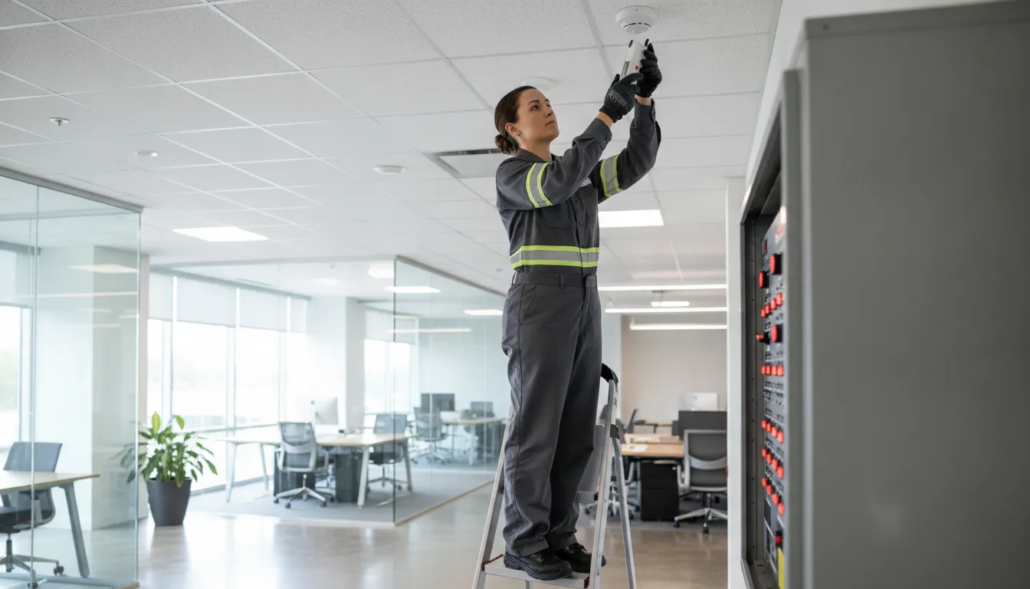
A professional installation turns an approved design into a coordinated life-safety system that can be operated, monitored, tested, and maintained. Commissioning is the verification stage: the installer checks that devices, notification appliances, programming, communications, and user procedures work together as intended for the property.
For a commercial fire alarm system in Sandy Springs, the process should be documented clearly. The owner, service team, monitoring center, and applicable authority should understand what was installed and how it was tested.
From consultation to installation
The work begins with a consultation and assessment of the property, its use, layout, occupants, existing equipment, and project requirements. That information guides a property-specific design rather than a generic equipment package. The installation plan may account for device locations, notification coverage, wiring pathways, power requirements, and how the system interfaces with other building functions.
Once the design and project scope are established, trained technicians install the control equipment, initiating devices, notification appliances, power supplies, pathways, and related components. Work should follow the approved design and identify field conditions that require clarification before equipment is moved or circuits are changed. Keeping those decisions visible helps prevent undocumented alterations that can create problems during future service or inspection.
Programming and monitoring integration
Installation is not complete when the hardware is mounted. Technicians program devices and zones so that the control panel identifies the correct area and condition. Labels, descriptions, and zone assignments should be understandable to the people who will respond to an alarm or troubleshoot a signal later.
The system can then be connected to the monitoring center, with communication paths and account information verified as part of the commissioning process. Integration should include a controlled signal test so the monitoring center receives the intended alarm, supervisory, and trouble signals. This is also the time to confirm contact lists, escalation instructions, test-account procedures, and any coordination needed with the property representative.
Testing, training, and records
Commissioning includes full system testing, not simply a visual check. Depending on the installed system, testing may cover initiating devices, notification appliances, power and batteries, supervisory conditions, trouble signals, communications, and connected functions. Any deficiency should be recorded, assigned for correction, and retested rather than left as an informal note.
Customer training gives designated personnel practical instruction on normal operation, alarm response, silencing and resetting procedures, test coordination, and when to contact the service provider. The final record should identify the equipment, programming, test results, open items, and maintenance expectations. Organized documentation supports future technicians, inspection preparation, insurance requests, and changes to the property.
American Alarm describes its installation workflow as consultation, property-specific design, professional installation, device and zone programming, monitoring-center integration, customer training, full system testing, documentation, and warranty provision. Its technical work is performed by certified, background-checked, trained technicians. Learn more about commercial fire alarm installation and the service approach before selecting a project partner.
How Does Monitoring Support Sandy Springs Businesses?
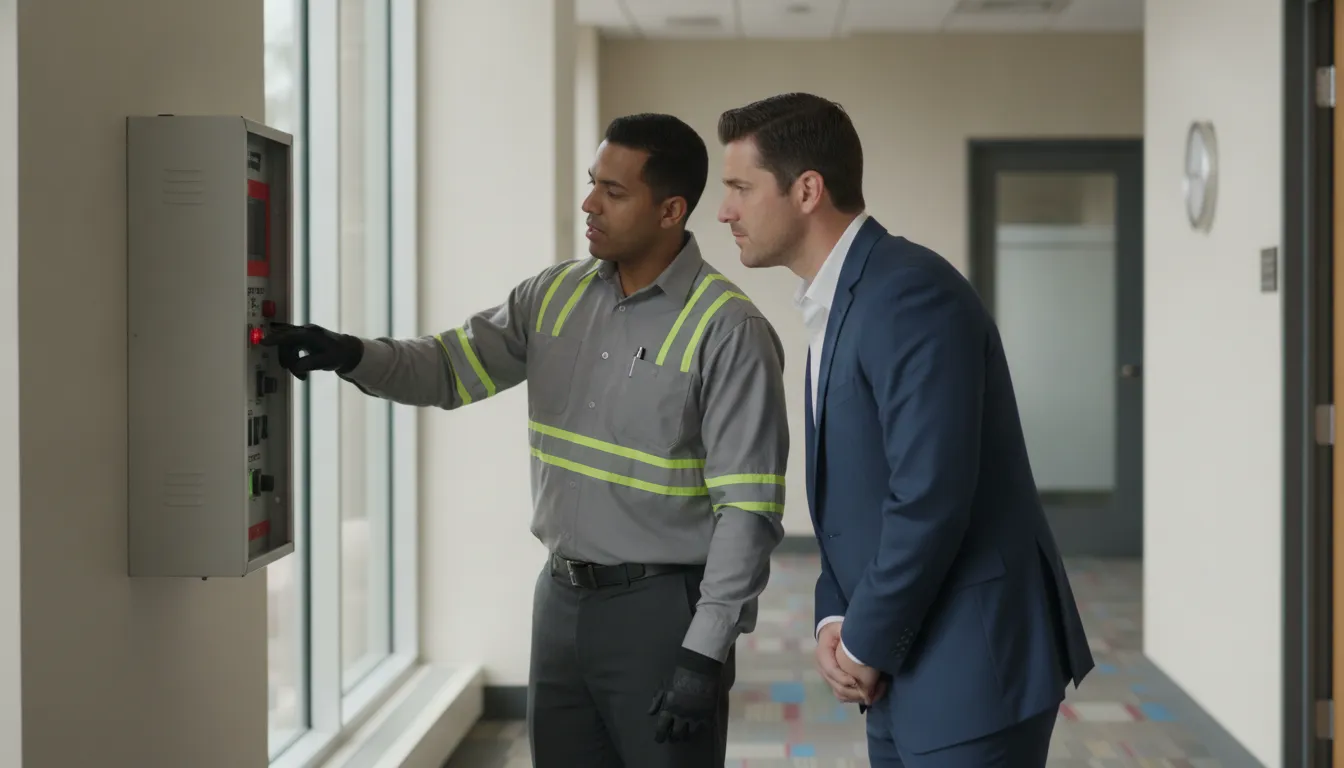
Monitoring is the communication and decision-making stage of a commercial fire alarm lifecycle. It receives signals from the protected property, helps route the appropriate information, and supports continuity when the building is occupied, closed, or between management changes. A reliable monitoring arrangement should complement sound design, installation, testing, and maintenance rather than substitute for them.
What a professional monitoring center adds
American Alarm’s monitoring center is UL 827 certified and uses redundant systems with backup power. Those safeguards are important because a fire alarm system must remain connected to its monitoring process through more than one potential point of failure. UL-certified monitoring may also be accepted by insurance companies and is required for many commercial applications. The exact requirement depends on the property, policy, and authority having jurisdiction. Learn more about commercial alarm monitoring.
Signal handling begins with a properly programmed system and an accurate account record. The monitoring center needs to know the site, signal type, contact procedures, and relevant escalation information. A fire alarm signal should not be treated like an intrusion signal. In Sandy Springs, the city states that the Sandy Springs Fire Department responds to all fire alarms. The city’s True Verification rules address intrusion alarms and police-dispatch eligibility, not a promise of a particular fire alarm response time. Review the Sandy Springs alarm ordinance for the local distinctions.
How monitoring helps reduce avoidable alarm activity
Monitoring also supports better alarm management by giving owners and service teams a structured way to investigate recurring signals. Sandy Springs identifies faulty equipment, improper installation, incorrect test procedures, and user error as causes of false alarms. Staff training, accurate contact information, planned testing, and prompt attention to trouble signals can help address those conditions. The goal is not to silence or delay a legitimate fire signal. It is to maintain the system so that emergency signals are clear and avoidable activations are corrected.
Owners should ask how event records are reviewed, how signal information is updated after a tenant or manager change, and how service issues are documented. These questions connect monitoring to the rest of the lifecycle, including inspection records and ongoing maintenance.
Monitoring for new, existing, or changing systems
A property does not always need a completely new system to obtain dependable service. American Alarm provides alarm reactivation, existing-system takeover, and troubleshooting. That can be useful when a business changes providers, acquires a building with an existing panel, or needs to restore monitoring after an interruption. The system still needs a property-specific evaluation before anyone represents it as ready for ongoing service.
For Sandy Springs businesses comparing options, the right question is not simply whether a company offers monitoring. Ask whether the provider can connect monitoring to qualified service, testing, documentation, and corrective work across the life of the fire alarm system.
How Can Owners Prepare for Inspection and Ongoing ITM?
Inspection and testing are related, but they are not the same task. A visual inspection looks for condition, accessibility, damage, blocked devices, and other observable issues. Testing operates the equipment to confirm that initiating devices, notification appliances, supervisory functions, and communication paths respond as intended. Ongoing inspection, testing, and maintenance, or ITM, keeps a fire alarm system ready between formal reviews and creates a defensible record of its condition.
Start with a property-specific readiness review
Before an inspection, make sure the responsible contact can provide current system information, prior reports, permits, certificates, and the contact details for the monitoring provider. Confirm that fire alarm panels, pull stations, detectors, notification appliances, valves, riser areas, and other related equipment are accessible. Remove stored materials or temporary obstructions that could prevent a technician from seeing or operating a device. Inform occupants and affected service providers about scheduled testing so an expected signal is not mistaken for an emergency.
A professional visual inspection should look for visible damage, corrosion, contamination, loose components, missing labels, impaired access, and changes to the property that could affect coverage. These checks are not a substitute for functional testing. They are the first step in identifying conditions that need correction before a device is placed into operation.
Document functional and sensitivity testing
Functional testing should be organized by device type. The technician may test initiating devices, notification appliances, supervisory signals, power supplies, and communications according to the system design and applicable requirements. Smoke detectors may also require sensitivity testing, which evaluates whether a detector remains within its intended operating range. This is different from simply confirming that the detector can produce an alarm signal.
Power supplies deserve specific attention. Maintain battery testing and replacement schedules, and record the date, result, and any replacement or corrective work. A battery that appears normal during a casual check may still fail to provide the expected standby or alarm support. The schedule should reflect the actual equipment, system configuration, and applicable requirements rather than relying on a generic calendar reminder.
Track deficiencies and preserve the history
When an inspection or test identifies a deficiency, record the affected device or circuit. The condition observed, the risk or operational impact, the recommended correction, and the status of follow-up work. Do not close a deficiency merely because a work order was created. Keep the repair result, retest outcome, and date of resolution with the original report. This makes it easier for an owner or manager to see recurring problems and decide when repair, replacement, or a broader system assessment is appropriate.
Historical records should be organized so an authority having jurisdiction, insurer, consultant, or future service technician can understand the system’s maintenance history. Depending on the property and review, useful records may include code-aware plans, permits, inspection and testing reports, certificates, deficiency closeouts, battery records, sensitivity results, and monitoring documentation. Requirements vary by property and AHJ, so confirm which documents the applicable Sandy Springs authority requests rather than assuming one universal checklist.
For a focused explanation of the difference between recurring tests and formal reviews, see our fire alarm testing and inspection resource. Owners preparing for a fire marshal visit can also use this fire marshal inspection guide to organize site access and records.
Schedule NFPA fire alarm inspection and ITM support. Call (770) 645-0061 for service.
What Should a Sandy Springs Fire Alarm Service Partner Provide?
A dependable commercial fire alarm partner should support the system through its full lifecycle, not stop when installation is complete. Owners should be able to identify who handles design, programming, monitoring, inspection, documentation, maintenance, and future service before signing an agreement.
The right scope depends on the property, its use, and the authority having jurisdiction. Use the following comparison as a practical screening tool, then confirm project-specific requirements with the fire alarm professional and local AHJ.
| Service area | What the partner should provide | What American Alarm documents or supports |
|---|---|---|
| Design | A property-specific assessment and design. It should address device placement, notification circuits, battery capacity, pathway survivability, and voice evacuation when applicable. | American Alarm provides NFPA 72-compliant commercial fire alarm design based on the individual property rather than assuming one generic system fits every building. |
| Installation | Professional installation followed by device and zone programming, commissioning, complete testing, customer training, and a clear handoff. | Its stated workflow includes consultation, design, installation, programming, monitoring-center integration, training, full system testing, documentation, and warranty provision. Certified, background-checked, trained technicians perform the technical work. |
| Monitoring | A monitoring arrangement appropriate for the property, with dependable infrastructure and a defined process for maintaining communications and handling system signals. | American Alarm identifies its monitoring center as UL 827 certified and supported by redundant systems and backup power. UL-certified monitoring is accepted by insurance companies and required for many commercial applications. |
| Inspection and testing | Planned inspection and testing that distinguishes visual review, functional tests, smoke-detector sensitivity testing, and battery evaluation. Deficiencies should be recorded and explained. | American Alarm supports NFPA 72-compliant annual inspection and testing, including visual inspections, device-specific functional tests, smoke-detector sensitivity testing, battery schedules, deficiency tracking, and historical records. |
| Documentation | Organized plans, permits, certificates, test results, service records, and other materials needed for AHJ review, property files, or insurance documentation. | Its fire alarm services include compliance documentation, AHJ submittal preparation, and insurance documentation support. Ask how records will be delivered and retained after each visit. |
| Service continuity | A practical path for repairs, maintenance, system changes, troubleshooting, and continued service when a property changes ownership or inherits an existing system. | American Alarm provides maintenance, repair, alarm reactivation, existing-system takeover, and troubleshooting. Sandy Springs is included in its Northeast Metro Atlanta territory, supported from Roswell. The company has served Metro Atlanta and North Georgia since 1995. |
American Alarm combines design, installation, monitoring, inspection, maintenance, repair, and compliance support in one service scope. That does not replace property-specific review or AHJ direction. But it gives commercial owners a clearer way to evaluate whether a prospective partner can remain involved after the initial installation.
Frequently Asked Questions
Does a monitored fire alarm system need to be registered in Sandy Springs?
Yes. The city requires monitored alarm systems in Sandy Springs to be registered, and the alarm company is responsible for completing that registration. Owners should receive proof of registration and the site’s registration number for their records. Sandy Springs alarm information explains the local requirement.
Does Sandy Springs treat fire alarms and intrusion alarms the same way?
No. The Sandy Springs Fire Department responds to fire alarms, while the city’s True Verification standard applies to intrusion alarms seeking police dispatch. An intrusion alarm generally needs audio or video verification, or another qualifying form of confirmation, before police dispatch. The city alarm ordinance describes these separate response standards.
What does NFPA 72-informed fire alarm design include?
Design is property-specific rather than one generic package. It can include device placement, notification circuit calculations, battery calculations, pathway survivability, and voice evacuation planning. The final scope should account for the property, the applicable authority having jurisdiction, and the system’s intended use.
What inspection records should a commercial property owner keep?
Keep inspection and testing reports, device-level functional test results, smoke-detector sensitivity results, battery schedules, deficiency records, historical service records, certificates, and AHJ submittal documentation. Organized records can also support insurance documentation and make it easier to demonstrate what was tested, when it was tested, and what corrective work remains.
Can an existing fire alarm system be taken over?
Often, an existing system can be evaluated for reactivation, takeover, troubleshooting, maintenance, or continued monitoring. The provider should first assess the equipment, programming, condition, documentation, and communication path. That review determines whether the system can be supported as-is or needs corrective work, upgrades, or replacement.
Schedule Your Sandy Springs Fire Alarm Consultation
A property-specific review can help clarify design priorities, monitoring needs, inspection documentation, and ongoing service before the next project decision. American Alarm can discuss your building’s current system, planned improvements, or lifecycle support in practical terms. To schedule a free consultation for a commercial fire alarm system in Sandy Springs, call (770) 645-0061.


Leave a Reply
Want to join the discussion?Feel free to contribute!