NFPA-Compliant Commercial Security Systems Guide
NFPA compliant commercial security systems require more than selecting alarms and access equipment from a catalog. Atlanta businesses should coordinate intrusion detection, access control, and fire alarm work with the property’s use, adopted requirements, authority having jurisdiction (AHJ), and the people responsible for approval and ongoing service.
Schedule a free consultation. Call (770) 645-0061.
What does NFPA-compliant commercial security planning mean?
NFPA-compliant planning identifies the standards and functions that apply to a particular project, then connects those requirements to the site, equipment, records, and approval process. The result should be a documented plan rather than a broad promise that every device follows one universal rule.
Answer: NFPA standards address defined fire and life-safety subjects. A commercial security project must identify the relevant standard, adopted code provisions, site conditions, and approval responsibilities for that project. A qualified provider can help organize those questions, but the AHJ and other responsible professionals determine what applies locally.
NFPA 72 is an important reference for fire alarm and signaling systems. It does not turn every intrusion alarm or access-control function into a fire-alarm function. The project team should define system boundaries, document interfaces, and avoid changes that could interfere with an approved life-safety function.
American Alarm is an Atlanta-based security and fire alarm company that has protected homes and businesses throughout Metro Atlanta since 1995. Its work includes design, installation, monitoring, and maintenance for security and life-safety systems. For related planning context, read the guide to NFPA 72 compliance for Atlanta businesses.
How do security and life-safety systems intersect?
Security and life-safety systems may affect the same doors, communications paths, control panels, and staff procedures. Reviewing those points together helps a business find where a small operational change needs broader coordination.
Access control may govern entry during ordinary operations, while emergency conditions may require a different approved response. Intrusion detection may send a security signal, while a fire alarm system performs life-safety notification and signaling. These functions can coexist, but they should not be treated as interchangeable.
- Access control: Review controlled doors, locking hardware, credential rules, egress conditions, and the proposed response during relevant emergency conditions.
- Intrusion detection: Define protected zones, arming responsibilities, signal handling, and the difference between a security alarm and a fire alarm.
- Fire alarm: Treat detection, notification, monitoring, testing, and required system functions as life-safety matters.
- Communications: Confirm how signals travel, who receives them, and how trouble conditions are reported and escalated.
- Operations: Give staff clear instructions for normal use, alarm response, service requests, and temporary system impairment.
For useful background, review commercial fire alarm panel types and the discussion of commercial and residential fire alarm differences. These resources do not replace project review, but they show why system scope and property use matter.
What should a business establish before choosing equipment?
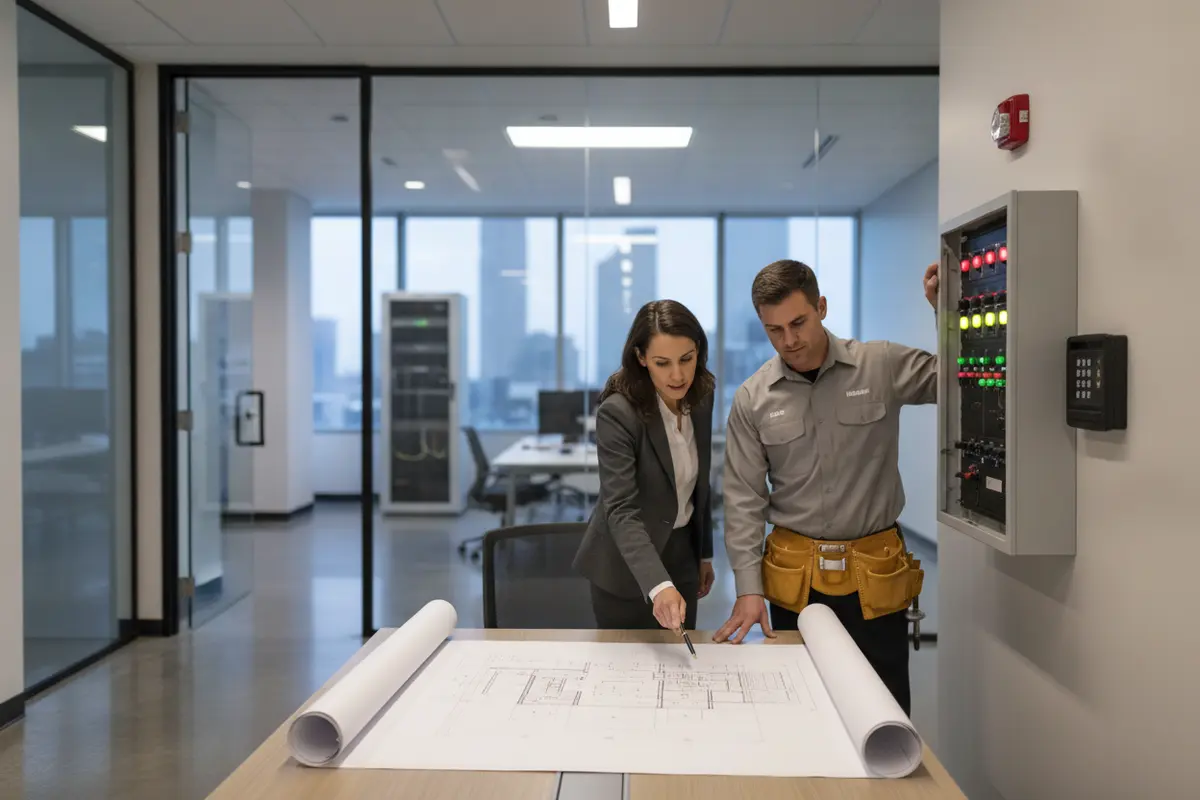
A site-specific inventory is the foundation for a useful proposal. Before comparing products, identify the property use, existing systems, planned changes, approval path, and people who will operate and maintain the result.
Gather available plans, device lists, panel information, monitoring details, prior inspection records, and open service issues. Note controlled entrances, restricted areas, occupied hours, unusual hazards, and renovation work that could change system coverage. If records are incomplete, mark that uncertainty clearly instead of assuming the old documentation is accurate.
- Define the scope: State whether the project involves a new installation, expansion, replacement, takeover, monitoring change, maintenance agreement, or several of these.
- Describe the property: Record occupancy, operating schedule, number of levels, special-use areas, critical rooms, and changes expected during the project.
- Inventory existing equipment: List panels, initiating devices, notification appliances, access points, communication paths, and known deficiencies where information is available.
- Map interfaces: Identify doors, signals, power arrangements, network paths, monitoring connections, and procedures where one system affects another.
- Identify decision makers: Include the owner or manager, facilities personnel, design professionals when involved, service contacts, and the relevant AHJ.
- Confirm review needs: Ask which permits, plan reviews, inspections, tests, records, and approvals apply to the proposed work.
This process matters when a business takes over an older system. A new provider may find undocumented changes, incompatible equipment, missing drawings, or conditions that affect the proposed scope. A responsible evaluation separates known facts from assumptions and explains what must be verified before installation.
American Alarm’s security systems and products overview offers general service context. Its security and alarm services page describes categories a business may discuss during planning.
How should Atlanta businesses compare proposals?
A proposal should explain what will be done, what is excluded, which approvals are expected, and how the system will be supported after handoff. Equipment price alone cannot show whether two proposals cover the same work.
| Proposal area | What to compare | Question to ask |
|---|---|---|
| Scope and drawings | Devices, locations, system boundaries, assumptions, and exclusions | Which existing equipment or site work is not included? |
| Requirements and approvals | Applicable standards, adopted provisions, permits, inspections, and review roles | Who coordinates documents and AHJ questions? |
| System interfaces | Door operation, signals, communications, power, and procedures | How will approved life-safety functions be protected? |
| Monitoring and service | Signal receipt, contact procedures, maintenance, testing, and support | Who receives alarms and handles trouble conditions? |
| Closeout and training | Records, instructions, orientation, outstanding items, and handoff | What documentation will the business retain? |
Ask each provider to distinguish design, installation, monitoring, inspection, maintenance, and repair. These activities may be related, but they are not the same responsibility. If work touches a fire alarm system, ask how technical qualifications, documentation, and local review will be handled. American Alarm’s information about a NICET fire alarm designer explains why technical capability can matter on complex projects.
Compare the assumptions behind each proposal. One bidder may include a site survey and updated drawings, while another may have priced only equipment. One may include user orientation and closeout records, while another leaves those tasks to the owner. Request clarification in writing so the final decision reflects comparable scopes.
Also ask how additions will be handled. A proposal that covers today’s doors but says little about future openings, tenant changes, or panel capacity may create a second planning exercise later. The provider should identify expansion assumptions, available documentation, and any conditions that would require a new review.
What changes when the property has multiple users or locations?
Multi-area operations need consistent rules without assuming that every area has identical risks or operating needs. The proposal should show how permissions, alarm zones, monitoring contacts, and service responsibilities are separated or coordinated.
For a business with several entrances, assign each opening a purpose. Employee entry, public entry, deliveries, restricted rooms, and emergency access may require different schedules or credentials. Document who can change permissions and how changes are recorded. Avoid leaving access decisions to an informal process that depends on one employee’s memory.
For multiple locations, identify whether each site has its own panel and contacts or whether operations are managed together. List local service needs, after-hours contacts, communication paths, and records for each site. A central operating process can help, but it should not hide site-specific requirements or local approval differences.
- Use consistent naming: Give doors, zones, signals, and responsible contacts clear names that staff can recognize during an event.
- Separate responsibilities: Specify who manages credentials, who receives alarms, who requests service, and who approves system changes.
- Review exceptions: Document areas with unusual schedules, sensitive operations, special hazards, or different emergency procedures.
- Keep records current: Update contact lists, drawings, user access, and service information when the business changes.
Consider a two-site retailer as an example. Both sites may use the same operating process, yet one may have a delivery entrance near a restricted room while the other has a different schedule and contact list. Treating them as identical could produce unclear permissions or confusing alarm descriptions. A shared standard with site-specific records is more useful than a single generic plan.
What happens during installation and handoff?
Installation is only one stage of a dependable commercial system. The business should plan for work-area coordination, temporary impairment, testing, documentation, staff orientation, and a clear handoff.
Before work begins, confirm access hours, affected areas, protection for occupants and property, and the process for communicating interruptions. If a life-safety function is temporarily impaired, follow the approved project procedure and direction of responsible professionals and local authorities. Do not assume that a security change has no effect on an adjacent life-safety function.
During the work, keep a running list of approved changes, field conditions, unresolved questions, and items that differ from the original scope. This record helps the owner, provider, and AHJ understand what was actually installed. It also reduces confusion when a future technician needs to service or expand the system.
At handoff, request records appropriate to the project, such as final drawings where provided, operating instructions, monitoring details, test or inspection records, warranty information, and a list of outstanding items. Make sure staff know who can request service and what to do when an alarm or trouble signal appears.
American Alarm provides monitoring and maintenance services for security and life-safety systems. Its information about commercial fire alarm service is useful when planning support, although this article is focused on project evaluation rather than repair instructions.
Which questions should an Atlanta business ask a provider?
Specific questions reveal whether a proposal is based on the property or on a generic package. Ask for clear answers about requirements, interfaces, responsibilities, and support.
- Project basis: What site information and existing records were used to prepare the proposal?
- Applicable requirements: Which standards, adopted codes, permits, and inspections appear relevant to this scope?
- Local review: Who communicates with the AHJ, and which approvals remain the owner’s responsibility?
- System boundaries: Which functions are security features, which are life-safety features, and where do they interface?
- Qualifications: What experience and credentials apply to the proposed design, installation, and life-safety work?
- Continuity: How will the business be informed about temporary impairment, testing, or service conditions?
- Closeout: What drawings, instructions, records, training, and unresolved-item lists will be delivered?
- Future changes: What should the owner review before changing doors, layouts, occupancy, contacts, or operating schedules?
A market comparison can help an owner think about service categories, but it cannot determine code obligations. For example, this office security systems comparison discusses commercial options and providers; use it only as general market context, then rely on the project documents, qualified professionals, and AHJ for site-specific decisions.
How can a business make a practical decision?
A sound choice matches the actual property, separates security functions from life-safety duties, and explains how questions, approvals, service, and documentation will be handled. It should leave the owner knowing what is included and what still requires confirmation.
Start by collecting current records and listing planned changes. Then request a site-specific discussion that covers system boundaries, interfaces, review responsibilities, monitoring, maintenance, and handoff. Compare proposals on total scope and support, not just the equipment list or initial price.
Use a simple decision record. Note the proposed system scope, assumptions, required approvals, responsible contacts, service plan, documentation deliverables, and unresolved questions. If two providers answer those points differently, ask for clarification before making a choice. This record also gives future managers a clear starting point when the property changes.
Atlanta-area businesses can review Roswell commercial security service and Alpharetta commercial security service when confirming whether a provider serves the property. Requirements depend on the site, adopted provisions, system scope, and local review.
Discuss your commercial system. Call (770) 645-0061.
Frequently asked questions
This summary addresses common planning questions, but it does not replace project-specific review or AHJ direction.
Does NFPA compliance apply to every commercial security device?
No. NFPA standards address defined subjects, including fire alarm and signaling. Other requirements may apply to security equipment, while the equipment’s interaction with life-safety systems still needs careful planning.
Can one provider confirm every local requirement?
A provider can help identify relevant standards, prepare a scope, and coordinate questions. Local requirements and approvals depend on the AHJ and the project, so confirm who is responsible for each review and decision.
Do security upgrades require fire alarm review?
Not every change has the same effect. Work that affects alarm functions, controlled doors, building systems, communications, or approved plans should be reviewed by qualified professionals, with the relevant authority consulted as needed.
What should an owner keep after installation?
Keep the final scope and drawings where provided, operating instructions, monitoring details, service contacts, inspection or approval records, test results, and unresolved-item notes. These records help future staff and providers understand the installed system.
Schedule a free consultation. Call (770) 645-0061.
American Alarm helps Atlanta-area businesses plan security and life-safety systems with a property-specific approach, so a careful review is the sensible first step before equipment or scope decisions are finalized.

Leave a Reply
Want to join the discussion?Feel free to contribute!