When a Fire Alarm Is Required in a Commercial Building
When you think of a fire alarm, you probably picture the small, battery-powered smoke detector on your ceiling at home. Its job is simple: make a loud noise to wake your family. For a business, however, that simple device is dangerously inadequate. A commercial environment has employees, customers, complex layouts, and valuable assets to protect. This requires an engineered life-safety system, not just a noisemaker. These systems are governed by strict legal codes that dictate their design, installation, and monitoring. This raises the crucial question for every Atlanta entrepreneur: when is a fire alarm system required in a commercial building? This guide will clarify the critical differences and help you understand the non-negotiable requirements for protecting your business.
Key Takeaways
- Commercial fire alarms are complex, code-driven systems essential for business safety and compliance.
- Significant distinctions exist in design, components, monitoring, and integration needs compared to residential systems.
- NFPA standards and Authority Having Jurisdiction (AHJ) requirements mandate rigorous commercial system specifications.
- Professional 24/7 monitoring and stringent maintenance are non-negotiable for commercial fire safety.
- Utilizing residential fire alarm solutions in a commercial setting leads to significant risks, legal liabilities, and non-compliance.
Home vs. Business Alarms: What’s the Real Difference?
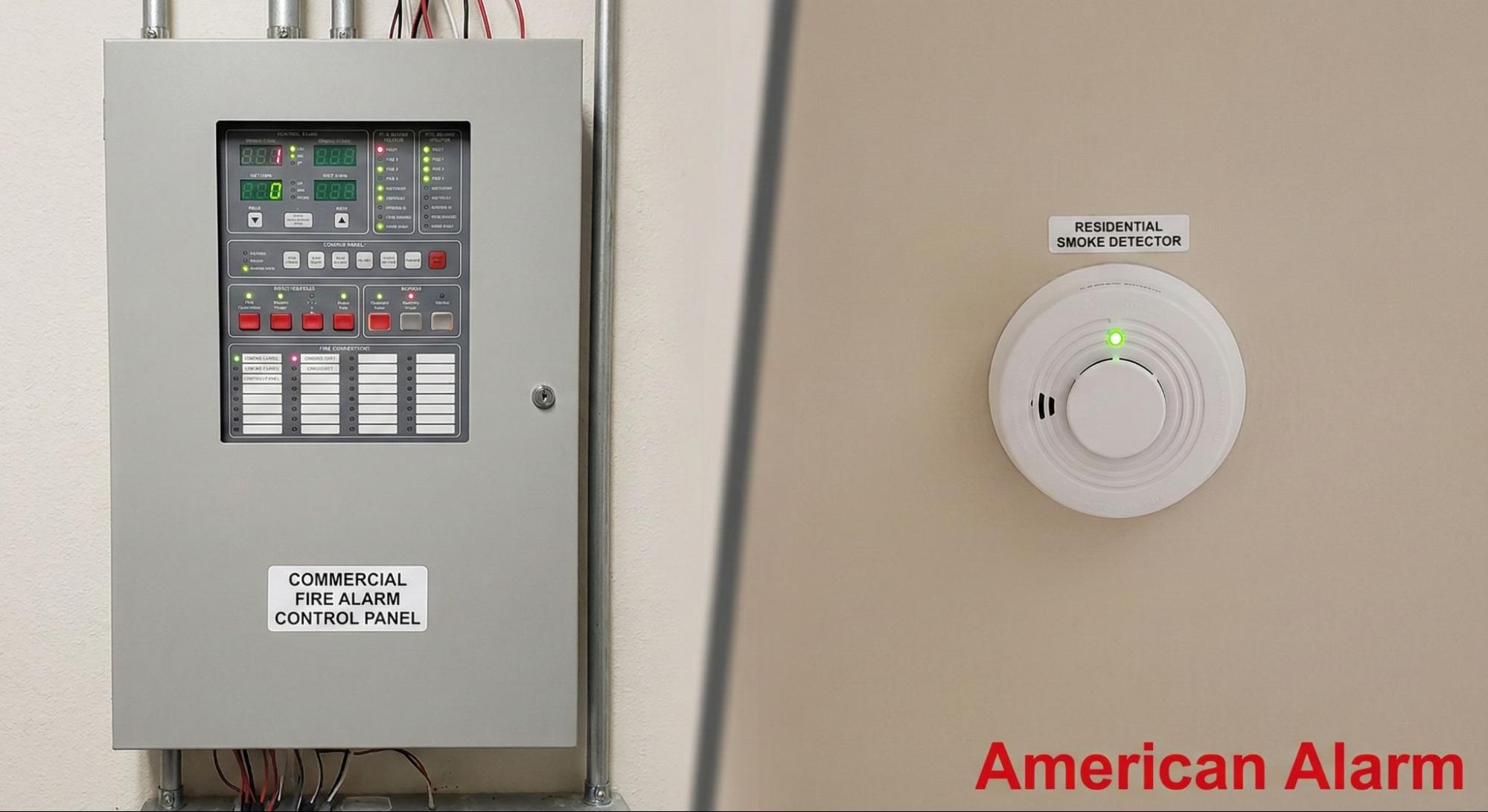
At their core, all fire alarms share a common purpose: to save lives and protect property by providing an early warning in the event of a fire. However, how they achieve this goal differs dramatically between a home and a business. A residential fire alarm, often a battery-powered smoke detector, is designed for a simple environment, a single-family home with a predictable layout and a small number of occupants who are familiar with the space. Its primary role is to wake a sleeping family, giving them crucial seconds to escape. Commercial fire alarm systems operate on a much grander and more complex scale. They are engineered life-safety systems designed to protect employees, customers, and the public in diverse and often large-scale environments like office buildings, retail stores, warehouses, and schools. Their function extends far beyond a simple audible alert; they must manage evacuation, notify emergency services automatically, and comply with strict legal standards. For Atlanta business owners, understanding this distinction isn’t just a matter of choice; it’s a critical component of legal compliance and responsible operation.
Why Your Building’s Design Dictates Your Alarm System
The fundamental difference between commercial and residential fire alarms begins with their design philosophy. A home system can be simple because the environment is contained. A commercial building, however, presents a multitude of challenges. Consider an office in Buckhead or a warehouse in Kennesaw; these structures have vast square footage, multiple floors, numerous exits, and a high density of occupants who may be completely unfamiliar with the layout. Commercial fire alarm systems are custom-engineered to meet these demands. The design process involves a detailed analysis of the building’s floor plan, occupancy load, specific uses of different areas, and local fire codes. The system must ensure that an alarm is not only detected quickly but that the warning reaches every corner of the building effectively, guiding people to safety. This contrasts sharply with a residential setup, where a few strategically placed smoke detectors are typically sufficient.
Inside a Commercial Fire Alarm: The Key Components
While a homeowner might think of a fire alarm as a single device on the ceiling, a commercial system is a sophisticated network of interconnected components. These devices work in concert to provide comprehensive detection, notification, and response capabilities far beyond what a residential alarm can offer. The complexity of these commercial security systems in Atlanta is necessary to meet the demanding safety requirements of a business environment.
Conventional vs. Addressable Systems
Not all commercial fire alarm systems are created equal. The two primary types you’ll encounter are conventional and addressable systems. Think of this as the difference between getting a general alert and receiving a precise notification. The choice between them depends heavily on your building’s size, complexity, and your budget. Understanding how each one operates is the first step in selecting the right fire protection strategy for your Atlanta business, ensuring you meet both safety standards and operational needs without overspending on features you don’t require.
Conventional Systems
Conventional fire alarm systems are the more traditional and straightforward option. These systems work by dividing your building into broad areas called “zones.” For example, one zone might cover the entire first floor, while another covers the second. When a smoke or heat detector is triggered, the main control panel will tell you which zone is in alarm, but not the exact location of the device. While this is a cost-effective and reliable solution for smaller, simpler buildings, it can slow down emergency response in a larger facility, as first responders have to search the entire zone to find the source of the fire.
Addressable Systems
Addressable systems, on the other hand, are more advanced and offer pinpoint accuracy. In this setup, each individual detector and pull station has a unique digital “address.” When a device is activated, the control panel displays its exact location—for instance, “Smoke Detector, Office 102” instead of just “First Floor.” This incredible precision allows for a much faster and more effective response from emergency personnel. For larger or more complex buildings in the Atlanta area, these intelligent systems and products are often the required standard, providing a superior level of life safety and property protection.
Smart and Wireless Options
Modern fire alarm technology is increasingly smart and interconnected. Today’s systems can integrate with other building safety functions to create a unified response during an emergency. For example, a fire alarm can automatically trigger access control systems to unlock specific doors for evacuation while securing other areas. Furthermore, wireless technology has made significant strides, using reliable radio signals to connect devices without the need for extensive wiring. This makes installation faster and less disruptive, offering a flexible solution for historic buildings or businesses looking to upgrade their existing infrastructure with minimal interruption.
The Control Panel: Your System’s Central Hub
The brain of any commercial fire alarm system is the Fire Alarm Control Panel. This central hub continuously monitors all connected devices, pinpoints the exact location of an alarm, and executes pre-programmed responses, such as activating notification devices and alerting the monitoring station. Modern addressable panels can identify the specific detector or pull station that was triggered, providing invaluable information to first responders. This is a world away from a residential smoke detector, which operates as a standalone unit with no central intelligence.
Detectors and Sensors for Every Business Need
Commercial properties contain varied environments that require different types of detection. While a home relies primarily on smoke and carbon monoxide detectors, a business may need a multi-layered approach. This includes:
- Heat Detectors: Used in areas like kitchens or workshops where smoke is common, preventing false alarms.
- Flame Detectors: Deployed in high-risk industrial settings where flammable materials could ignite quickly.
- Duct Detectors: Installed in HVAC systems to shut down airflow and prevent smoke from spreading throughout the building.
- Multi-Sensor Detectors: Advanced devices that combine multiple detection methods (e.g., smoke and heat) to improve accuracy and reduce false alarms.
Alerting Everyone: Notification and Evacuation Tools
Getting people’s attention in a noisy warehouse or a sprawling office complex requires more than a simple beeping sound. Commercial systems utilize powerful notification appliances, including high-decibel horns, bright strobe lights to assist the hearing-impaired, and voice evacuation systems that provide clear, pre-recorded instructions for a safe and orderly exit. These components are strategically placed to ensure the alert is unmistakable, regardless of where someone is in the building.
Is a Fire Alarm System Required in Your Commercial Building?
Perhaps the most significant differentiator is the legal and regulatory framework governing commercial fire alarms. While homeowners are encouraged to install smoke detectors, business owners are legally mandated to install, maintain, and monitor systems that meet stringent codes. The primary standard governing these systems is NFPA 72, the National Fire Alarm and Signaling Code. This comprehensive document dictates everything from system design and component placement to testing schedules and maintenance procedures. Adhering to these rules is a cornerstone of commercial fire safety & NFPA compliance.
Rules Based on Occupancy Group and Load
Beyond the general standards, the specific requirement for a fire alarm system often comes down to two key factors: the building’s “occupancy group” and its “occupant load.” In simple terms, this means what your building is used for and how many people can be inside it at one time. Local and national codes classify every commercial building into a specific group based on its purpose—whether it’s a store, an office, a school, or a factory. Each classification comes with its own set of rules because the risks and evacuation challenges differ greatly. Understanding your building’s classification is the first step in determining your specific fire safety obligations.
Group A: Assembly
This group includes places where large numbers of people gather for events, entertainment, or worship, such as theaters, restaurants, and event halls. Generally, a fire alarm system is required in an Assembly building if the occupant load is 300 people or more. The rules get even stricter if the assembly area is not on the main ground floor. If more than 100 people can gather on a floor above or below the primary exit level, a system is typically mandated. This ensures that in a crowded and potentially chaotic environment, everyone receives a clear and immediate warning to evacuate safely.
Group B: Business
Group B covers most typical office buildings and professional service providers, like banks or clinics. For these business environments, a fire alarm system is usually required when the total occupant load reaches 500 or more people. A system is also necessary if more than 100 people occupy a single floor that isn’t on the same level as the main exit. For many Atlanta businesses, this means that as your company grows and your team expands, your fire safety needs may evolve, potentially requiring an upgrade from a basic setup to a fully integrated commercial fire alarm system.
Group E: Educational
Educational facilities, from daycares to high schools, fall under Group E. Given that these buildings are filled with children, the fire code requirements are exceptionally stringent. A fire alarm system is almost always required in K-12 schools. The specific rules depend on the number of classrooms and the overall layout, but the priority is always the rapid and orderly evacuation of students and staff. These systems must be robust and reliable, as they are a critical component of a school’s comprehensive safety plan, ensuring the protection of its most vulnerable occupants.
Group M: Mercantile
If you own a retail store, a shopping center, or any business where merchandise is sold, your building is classified as Group M. Similar to business occupancies, the trigger for a required fire alarm system is often based on occupant load. A system is generally mandated if the building can hold 500 or more people at once. The rule also applies if more than 100 people are on a floor above or below the main exit level. This is crucial for busy retail environments where customers may be unfamiliar with the layout and need clear guidance during an emergency.
Other Specialized Groups (F, H, I, R, S)
The code also defines several other specialized occupancy groups, each with unique risks and requirements. These include factories (Group F), buildings with high-hazard materials (Group H), and institutional facilities like hospitals and nursing homes (Group I). Hotels and other transient living spaces fall under Group R, while storage facilities and warehouses are classified as Group S. Each of these categories has a detailed set of fire code regulations tailored to its specific dangers, from industrial processes to the needs of non-ambulatory occupants, making professional consultation essential.
Triggers Beyond Occupancy: Size, Height, and Use
While occupant load is a primary factor, it’s not the only one. A building’s physical characteristics, such as its overall size and height, can also trigger the need for a fire alarm system, regardless of how many people are inside. Tall buildings, for instance, have unique evacuation challenges that necessitate a more sophisticated alarm and communication system. Furthermore, the specific use of a building, even within a broader occupancy group, can introduce additional requirements. Ultimately, the final determination rests with the Authority Having Jurisdiction (AHJ)—typically the local fire marshal in the Atlanta area—who interprets and enforces the code. This is why partnering with experts who understand local regulations is so important for ensuring your services and systems are fully compliant.
The Role of Automatic Sprinkler Systems
Many business owners wonder if having an automatic sprinkler system eliminates the need for a fire alarm. The answer is usually no; they are designed to work together. A sprinkler system is your first line of defense for suppressing a fire, while the fire alarm system is your primary tool for life safety and notification. In most modern commercial buildings, the two are integrated. When a sprinkler head activates, it also triggers a water-flow switch that sends a signal to the fire alarm control panel. The panel then activates the building’s notification devices and alerts your 24/7 monitoring station. While having a full sprinkler system can sometimes reduce the requirement for manual pull stations, it doesn’t replace the need for a professionally installed and monitored system that meets all NFPA codes.
What Your Business Needs to Know About NFPA 72
NFPA 72 is the gold standard for fire alarm systems in the United States. It provides the minimum requirements for performance and reliability, ensuring that a system will function as intended during an emergency. Compliance involves much more than just buying equipment; it requires professional design, certified installation, and documented proof of ongoing maintenance. For businesses, this often means obtaining NFPA certificates for their fire alarm system as proof of compliance.
Understanding the Codes: IBC, IFC, and NFPA
Navigating the web of regulations for commercial fire safety can seem daunting, but it primarily comes down to three key sets of standards. The International Building Code (IBC) and the International Fire Code (IFC) are the main rulebooks that establish when a fire alarm system is required, based on factors like your building’s size, use, and occupancy. Once a system is mandated, the National Fire Protection Association’s code, NFPA 72, takes over. This is the definitive guide that details how the system must be designed, installed, and maintained to ensure it works reliably in an emergency. It’s also crucial to remember that local authorities in the Atlanta area may have their own specific rules that build upon these national standards, making professional guidance essential for full compliance.
Passing Inspection: The Role of the Local Fire Marshal (AHJ)
In addition to national standards, businesses in Atlanta, Roswell, and across North Georgia must comply with local ordinances. The Authority Having Jurisdiction (AHJ), typically the local fire marshal or building inspector, has the final say on whether a system meets all required codes. The AHJ reviews plans, inspects installations, and witnesses system tests before a business can receive its Certificate of Occupancy. This rigorous oversight ensures every commercial system is properly installed and fully operational, a level of scrutiny that simply doesn’t exist for residential alarms.
Why 24/7 Professional Monitoring Is a Must-Have
For a residential alarm, monitoring is often optional or a DIY affair where an alert is sent to the homeowner’s phone. For a business, professional fire alarm monitoring for businesses is almost always a requirement. A commercial fire alarm system is connected to a 24/7 central monitoring station staffed by trained professionals. When an alarm is triggered, a signal is instantly transmitted to the station. Operators verify the alarm and immediately dispatch the local fire department, often before employees on-site are even aware of the full situation. This rapid, professional response is critical for minimizing damage, protecting assets, and, most importantly, ensuring life safety. This is why 24/7 professional security monitoring in Atlanta is a non-negotiable part of any robust commercial safety plan.
Keeping Your System Ready: Installation, Testing, and Maintenance
A commercial fire alarm system is not a “set it and forget it” device. NFPA codes mandate a strict schedule of inspection, testing, and maintenance (ITM) to ensure the system remains in perfect working order. Installation must be performed by licensed, factory-trained technicians who understand the complexities of the system and local code requirements. Following installation, the system undergoes rigorous and regular testing. This can include daily checks of the control panel, weekly visual inspections, and comprehensive annual tests of every single device. All of this activity must be meticulously logged and available for review by the AHJ. This contrasts sharply with a residential detector, where the homeowner is solely responsible for occasionally pressing a test button and changing batteries.
The Installation and Approval Process
Think of installing a commercial fire alarm as a partnership between your business, your security provider, and local officials. It’s a process that requires precision from start to finish. First, the installation must be performed by licensed, factory-trained technicians who understand the intricate details of the system and Atlanta’s specific code requirements. Once installed, the system isn’t immediately ready. It must pass a rigorous approval process managed by the Authority Having Jurisdiction (AHJ), usually the local fire marshal. They will review the plans, inspect the installation, and witness tests before giving the final green light. This thorough vetting is essential for obtaining your Certificate of Occupancy and ensuring your system is truly ready to protect your business.
Beyond Fire: Integrating Alarms with Your Building’s Systems
Modern commercial security is about creating a holistic, integrated ecosystem. Fire alarm systems in a commercial setting rarely stand alone. They are often integrated with other critical building systems to enhance safety and automate emergency responses. For example, when a fire alarm is activated, it can automatically:
- Signal the Atlanta access control systems to unlock emergency exit doors.
- Trigger the Atlanta security camera systems to record the event area.
- Recall elevators to the ground floor.
- Shut down HVAC systems to stop smoke from circulating.
This level of integration creates a powerful, automated response that streamlines evacuation and provides first responders with critical situational awareness.
Beyond Legal Mandates: Other Reasons for a Fire Alarm
While meeting the fire marshal’s requirements is a top priority, legal codes aren’t the only reason your business might need a commercial fire alarm system. Often, other powerful entities have their own set of rules that can be just as, if not more, stringent than local ordinances. Your insurance carrier and, if applicable, your corporate headquarters, also have a major say in your safety protocols. Thinking beyond the codebook and considering these other requirements is a hallmark of a savvy business owner. It’s about creating a comprehensive safety net that protects your investment, your employees, and your customers from every angle.
Understanding these additional layers of compliance ensures you’re not just meeting the minimum standard but are truly prepared. This proactive stance can save you from major headaches, financial losses, and reputational damage down the line. Instead of viewing a fire alarm system as just a box to check for an inspector, you can see it as a fundamental part of your business’s operational health and risk management strategy. It demonstrates a commitment to safety that resonates with insurers, corporate partners, and the community you serve, solidifying your reputation as a responsible and trustworthy establishment.
Insurance Company Requirements
It’s a common misconception that if the city doesn’t require a fire alarm, you don’t need one. Your insurance company might require a fire alarm system even if local building codes don’t. Insurance carriers are in the business of risk management, and a professionally installed and monitored fire alarm system significantly reduces their financial risk in the event of a fire. Because of this, many insurers mandate these systems as a condition of providing coverage for a commercial property. Failing to comply could mean being denied a policy altogether or facing exorbitant premiums. On the flip side, proactively installing compliant fire safety solutions can often lead to substantial discounts on your insurance policy, making the investment pay for itself over time.
Corporate Safety Standards
For businesses that are part of a larger chain or franchise, local codes are just the starting point. Many large companies choose to install fire alarms in all their locations for safety and consistency, even if not strictly required by law in every jurisdiction. This approach ensures that every employee and customer receives the same high level of protection, regardless of whether they’re in downtown Atlanta or a smaller suburban outpost. These corporate standards often exceed the local minimums and reflect a deep commitment to safety and brand integrity. Compliance involves much more than just buying equipment; it requires professional design, certified installation, and documented proof of ongoing maintenance to meet these elevated internal benchmarks. This is where professional NFPA fire alarm services become essential for ensuring consistency across all your locations.
The Dangers of Using Home Alarms in a Business Setting
Attempting to protect a commercial property in Smyrna, Marietta, or Johns Creek with residential smoke detectors is not just inadequate, it’s dangerous and illegal. The risks are severe and multifaceted. First and foremost, these devices lack the power and scope to alert everyone in a large, complex building, putting lives at extreme risk. Legally, using non-compliant equipment will result in failed inspections, fines from the AHJ, and potentially a shutdown of the business until the violations are corrected. Furthermore, in the event of a fire, an insurance company could deny a claim if it discovers the property was not protected by a code-compliant commercial fire alarm system. The liability for any injuries or fatalities would fall squarely on the business owner. Making the right choice in a professional partner is crucial, which is why you should choose American Alarm for your business’s safety needs.
Choosing the Right Fire Alarm Solution for Your Business
For business owners in Atlanta, Alpharetta, Sandy Springs, and throughout North Georgia, fire safety is a foundational responsibility. The differences between residential and commercial fire alarms are not minor details; they are critical distinctions rooted in design, technology, and legal code. Protecting your employees, customers, and assets requires a system built specifically for the unique challenges of your commercial environment. Navigating the complexities of NFPA standards and AHJ requirements demands expertise. American Alarm specializes in designing, installing, and monitoring advanced commercial alarm systems that ensure your business is not only protected but fully compliant. We provide tailored, NFPA-compliant commercial fire alarm solutions that give you peace of mind. Don’t leave your business’s safety to chance; contact American Alarm for a quote and a professional assessment of your fire safety needs.
Your Next Steps for a Compliant Building Alarm System
Don’t leave your business vulnerable to fire risks or non-compliance. Understand the complex world of commercial fire alarms and ensure your property is protected with the right system. Get a quote today from American Alarm for expert installation, monitoring, and peace of mind in Atlanta and North Georgia.
FAQs
What is NFPA 72, and why is it important for commercial fire alarms? Answer: NFPA 72 is the National Fire Alarm and Signaling Code, a widely adopted standard that provides comprehensive requirements for the installation, inspection, testing, and maintenance of fire alarm and emergency communication systems. For commercial buildings in Atlanta and Georgia, adherence to NFPA 72 is critical for legal compliance, ensuring optimal life safety, and protecting property from fire hazards. Can a business use residential smoke detectors for fire protection? Answer: No, commercial buildings cannot use residential smoke detectors as their primary fire protection system. Commercial fire alarm systems require specialized, robust components, advanced monitoring capabilities, and must comply with stringent commercial fire codes like NFPA 72, which residential alarms are not designed to meet. Using residential equipment in a commercial setting can lead to significant safety risks, legal penalties, insurance complications, and may not trigger an appropriate emergency response. How often should commercial fire alarm systems be inspected and tested? Answer: Commercial fire alarm systems require regular, scheduled inspection, testing, and maintenance (ITM) to ensure continuous compliance and functionality. NFPA 72 outlines specific frequencies, which can include daily, weekly, monthly, quarterly, semi-annual, and annual tests for various system components. These ITM activities are typically performed by qualified, licensed professionals, such as those at American Alarm. What is an AHJ, and how does it affect my commercial fire alarm system in Georgia? Answer: AHJ stands for Authority Having Jurisdiction. In the context of fire alarm systems, this refers to the local government body, such as the fire marshal’s office or building department in Atlanta or other Georgia cities, responsible for enforcing building codes, fire codes, and related standards. The AHJ inspects and approves commercial fire alarm system designs and installations to ensure they meet local and state regulations, which often adopt NFPA standards. How do commercial fire alarms integrate with other security systems? Answer: Commercial fire alarm systems can integrate seamlessly with a range of other security measures to create a unified safety and security platform. This includes access control systems (e.g., automatically unlocking exit doors or recalling elevators during an alarm), security cameras (recording footage during an emergency event), and even HVAC or building management systems to control airflow. This integration enhances overall safety, response capabilities, and operational efficiency for businesses.
Related Articles
- Commercial Fire Alarm Code Compliance: Atlanta Guide
- Commercial Fire Alarm Systems Installation Guide for Georgia | American Alarm Corp
- Atlanta Fire Alarm Installation & Monitoring for Businesses
- Commercial Building Fire Alarm Systems: A GA Guide
- Monitored Commercial Fire Alarms: Faster Response in Atlanta | American Alarm


Leave a Reply
Want to join the discussion?Feel free to contribute!