Surveillance Cameras Systems Business: An Atlanta Guide
A camera system should do more than record an incident after it happens. For an Atlanta business, well-placed video can discourage theft, help managers understand what is happening across the property. And preserve a clearer account when an accident or dispute occurs. The value comes from thoughtful coverage and dependable recording, not from collecting the most devices.
Answer: The most effective commercial surveillance plan combines coverage of entrances, high-traffic areas, and vulnerable assets with reliable recording and practical remote access. That is what business owners should look for when evaluating the surveillance cameras systems business owners need to protect operations and reduce liability.
Schedule a free consultation. Call (770) 645-0061 or contact American Alarm online to discuss your commercial camera coverage. A qualified technician can assess your property and recommend the right coverage before you invest.
Modern IP-based surveillance systems support event detection and incident investigation across commercial facilities, while research indicates that visible cameras can both document illegal behavior and deter crime (academic review; research study). The business case starts with understanding where those benefits matter most throughout an Atlanta property.
Why Atlanta Businesses Need Surveillance Camera Systems
Commercial surveillance camera systems help Atlanta businesses deter theft, document incidents, and manage daily operations with better visibility. For Metro Atlanta retailers, warehouses, offices, and service locations, video is not only a response tool after a loss. It is a practical way to protect inventory, employees, customers, and business decisions.
The financial exposure is substantial. The National Retail Federation reported that shrink accounted for more than $112 billion in industry losses in 2022, representing roughly 1.6% of retail sales. External theft and employee or internal theft were among the leading causes. Those figures describe the retail industry broadly, but they illustrate why businesses need a consistent way to observe entrances, sales areas, loading zones, stockrooms, and other vulnerable locations. Read the NRF research on retail shrink.
Deterrence before a loss occurs
Visible, well-placed cameras can change behavior before an incident begins. Research on digital public surveillance systems finds that cameras can record illegal behavior and deter crime in urban and commercial environments. The value is not simply the presence of a device on a wall. A properly designed system makes important areas observable, preserves usable recordings, and gives management a clear process for reviewing events. Review the research on surveillance, deterrence, and incident documentation.
For an Atlanta business, that visibility can support practical controls. Managers can verify whether a delivery arrived, review an after-hours door event, investigate a point-of-sale concern, or identify where a process broke down. Video does not replace sound policies and responsible supervision, but it gives those policies an objective record. It also helps distinguish a suspected loss from a confirmed incident, which can prevent rushed decisions based on incomplete information.
Documentation that supports better decisions
When theft, property damage, or a customer incident occurs, timely documentation matters. A surveillance system designed to balance deterrence with incident recording can help a business establish what happened, when it happened, and which areas were involved. That record may assist with internal investigations, insurance documentation, or a dispute involving the property. The academic literature specifically connects surveillance cameras with both crime deterrence and the recording of illegal behavior, making those two functions complementary rather than separate goals. See how IP surveillance supports commercial monitoring and investigation.
American Alarm serves Metro Atlanta businesses with more than 30 years of local experience, including guidance from NICET IV certified engineer Scott Gilkey. A site-specific design can focus investment where it will produce the clearest operational and risk-management value, instead of treating every property the same.
Call (770) 645-0061 to discuss surveillance camera coverage for your Atlanta business.
Schedule a commercial camera consultation with American Alarm today.
What a Commercial Surveillance Camera System Includes
Section summary: A commercial surveillance camera system combines purpose-built cameras, network equipment, recording hardware, and storage. The right combination gives a business clear evidence when an incident occurs without creating unnecessary equipment or ongoing service costs.
Modern systems are more than a collection of cameras mounted around a property. Surveillance technology has evolved from analog signals into packet-switched IP systems operating over IPv4 and IPv6 networks. That shift allows video devices to communicate across a structured network, connect with recording equipment, and support more efficient management of multiple areas. Research on IP surveillance describes these systems as practical for protecting commercial facilities and investigating incidents across large sites: review the research on modern IP-based surveillance.
Camera types matched to the property
Camera selection should follow the way a business uses each space. A fixed bullet camera can provide a focused view along an exterior wall, loading area, driveway, or other defined approach. Dome cameras offer a discreet, compact form that works well in entrances, corridors, retail areas, and offices. A PTZ, or pan-tilt-zoom, camera can move across a broad area and zoom in when an operator needs a closer view.
- Bullet cameras: Focused coverage for exterior approaches, gates, driveways, and loading areas.
- Dome cameras: Low-profile coverage for entrances, hallways, customer areas, and interior workspaces.
- PTZ cameras: Flexible coverage for larger areas where controlled movement and optical zoom are useful.
Resolution, networking, and recording
Resolution determines how much detail remains available when video is reviewed. 4K resolution is critical when a business needs to identify fine details such as faces or license plates, especially at entrances and vehicle access points. It is not automatically the best choice for every camera, however. Lighting, distance, camera placement, lens selection, and available network capacity all affect the final image.
IP cameras send video through the network to an NVR, or Network Video Recorder. A hardwired NVR system can store footage locally on a physical hard drive, eliminating recurring cloud storage subscription fees. Local storage also gives the business a defined recording location and retention plan. Some businesses may still choose cloud or hybrid storage for remote access, redundancy, or off-site preservation, depending on operational and compliance needs.
The complete design should account for camera views, network connectivity, recording capacity, power, and retention. A professional assessment helps ensure that the system supports actual business operations rather than simply adding devices to a property.
Schedule a commercial surveillance consultation. Call (770) 645-0061 to discuss the right camera system for your business.
How Surveillance Camera Systems Help Businesses Reduce Liability
Summary: Recorded video gives businesses an objective account of what happened during an incident. When cameras are positioned to cover entrances, work areas, customer spaces, and other high-risk zones. That record can help clarify disputes, support insurance documentation, and discourage conduct that may create liability.
Liability often turns on details that are difficult to reconstruct later. A customer may report a fall near an entrance, an employee may dispute how an injury occurred, or a business may face a claim involving damaged property. Without documentation, management may have to rely on conflicting statements and incomplete recollections. A properly configured system preserves a time-stamped view of the relevant area. Giving the business a clearer basis for its internal review and its communication with insurers or legal counsel.
Documenting customer and visitor incidents
Video can help establish conditions before, during, and after an alleged injury. It may show whether an entrance was clear, how a person moved through a space, whether warning procedures were followed, or whether another event contributed to the incident. That does not replace a thorough safety investigation, but it can prevent assumptions from becoming the only record.
The same documentation can help resolve disputes involving delivery areas, loading zones, parking lots, equipment rooms, and restricted access points. Clear footage may confirm the sequence of events, identify witnesses or involved parties, and help preserve evidence before memories change. Video surveillance is recognized as potentially essential evidence for insurance claims and legal disputes arising from commercial properties. Research on digital surveillance systems also describes their role in recording illegal behavior and deterring crime.
Supporting workplace injury and theft investigations
Worker’s compensation disputes can become especially difficult when an injury is reported after the fact or when the circumstances are contested. Footage can help management understand the activity leading up to an incident. Review whether procedures were followed, and provide a factual record to the appropriate insurance or legal professionals. It should be handled carefully, with access limited to authorized personnel and retention practices aligned with the business’s policies.
Deterrence and documentation work together. Visible cameras may discourage theft, vandalism, or unsafe conduct, while recorded footage provides an investigative record if an event still occurs. That balance can reduce the likelihood of preventable incidents and help the business respond more confidently when a claim is made. For owners comparing surveillance cameras systems business solutions, the important question is not simply whether cameras are present. It is whether the system captures useful views, stores footage reliably, and allows authorized users to retrieve the right event quickly.
Protect your business with properly planned video coverage. Call American Alarm at (770) 645-0061 to discuss your security needs.
How to Choose the Right Surveillance Camera System for Your Business
Summary: The right business camera system starts with a site assessment, not a product list. Plan coverage around entry points, high-traffic areas, operational priorities, storage needs, and future expansion so the system supports both daily management and incident review.
Begin by walking the property with a professional who can identify where visibility matters most. Entrances, loading areas, sales floors, cash-handling points, parking areas, restricted rooms, and high-value equipment may require different camera views. A warehouse, for example, may need coverage across multiple aisles, dock doors, and exterior approaches. Our warehouse security resource provides additional context for industrial facilities.
The number of recorder channels should follow this coverage plan. A channel is generally allocated for each camera, so the correct count depends on how many entry points and high-traffic areas need reliable coverage. Choosing a recorder with no room for expansion can create unnecessary replacement costs when your business adds a location. Remodels a facility, or needs visibility in a newly identified risk area.
| Option | Best fit | Planning considerations |
|---|---|---|
| Fixed bullet camera | Exterior approaches, parking areas, and long sightlines | Useful for clearly defined views. Confirm mounting height, lighting, weather exposure, and nighttime visibility. |
| Fixed dome camera | Interior spaces, offices, retail areas, and corridors | Provides a discreet profile. Check the viewing angle and ensure shelving, equipment, or fixtures will not obstruct coverage. |
| PTZ camera | Large areas that need active observation | Can pan, tilt, and zoom, but should complement fixed cameras rather than replace coverage at critical entry points. |
Match resolution and storage to the business risk
Resolution should reflect what the video must show. Standard high-definition video may be appropriate for general activity monitoring, while 4K can provide finer detail when identification of faces or license plates is important. Higher resolution also creates larger files, so storage capacity and retention settings must be planned together. Ask how long footage should remain available, which cameras need continuous recording, and whether motion-based recording is appropriate for lower-risk areas.
Storage architecture is another budget decision. A hardwired network video recorder can store footage locally on a physical drive, which may avoid recurring cloud storage fees. Cloud surveillance can provide convenient access and off-site storage, but ongoing service costs and internet dependency should be included in the evaluation. The best choice depends on access requirements, retention goals, cybersecurity practices, and the consequences of losing connectivity.
Leave room for growth
Modern IP-based surveillance networks can scale from a focused installation to very large deployments. Research on IP surveillance describes systems that can support thousands of cameras across large areas as intelligent applications improve network management. For a growing Atlanta business, that means selecting compatible equipment, network capacity, and recorder channels with the next phase in mind, rather than only the current floor plan.
- Coverage first: Prioritize documented risks and business operations before comparing hardware features.
- Total cost: Include installation, network upgrades, storage, maintenance, and any recurring service fees.
- Reliable evidence: Confirm that camera placement, lighting, resolution, and retention support useful incident review.
Schedule a business camera assessment. Call (770) 645-0061 to discuss the right surveillance camera system for your property.
The Value of Professional Installation for Business Camera Systems
Section summary: Professional installation turns surveillance equipment into a dependable business asset by matching camera placement, cabling, configuration, and support to the property’s actual risks.
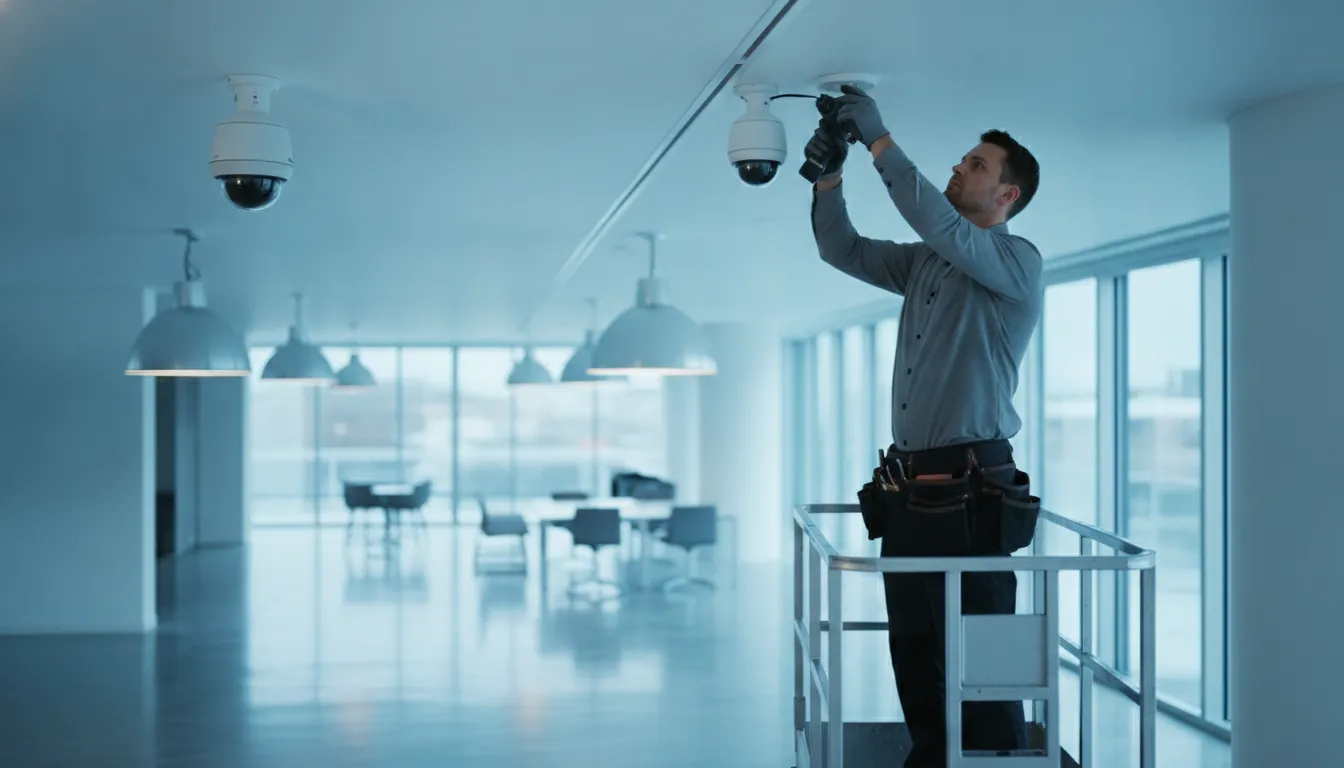
A business camera system is only useful when it captures the right view at the right time and continues recording reliably. Professional installation begins with a site assessment rather than a one-size-fits-all equipment package. An experienced installer reviews entrances, loading areas, cash-handling points, parking areas, restricted spaces, and high-traffic routes. This process identifies blind spots, glare, poor lighting, and locations where a camera may be vulnerable to damage.
Placement decisions also affect the usefulness of recorded video. A camera aimed too broadly may show activity without enough detail to identify what happened. A camera installed at the wrong height or angle may capture faces poorly or lose visibility when doors, vehicles, or seasonal conditions change. A professional designs coverage around the property’s operations and the business’s priorities, whether that means documenting deliveries, monitoring customer areas, or reviewing an incident quickly.
Reliable infrastructure matters as much as camera selection
Commercial surveillance systems depend on more than the camera housings. Cabling must be routed neatly and protected from interference or accidental damage. Network connections, power requirements, recording hardware, storage settings, time synchronization, user permissions, and remote access all need to work together. Proper configuration helps ensure that footage is available when management needs it and that authorized users can review it without creating unnecessary access risks.
- Coverage planning: Camera views are matched to entry points, high-traffic areas, and operational priorities.
- Protected cabling: Wiring and connections are installed with durability, serviceability, and the building layout in mind.
- System configuration: Recording, notifications, permissions, and remote viewing are set up for practical daily use.
- Ongoing support: Maintenance and responsive service help keep cameras and recording hardware working as the business changes.
For Metro Atlanta businesses, engineering oversight and local response can be important differentiators. American Alarm is led by Scott Gilkey, a NICET IV certified engineer, a benchmark that signals advanced technical expertise in life-safety system design and related security projects. The company also brings more than 30 years of local experience, helping business owners plan systems that fit their facilities instead of relying on outsourced, automated support. Learn more about why businesses choose American Alarm.
Professional installation does not end when the cameras are mounted. A dependable provider explains system operation, confirms views with the customer, and remains available for adjustments, troubleshooting, and expansion. American Alarm keeps service pricing clear with a flat $69 service call, giving businesses a straightforward path to support when an issue needs attention.
Schedule professional surveillance camera installation in Atlanta. Call (770) 645-0061 to discuss coverage for your business.
Monitoring and Remote Access for Business Cameras
Section summary: Remote access lets authorized business leaders review live and recorded video from mobile apps or desktop software. While professional monitoring can help connect camera events to a timely response.
A business camera system becomes more useful when decision-makers can see what is happening without being on site. Authorized users can open a mobile app or desktop dashboard to check entrances, loading areas, cash-handling spaces, or other priority locations. This can support daily operations as well as security. Remote monitoring is especially valuable for checking high-risk areas during off-hours, when a manager may need to confirm whether activity is expected or requires follow-up.
Remote viewing, alerts, and footage retention
Remote viewing should be paired with a clear alert strategy. Depending on the system design, users may receive notifications for motion, activity in a defined zone, or another configured event. Alerts should be tuned to the property and operating schedule so that staff can focus on meaningful activity instead of responding to every change in a scene. Modern surveillance systems also support event detection and faster incident investigation across large areas, according to a review of IP-based surveillance technology (academic research on IP surveillance).
Retention is equally important. The right recording period depends on the business’s risk profile, available storage, and how long an incident may take to surface. A hardwired Network Video Recorder can store footage on a physical drive, which may eliminate recurring cloud storage subscription fees. Cloud-based storage can provide convenient access and off-site redundancy, while local recording can offer direct control over the recording hardware. A qualified design should weigh access, continuity, cybersecurity, and retention requirements together. Learn more about cloud surveillance for business before choosing a storage model.
How monitored systems support response
Remote access is not the same as response coverage. A manager may review an alert, but cannot always investigate an event immediately. American Alarm provides 24/7 UL-certified central station monitoring, allowing a camera system to work as part of a broader security protocol. When video is integrated with alarms and other security signals, defined procedures can help determine whether an event should be escalated, verified, or documented for follow-up.
Businesses should also clarify user permissions, notification recipients, footage export procedures, and the steps for preserving video after an incident. These details help protect privacy and create a repeatable process for insurance questions, internal reviews, or legal disputes. For budgeting context, review current alarm monitoring fees alongside camera storage and service requirements.
Plan dependable business camera monitoring today. Call (770) 645-0061 to discuss your property and response needs.
Frequently Asked Questions
What is the best commercial surveillance camera system for my business?
The best system matches your property, operating hours, risk areas, and evidence needs. Start by mapping entrances, loading areas, cash-handling points, employee access routes, and other high-traffic zones. Then select camera views, recording capacity, remote access, and analytics that support both theft deterrence and daily operations. A professional assessment helps avoid blind spots and unnecessary equipment.
Do I need professional installation for business security cameras?
Professional installation is strongly recommended for a commercial property. Correct camera height, viewing angles, lighting coverage, network configuration, recorder setup, and system testing determine whether footage is useful when an incident occurs. It also makes future service and expansion easier. A qualified installer can design coverage around your actual workflow instead of simply mounting cameras where power is available.
Can I view my business security cameras remotely?
Yes. Modern systems commonly provide remote viewing through mobile apps or desktop software, allowing authorized users to check entrances, work areas, and other priority zones from another location. Access should be protected with strong credentials and limited to appropriate personnel. Remote viewing is useful for operational oversight, but it does not replace a defined response plan or professional monitoring when immediate action is needed.
What are the benefits of a 4K surveillance system for a business?
4K video provides more detail than standard high-definition footage, which can help identify faces, license plates, labels, and other evidence when the camera is properly positioned. It is most valuable at entrances, driveways, parking areas, and transaction points. Higher resolution also requires appropriate storage, network capacity, and recording settings, so the complete system should be designed together.
Can a business camera system work without recurring subscription fees?
Yes. Many hardwired systems use a network video recorder with local hard-drive storage, which can avoid recurring cloud storage fees. Local recording still requires maintenance, retention planning, secure access, and replacement of storage hardware when needed. Some businesses choose a hybrid approach that combines local recording with cloud access or backup based on their operational and evidence requirements.
Ready to Strengthen Your Business Camera Plan?
A focused assessment can help align camera coverage with your Atlanta business’s entry points, daily operations, and documentation needs. Schedule a free consultation and commercial camera system assessment through professional surveillance camera installation in Atlanta. American Alarm can help you take the next practical step toward clearer oversight and a more dependable surveillance strategy.

Leave a Reply
Want to join the discussion?Feel free to contribute!