Fire Alarm System Woodstock: Installation and Service Guide
How to Plan a Fire Alarm System Woodstock Businesses Can Rely On
Planning a fire alarm system Woodstock businesses can depend on requires more than selecting devices. The system should match the building, support clear occupant notification, communicate alarm conditions to a supervising station, and remain supported through documented inspection, testing, maintenance, and service. For Woodstock businesses and commercial properties, that planning process helps connect life safety goals with practical operations.
Call (770) 645-0061 to discuss your fire alarm needs or contact American Alarm online.
A dependable fire alarm system in Woodstock should be professionally designed, installed, monitored, inspected, tested, and maintained for the specific property. American Alarm serves Woodstock and the greater Atlanta area with NFPA-focused expertise, local service, and leadership from NICET IV-certified founder Scott Gilkey.
Reviewed by Scott Gilkey, NICET IV-certified founder of American Alarm. American Alarm has protected homes and businesses throughout Metro Atlanta since 1995. The company provides design, installation, monitoring, inspection, maintenance, and repair support for fire alarm and security systems.
The right provider should explain what the system does, how signals are handled, what records will be supplied, and how future service will work. It should also account for the property’s use, layout, construction, occupant needs, and applicable local requirements. This guide outlines the main questions Woodstock decision-makers should ask before starting a project.
What Should a Fire Alarm System Woodstock Property Include?
Summary: A commercial fire alarm system combines detection, control, notification, communications, power, and documentation. American Alarm evaluates how those elements work together for a Woodstock property. Then helps align the completed system with its life safety plan, operating conditions, monitoring needs, and ongoing service responsibilities.
A fire alarm system is a coordinated group of components rather than a single product. The design may include initiating devices that identify smoke, heat, water flow, or manual alarm conditions. A fire alarm control panel receives and interprets those signals. Notification appliances then alert occupants through audible, visible, or voice-based signals, depending on the design and property requirements.
| System area | What it does |
|---|---|
| Detection and initiating devices | Identify conditions such as smoke, heat, manual activation, or water flow. |
| Control equipment | Receives signals, displays system status, and coordinates programmed responses. |
| Notification appliances | Communicate an alarm or supervisory condition to people in the building. |
| Communications and power | Support signal transmission and system operation, including required standby power. |
Detection should reflect the building
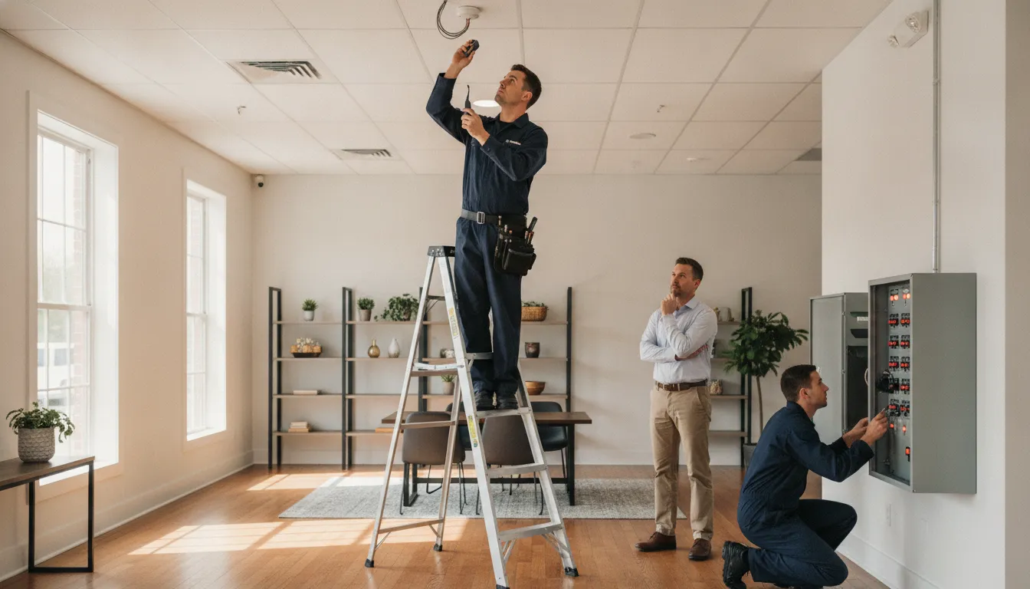
Device selection and placement depend on the building’s layout, occupancy, environmental conditions, and potential hazards. Areas with dust, temperature changes, cooking activity, mechanical equipment, or unusual airflow may need a carefully considered approach. A qualified designer should explain why devices are being proposed in particular locations rather than treating every property as identical.
Businesses should also ask how the proposed system will interact with related life safety equipment. Sprinkler water-flow switches, supervisory signals, elevator functions, doors, smoke control equipment, and emergency power may be part of the overall design. The exact arrangement depends on the property and the authority having jurisdiction.
Notification and communication make the signal useful
Detection is only the first step. Occupants need an understandable warning, and designated responders need timely information about the condition. The system design should identify how alarms, troubles, and supervisory signals will be displayed locally and transmitted for monitoring when that service is part of the plan.
American Alarm can help property owners review the relationship between equipment, monitoring, testing, and service. Its fire and security services are structured around the property’s needs rather than a one-size-fits-all package.
Why NFPA 72 Compliance Matters for Woodstock Businesses
Summary: NFPA 72 provides nationally recognized guidance for fire alarm and signaling systems, while local authorities may apply adopted codes and amendments. American Alarm uses NFPA-focused design and documentation practices to help Woodstock property owners navigate those requirements, coordinate project stages, and maintain records that support continued system care.
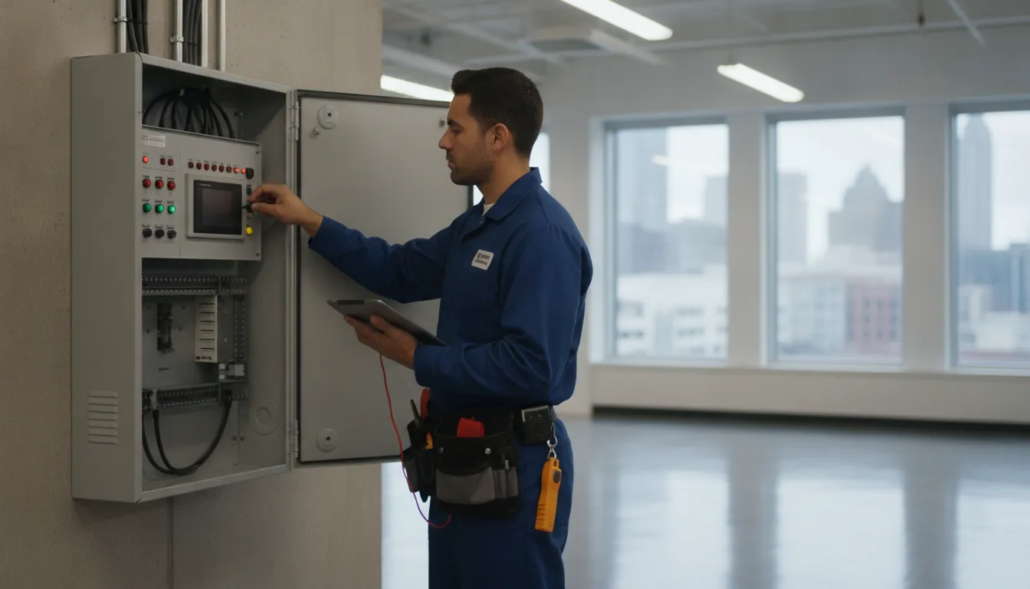
NFPA 72, the National Fire Alarm and Signaling Code, addresses the application, installation, location, performance, inspection, testing, and maintenance of fire alarm and emergency communications systems. It is an important reference for designers, installers, inspectors, facility managers, and authorities having jurisdiction. A system should be evaluated against the requirements that apply to the property, its use, and the adopted code edition.
Compliance is not simply a label added after installation. It begins with the design and continues through installation, commissioning, inspection, testing, maintenance, recordkeeping, and correction of deficiencies. American Alarm’s NFPA fire alarm compliance service explains how those stages can support a documented program.
For additional background, property owners can review American Alarm’s NFPA 72 compliance guidance for Atlanta-area properties. The company can also help coordinate questions involving local review, permits, inspections, and system documentation. Requirements can vary, so a property-specific evaluation remains important.
American Alarm’s technical leadership includes Scott Gilkey, a NICET IV-certified fire alarm engineer and the company’s founder. The company also maintains an unlimited Georgia low-voltage credential and serves Metro Atlanta and North Georgia. These credentials do not replace the authority having jurisdiction, but they provide useful technical experience when a project requires code-aware planning.
NFPA also explains the role of supervising station service in its fire alarm supervision resource. The details of a monitoring arrangement should be confirmed with the system provider and the property’s responsible parties.
How Does Fire Alarm System Woodstock Monitoring Support a Property?
Summary: Fire alarm monitoring transmits qualifying system signals to a supervising station so the appropriate response process can begin. American Alarm helps Woodstock property owners understand monitoring procedures, signal handling, test coordination, and contact maintenance. While emphasizing that monitoring does not replace local notification, inspections, testing, maintenance, or an emergency plan.
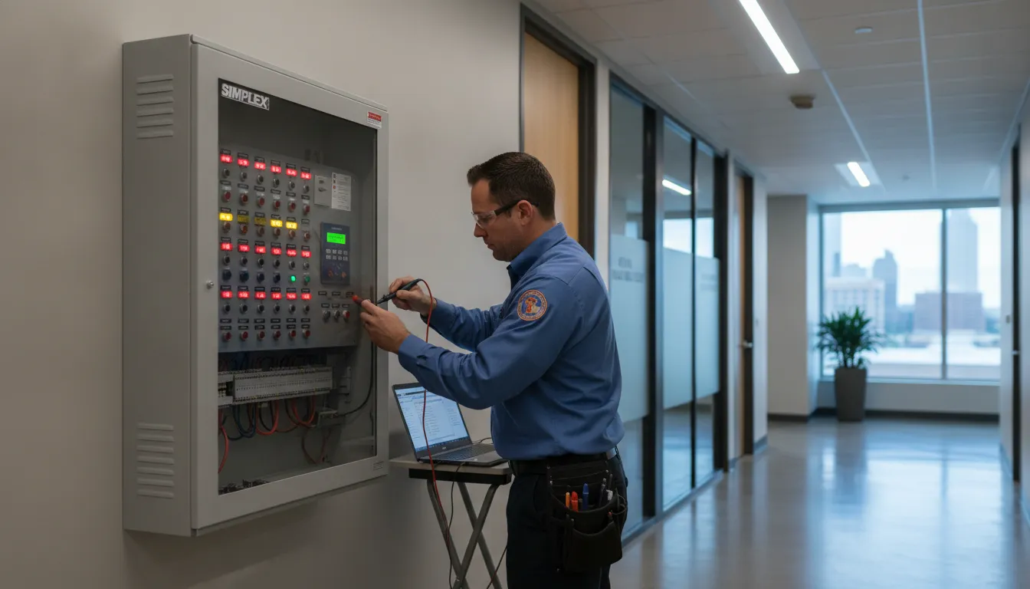
When a monitored fire alarm system detects an alarm condition, the control panel processes the signal and the communications path transmits it to the supervising station. Trained operators follow established account procedures and communicate the signal to the appropriate emergency contacts or response agencies as required by the account and jurisdiction. The exact sequence depends on the system, service arrangement, account instructions, and applicable requirements.
Property owners should ask which signals are monitored, how the communications path is supervised, what happens when a trouble signal occurs, and how contact information is kept current. They should also confirm how testing is coordinated so a test signal is not mistaken for an emergency event. Clear procedures help reduce confusion when a system is placed into test or when a deficiency is found.
American Alarm provides 24/7 UL-certified central station monitoring as part of its broader service offering. A property-specific conversation can clarify whether the existing equipment is compatible, whether a communications upgrade is appropriate, and how the monitoring account would be managed. Monitoring rates and arrangements vary by system and service scope. The company’s alarm monitoring cost guide provides general context for monitoring fees without replacing a property-specific estimate.
Monitoring should be treated as one layer in a broader safety program. Employees and occupants still need appropriate emergency procedures. Facility leaders should keep access information current, maintain clear contacts, and coordinate with the service provider when the building’s use, layout, ownership, or responsible personnel change.
When Should a Woodstock Fire Alarm System Be Tested?
Summary: Inspection, testing, and maintenance are separate but connected activities. The correct schedule depends on the system, property, adopted requirements, and authority having jurisdiction, so Woodstock businesses should use a documented program. American Alarm can help organize testing, records, deficiency follow-up, and restoration-to-service checks without treating an informal calendar as a compliance program.
Inspection generally evaluates whether equipment and conditions appear as expected. Testing uses a defined method to confirm that devices, signals, notification appliances, and related functions operate as intended. Maintenance addresses cleaning, adjustment, repair, replacement, and other work needed to keep the system reliable. These activities work together, but one cannot automatically stand in for the others.
Build a documented inspection and testing program
A program should identify the devices and functions to be reviewed, the people responsible for scheduling, the test procedures, notification steps, deficiencies, corrective actions, and completed records. Some properties require recurring visual inspections, functional testing, sensitivity testing, battery checks, or other evaluations at defined intervals. The applicable schedule should come from the adopted requirements and the property’s system design.
American Alarm’s commercial fire alarm testing frequency guide offers practical context for facility leaders. Its fire alarm testing and inspection guide also explains why the terms should not be treated as interchangeable.
Use records to manage deficiencies
Good records show what was inspected or tested, when it occurred, what was found, and how deficiencies were addressed. They can help facility teams plan repairs, answer questions from insurers or authorities, and recognize repeated trouble conditions. Records are especially useful when a building changes managers or when an older system is evaluated for upgrade or replacement.
Testing should be coordinated with the monitoring provider and the people responsible for the property. Before work begins, confirm the test window, affected zones or functions, contact procedures, and any required notifications. Afterward, confirm that the system has been restored to normal operation and that open deficiencies have an assigned next step.
Call (770) 645-0061 to plan Woodstock fire alarm service or request information from American Alarm.
What Happens During Fire Alarm Installation in Woodstock?
Summary: Professional installation typically moves from site review and design to equipment installation, programming, monitoring coordination, testing, documentation, and customer instruction. American Alarm can support a Woodstock project from evaluation through ongoing service, while helping property leaders understand scope, responsibilities, records, and future maintenance needs.
The first stage is a site review. The provider examines the building’s use, layout, construction, existing equipment, hazards, access, and operational constraints. The design then identifies devices, control equipment, notification, communications, standby power, pathways, and interfaces with related systems. The scope should state what is included, what assumptions were made, and what information the property owner must provide.
During installation, technicians place and connect equipment according to the approved design. Programming and labeling should make it clear which area or device generated a signal. The system is then commissioned and tested to verify the intended functions. Where required, documentation can support plan review, inspection, acceptance, and future service.
Customer instruction is another important step. Staff should understand normal operation, alarm response procedures, trouble indications, test coordination, and whom to contact for service. A system is more useful when responsible people know what the control panel is communicating and how to respond.
Service continues after the initial installation
Fire alarm ownership does not end when the installation is complete. Businesses may need recurring inspections, testing, maintenance, repairs, battery replacement, programming changes, or system expansion. Changes to walls, occupancy, processes, equipment, or emergency contacts can affect the system and should be reviewed with the provider.
American Alarm has provided local alarm service since 1995 and supports major system brands and platforms. Its technicians can help evaluate an existing system, discuss a new installation, or identify practical next steps when equipment is producing trouble signals. A service conversation should distinguish between urgent conditions, routine maintenance, and improvements that can be planned.
How Can Woodstock Businesses Choose a Fire Alarm Provider?
Summary: Woodstock businesses should compare providers on technical qualifications, code knowledge, monitoring, documentation, service responsiveness, and the clarity of the proposed scope. American Alarm combines local service with NICET IV technical leadership and more than 30 years of Metro Atlanta experience. The lowest initial price is not a complete measure of life safety value.
- Ask about design responsibility: Confirm who evaluates the property, prepares the design, coordinates documentation, and answers technical questions.
- Confirm code and jurisdiction experience: Ask how the provider handles NFPA 72, local amendments, plan review, permits, inspections, and acceptance requirements.
- Review monitoring procedures: Understand which signals are transmitted, how tests are coordinated, and how account contacts are maintained.
- Request a service plan: Clarify inspection, testing, maintenance, repair response, documentation, and deficiency correction.
- Check technical credentials: Look for relevant certification, licensing, training, insurance, and experience with systems similar to the one at your property.
- Compare the written scope: Make sure equipment, labor, programming, testing, documentation, training, monitoring coordination, and exclusions are clearly stated.
American Alarm combines local service with technical leadership from a NICET IV-certified founder and more than 30 years of Metro Atlanta experience. The company’s company background and service approach provide additional information for property owners evaluating a local provider.
A consultation should leave the property owner with a clear understanding of the proposed system, project stages, expected documentation, monitoring arrangement, and ongoing responsibilities. If the scope is unclear, ask for clarification before approving work.
- Review the property: Identify occupancy, layout, hazards, existing equipment, and operational constraints.
- Confirm the design: Ask how detection, notification, communications, power, and interfaces are addressed.
- Plan ongoing care: Set expectations for monitoring, inspection, testing, maintenance, records, and service.
Frequently Asked Questions About Fire Alarm Systems in Woodstock
Summary: These answers give Woodstock property owners a concise starting point for evaluating a fire alarm system, monitoring arrangement, testing program, and service provider. American Alarm recommends confirming property-specific requirements, adopted codes, and authority having jurisdiction expectations before selecting equipment or approving work.
How much does a fire alarm system cost in Woodstock?
There is no single price because cost depends on the building, system type, number of devices, communications, interfaces, monitoring, installation conditions, testing, and ongoing service. A site review and written scope are the best way to develop a property-specific estimate.
Do Woodstock businesses need fire alarm monitoring?
Monitoring requirements depend on the property, adopted codes, authority having jurisdiction, insurance requirements, and the system’s intended use. Monitoring can provide a supervised signal path to a supervising station, but it does not replace local notification, inspection, testing, maintenance, or emergency procedures.
What is the difference between inspection and testing?
Inspection generally checks whether equipment and conditions appear as expected. Testing uses defined procedures to confirm that devices and system functions operate properly. Maintenance addresses work needed to keep the system reliable. A complete program may include all three.
Can an existing fire alarm system be serviced or upgraded?
Often, an existing system can be evaluated for service, reprogramming, repair, communications updates, or expansion. The best option depends on equipment condition, compatibility, available parts, the building’s current needs, and applicable requirements. A professional evaluation can identify whether an upgrade or replacement is more practical.
Call (770) 645-0061 to discuss a fire alarm system Woodstock project or contact American Alarm online.


Leave a Reply
Want to join the discussion?Feel free to contribute!