
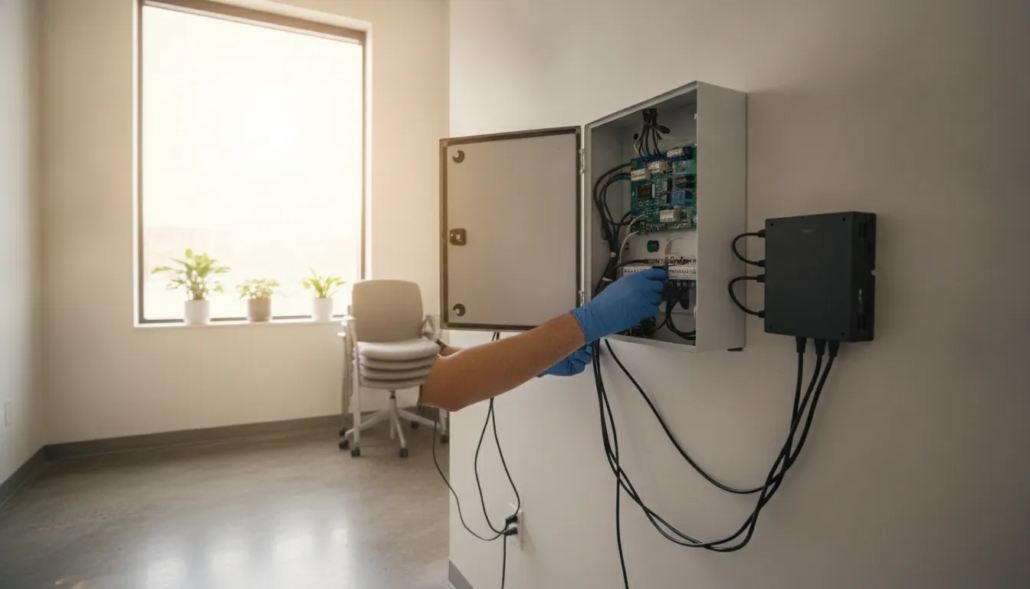
Dual Path Alarm Monitoring Atlanta: Why One Path Fails
A monitored alarm only helps if the signal leaves the building. Dual path alarm monitoring Atlanta businesses rely on uses two different ways to send that signal, so a cut cable, a dead internet circuit, or a jammed cellular radio does not leave the property silent. One path is the normal route. The second path is there for the moment the first one fails.
That second route is not a spare keypad or an extra sensor. It is a separate communication method between the alarm panel and the monitoring center. If both routes share the same wire, the same router, or the same carrier, the backup is weaker than it looks on a proposal.
Ask American Alarm to review your signal paths. Call (770) 645-0061.
What dual path alarm monitoring in Atlanta means
Dual path alarm monitoring means the control panel can reach the monitoring center on two communication paths that do not depend on the same failure. A common pair is an internet communicator plus a cellular communicator. Another pair is two cellular carriers. The useful test is simple: if one path is unplugged or loses service, the other path should still deliver alarm, trouble, and supervisory signals.
A single path can look fine during a walk-through. The panel is powered, the zones are closed, and a test signal arrives. The risk shows up later, when the internet modem is swapped, a construction crew cuts a line, or the cellular account lapses. The building still has sensors. It no longer has a reliable way to ask for help.
Industry guidance treats that backup as a design choice, not a luxury. Security Sales & Integration notes that a second path lets signals continue when a wired connection is cut by construction, damage, or another event outside the alarm company’s control. The same report says the usual pairing is cellular with internet backup, or internet with cellular backup, and that two wired paths should come from different carriers so one provider outage does not take both.
American Alarm has designed, installed, and monitored security and fire alarm systems for Metro Atlanta homes and businesses since 1995. A path review is part of fitting the communicator to the property, not a separate product pitch.
What happens when a commercial alarm has only one path
With one path, the panel and the monitoring center share a single point of failure. Lose that path and new alarm signals stop. The center may not know an event happened until someone on site calls, or until a missed supervision check finally creates a trouble condition.
That gap matters more for a commercial site than for a small home. A warehouse, clinic, retail shop, or office can sit empty for hours. A door contact or motion detector can trip, and the event stays local if the communicator cannot get out. Staff who arrive later see a panel message, not a recorded response.
- Internet only: A router reboot, a provider outage, or an unplugged switch stops the path. Many internet communicators also need building power, so a power cut can drop the path even when the panel battery is still good.
- Cellular only: A weak indoor signal, a suspended radio account, or a damaged antenna stops the path. Cellular does not use the phone jack, but it still needs power at the radio and a working carrier account.
- Phone-line only: A cut or disconnected line stops the path. Traditional phone lines are also a poor fit for many newer phone services, which can garble the tones an older dialer expects.
None of these failures means the sensors are bad. It means the message never left. A second, different path is how the system keeps a way out.
How the second path should behave during an outage
A real second path does three jobs. It carries signals when the primary path is down. It tells the monitoring center that the primary path failed. It tells someone at the premises, usually with a trouble light or message, that service is not whole.
Those jobs are easy to describe and easy to skip in programming. Some panels are set to use the second radio only after several failed tries, with a long delay. Others send a trouble for a total failure but never report that one of the two paths is already down. The operator then treats the account as healthy while half of the design is offline.
For fire alarm communication, NFPA 72 sets the supervision idea in plain terms. Where a single communication path is used, that path is supervised so a failure is annunciated at the supervising station and at the protected premises. The check interval is not more than 60 minutes, unless the authority having jurisdiction requires something stricter. Multiple-path arrangements have their own rules in the same chapter. The point for an owner is not to memorize the section number. It is to ask which rule the designer is following and how a path failure will show up.
Burglar alarm accounts are not automatically held to that fire-alarm rule. A commercial burglary system can still be programmed with a slow or missing supervision check. Ask for the check interval in writing. A path that is only tested when someone remembers to send a manual signal is not supervised.
Two paths that still fail together
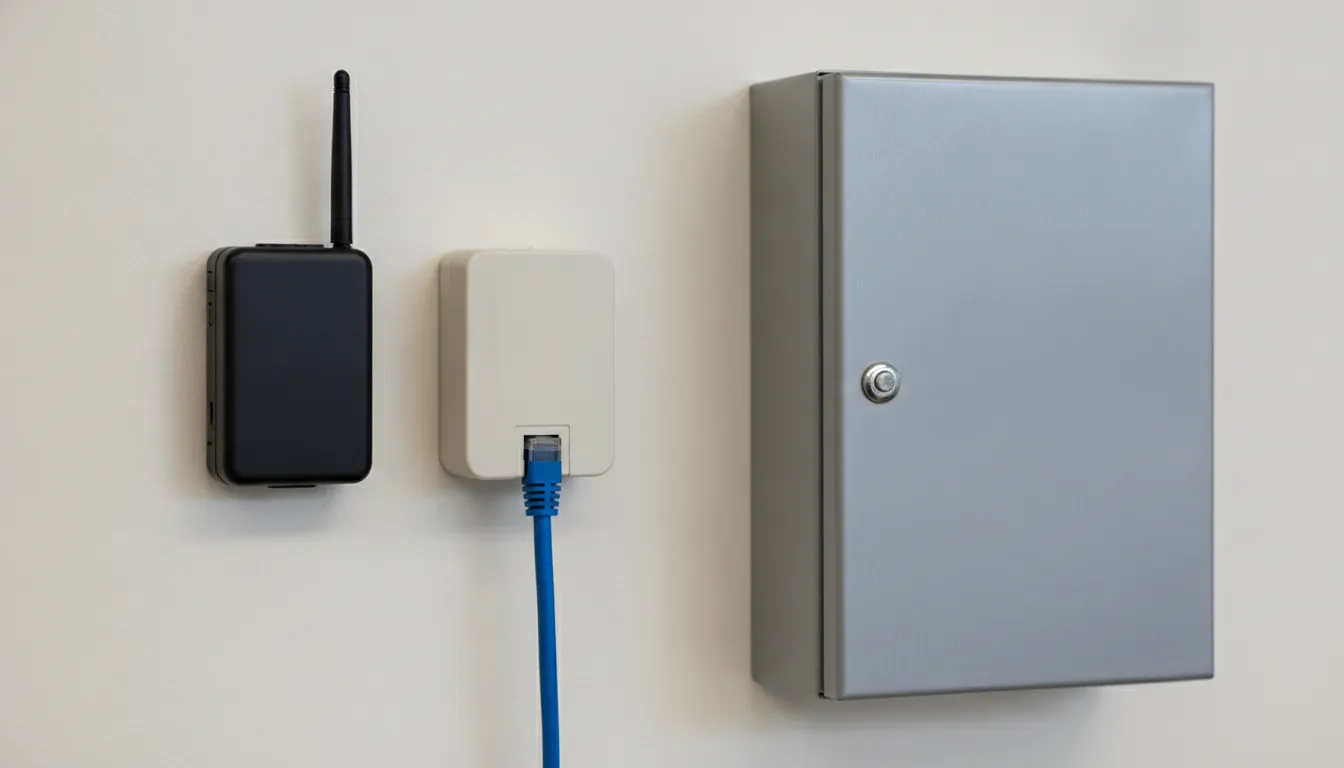
Two devices on the wall do not guarantee two paths. The backup fails with the primary when they share a hidden dependency. Look for these overlaps before you accept a one-line note that says “dual path” on a quote.
| Shared dependency | What still takes both paths down |
|---|---|
| Same carrier | A carrier outage, account hold, or radio shutdown hits both modules. |
| Same router or switch | An unplugged network closet drops every IP communicator on that switch. |
| Same power supply | A dead plug-in transformer or a tripped breaker darkens both radios even if the panel battery is fine. |
| Same antenna location | A weak room, a metal roof, or a moved ceiling tile leaves both cellular radios with poor signal. |
| One account, no failover test | The second path was installed but never programmed as the backup, so an outage produces silence. |
A clean design separates those risks. Cellular and internet use different networks. Each communicator has a listed power source and a battery or panel-backed supply where the equipment requires it. The cellular radio is placed where the signal was measured, not where the panel happened to fit. And the monitoring center has both paths on the account, with a trouble response for each.
Questions to ask before you accept a single path
You do not need a wiring diagram to spot a thin design. Use this sequence on a proposal or a service visit. The answers should name the equipment and the failure behavior, not a brand slogan.
- Name both paths. Which technology is primary, which is secondary, and which carriers or circuits do they use?
- Ask what the center receives if the primary path is unplugged for ten minutes. You want an alarm path that still works and a trouble that says the primary failed.
- Ask what the premises shows. A trouble that only exists at the monitoring center leaves staff walking past a silent failure.
- Ask the supervision interval for each path. For a commercial fire system, confirm the design meets the communication rules the local fire official enforces, including NFPA 72 path supervision where it applies.
- Ask who owns the cellular and internet accounts, who renews them, and who is called if a radio stops checking in.
- Ask for a witnessed test. Unplug or disable the primary path, trip a zone or send a test, confirm the secondary delivery, then restore the primary and confirm the restore signal.
If the proposal cannot answer those items, the second path may be a spare part in a box rather than a working route. That is the moment to pause, not the moment to add more sensors.
A monitoring center that is UL Listed for central-station service is a separate question from the path design. UL 827 is the standard UL Solutions uses for central-station alarm services, and listed stations are audited. Listing tells you the station was evaluated for that service. It does not, by itself, tell you that your building has two working paths. Ask both questions.
How a path review fits an Atlanta property
Metro Atlanta buildings rarely match a stock diagram. Older retail strips still have a phone jack and a consumer router in a back office. Newer warehouses may have one IT closet and a metal roof that weakens indoor cellular signal. A clinic may already have a fire alarm communicator that must stay on its own supervised route, separate from the burglary panel.
Start with the panel you have. A compatible communicator can often be added or swapped without replacing every door contact. That work is a takeover or an upgrade, and it should include a signal test, not only a parts list. If the panel is proprietary or the existing radio is locked to another company’s account, say so early. Hidden account locks are a common reason a “simple backup” turns into a panel replacement.
Then match the path to the risk that actually occurs at the site. A storefront with unreliable internet needs a cellular primary and a real second route, not a second internet device on the same modem. A site with poor indoor signal may need an antenna moved outside or higher, then a measured signal test before the account is called dual path. A property with both burglary and fire should keep those communicators identified, because a fire official may require a supervised fire path even when the burglary account is more flexible.
American Alarm’s technicians handle that site work across the Atlanta area, including communicator changes and panel service. The company is led by Scott Gilkey, who holds NICET Level IV certification in fire alarm systems, and it holds Georgia low-voltage credentials for this work. Those facts support a local service visit. They do not replace the path test.
If you want the broader monitoring relationship, start with security system monitoring in Atlanta. If the panel is already in place and only the reporting path is in doubt, alarm reactivation and monitoring is the service conversation to open. For the fire alarm side of the same building, NFPA fire alarm certificate service covers the life-safety system that may need its own communicator. When the open question is which single method to use, read cellular versus landline alarm monitoring first, then come back to the second-path test. A wider buyer checklist lives in the commercial alarm monitoring guide, and fire-signal handling is covered in commercial fire alarm monitoring.
What this article does not decide for you
Dual path is a communication design. It does not set your monthly monitoring fee, and it does not choose between cellular and landline as the only two products on a menu. A single strong cellular path can be the right primary. The missing piece is what happens when that path stops.
It also does not replace a full monitoring review. Hours of coverage, who gets called, and how a dispatch is verified still belong in the service agreement. Use this article to judge the routes. Use a separate review to judge the response plan and the contract.
Price belongs in a quote after someone sees the panel, the signal strength, and the fire alarm scope. Publishing a commercial monthly number here would describe a different building. If you are comparing what changes a monitoring price, that is a different question from whether the signal can survive one failed route.
Schedule a dual path review with American Alarm. Call (770) 645-0061.
Frequently asked questions
Is dual path alarm monitoring the same as having two sensors?
No. Sensors detect an event at a door, a motion area, or a fire device. Dual path describes how the panel sends that event to the monitoring center. You can have dozens of sensors and still have one communication path.
Does a cellular communicator already count as dual path?
Only if a second, different path is also programmed and tested. One cellular radio is a single path, even when it is more reliable than an old phone line. Dual path needs a second route that survives the failure of the first.
Will I know if one path is down?
You should. A supervised path reports trouble to the monitoring center and should annunciate at the premises. Confirm the interval and ask for a test that takes the primary path offline on purpose. A path that fails quietly is not finished.
Do fire alarm systems and burglar alarms share one communicator?
Sometimes a site has separate communicators, and sometimes a design ties reporting together. Do not assume the burglary radio covers the fire alarm. Fire alarm communication follows the code and the local fire official, and it may require its own supervised path.
Can an existing Atlanta system add a second path?
Often yes, when the panel accepts a compatible communicator and the account can be programmed for both routes. A locked or failing panel may need replacement first. A technician should test signal strength and failover before calling the system dual path.
Have both paths tested at your building
Bring the panel model, any communicator model numbers, and a note about recent internet or phone changes. A short site visit can show whether the second path is real, shared with the first, or missing. American Alarm can test the routes, explain the trouble signals, and quote only the work the panel actually needs.
Schedule a dual path review with American Alarm. Call (770) 645-0061.


Leave a Reply
Want to join the discussion?Feel free to contribute!