Commercial Alarm Systems: A Business Owner’s Guide
The most significant change in modern business security involves Artificial Intelligence and machine learning. These aren’t just buzzwords; they are the brains behind a fundamental shift from reactive alarms to proactive, predictive security. Instead of just sounding an alarm after a window is broken, intelligent systems can now identify and flag threats before an incident occurs. This is the new reality for commercial alarm systems. This guide will break down how these smart technologies work, how they integrate into a single platform, and why they are becoming essential for protecting your Atlanta business now and in the future.
Key Takeaways
- The AI Revolution: Security is shifting from reactive to proactive, with AI and machine learning identifying potential threats before they happen, significantly reducing false alarms.
- Unified Platforms: The future is integrated. Businesses can now manage security systems, cameras, and access control from a single, seamless interface for greater control and efficiency.
- Cloud & Connectivity: Cloud-based systems offer unparalleled accessibility, scalability, and reliability, allowing business owners to manage their security from anywhere, anytime.
- Proactive Protection: Adopting these next-generation technologies is crucial for creating a comprehensive security strategy that protects your assets, employees, and bottom line now and in the future.
The world of commercial security is evolving at a breakneck pace. The traditional “beep-beep” alarm system, once the standard for protection, is quickly becoming a relic of the past. Today’s businesses in Atlanta face more sophisticated threats than ever, from targeted theft and vandalism to complex liability issues and operational inefficiencies. Fortunately, the solutions designed to combat these challenges are evolving even faster. The future is not just about reacting to a break-in; it’s about preventing it from ever happening. This guide will explore the key trends shaping the future of commercial alarm systems. For business owners across Georgia, from a retail shop in Buckhead to a warehouse in Marietta, understanding these innovations is the first step toward making smarter, more effective security decisions and ensuring your business isn’t left vulnerable. As local experts in Atlanta since 1995, we are on the cutting edge of this technology.
The Evolution of Commercial Security in Atlanta
As the business landscape in Atlanta grows and changes, so do the tools we use to protect our livelihoods. We’re moving past the era of alarms that simply react to a problem. The new standard is about proactive, intelligent protection that anticipates issues before they start. This evolution is driven by incredible advancements in technology that make security more effective and easier to manage. For business owners, this means fewer headaches from false alarms and a deeper sense of security, knowing your system is actively working to keep your property safe.
One of the biggest game-changers is the rise of smarter systems that can learn and adapt. Think of it as upgrading from a basic motion detector to a system with virtual intelligence. These modern security systems can distinguish between a stray animal and a genuine threat, drastically cutting down on those disruptive false alarm calls. This shift toward proactive threat identification means your system isn’t just waiting for a window to break; it’s analyzing activity to flag suspicious behavior before an incident occurs, giving you a powerful advantage in protecting your assets.
The future of commercial security is also about integration. Juggling separate systems for alarms, access control, and visual monitoring is inefficient and can leave gaps in your protection. The modern approach brings everything together onto a single, unified platform. Imagine managing every aspect of your building’s security from one simple interface on your computer or phone. This streamlined control makes managing your security effortless and provides a complete, real-time picture of your business, which is one of the core services we help Atlanta businesses implement.
This new level of control is made possible by cloud-based technology. By moving your system’s brain to the cloud, you gain incredible flexibility and reliability. You’re no longer tied to an on-site piece of hardware. You can check on your business, adjust settings, or review alerts from anywhere with an internet connection. This gives you the freedom to manage your business’s protection on your own terms, offering invaluable peace of mind. If you’re curious how these technologies can be tailored for your business, we’re always here to talk through the options.
Common Myths About Business Security
When it comes to protecting your business, what you don’t know can hurt you. A lot of outdated ideas about commercial security are still floating around, and believing them can leave your company exposed. It’s easy to fall into the trap of thinking “it won’t happen to me,” but a proactive mindset is your strongest defense. Let’s clear up a couple of the most common and dangerous myths so you can make informed decisions about safeguarding your livelihood.
Myth: “My small business is not a target.”
This is one of the most pervasive and risky assumptions a business owner can make. The reality is that criminals often view small businesses as easier targets precisely because they might have fewer security measures in place. Whether you run a boutique in Virginia-Highland or an auto shop in Decatur, your assets are valuable. This includes not just your inventory and equipment, but also your employee’s safety and your customer’s data. Thinking your business is too small to attract attention is a gamble that unfortunately doesn’t pay off. Every business deserves professional protection, regardless of its size.
Myth: “Alarms only protect against break-ins.”
While older alarm systems were primarily focused on intrusion, modern security solutions have evolved far beyond that. Today’s integrated systems are powerful tools for overall business management and safety. They can do so much more than just sound an alarm during a burglary. For instance, access control lets you manage and monitor who enters specific areas and when, protecting sensitive information or high-value stock. Meanwhile, advanced systems can also incorporate critical life-safety functions, like NFPA-compliant fire monitoring, to protect your people and property from a wider range of threats. It’s about creating a complete safety net for your entire operation.
Planning Your Business Security Strategy
A solid security strategy isn’t a one-size-fits-all product; it’s a customized plan built around your specific operation. Instead of reacting to an incident after it happens, the goal is to create an environment that deters threats from the start. This requires a thoughtful approach where you identify your vulnerabilities and choose solutions that directly address them. Taking the time to plan ensures you invest in a system that truly serves your needs, providing both peace of mind and a real return on your investment through enhanced safety and operational oversight. Here’s where to begin.
Assessing Your Unique Risks
Before you can choose the right tools, you need to understand what you’re protecting against. Start by walking through your property and thinking like a potential thief. Where are the weak spots? Are there unlit entry points, unmonitored storage areas, or windows that are easily accessible? Next, identify your most critical assets. This could be expensive equipment, cash registers, sensitive client files, or valuable inventory. Finally, consider any industry-specific regulations you must follow, such as those in healthcare or finance. A clear understanding of your risks is the foundation for building an effective security plan. A professional consultation can also help you identify vulnerabilities you might have missed.
Common Businesses We Protect
Every industry in the Atlanta area faces its own set of security challenges, from protecting inventory in a retail store to securing sensitive data in a medical office. A security provider should have experience tailoring solutions for different operational needs. We have a long history of designing and installing comprehensive security services for a diverse range of local businesses, including retail shops, professional offices, restaurants and bars, health and wellness clinics, manufacturing facilities, and automotive repair shops. This experience allows us to recommend the right combination of technologies to address the specific risks your business faces daily.
Getting Professional Quotes and Checking Licenses
Once you have a good grasp of your needs, it’s time to find the right partner. Don’t settle for the first offer you receive. It’s wise to ask at least two or three licensed commercial security companies for a detailed quote. This allows you to compare not just the price, but also the technology offered, the monitoring services, and the level of customer support. Most importantly, ensure any company you consider is fully licensed and insured. This is a non-negotiable mark of professionalism and accountability. A reputable company will be transparent about their credentials and confident in their ability to provide a competitive, effective solution for your business. You can learn more about our commitment to excellence and our long-standing history in Atlanta.
AI-Powered Security: Stopping Threats Before They Start
The most significant change in next-gen commercial security in Atlanta is integrating Artificial Intelligence (AI) and machine learning. These aren’t just buzzwords; they are the brains behind a fundamental shift from reactive alarms to proactive, predictive security Atlanta businesses can rely on. Instead of simply sounding an alarm after a window is broken, intelligent systems can now identify and flag threats before an incident occurs. A primary benefit is a dramatic reduction in false alarms. AI-powered video analytics can intelligently distinguish between a person attempting to scale a fence and a tree branch swaying in the wind. This means your team and local authorities only respond to genuine threats, saving time and potential fines. More importantly, these systems learn your business’s “normal” rhythm. They understand typical activity at your loading dock, in your parking lot, or near a sensitive entryway. When the AI detects an anomaly—like a vehicle loitering near your Alpharetta office after hours—it can trigger a real-time alert, allowing for intervention before committing a crime. This level of behavioral analysis goes beyond simple security, providing insights into everything from slip-and-fall incidents to unauthorized access, making your entire operation smarter and safer. This is why effective 24/7 security monitoring is more potent than ever.
Gain Total Control with a Unified Security System
Gone are the days of juggling separate, siloed systems for your alarms, cameras, and access control. The future is a single, seamless, and unified security ecosystem. This integration creates a powerful force multiplier, where each component works together to provide a level of security and control that standalone systems simply cannot match. This is a core component of modern commercial alarm systems in Atlanta. Imagine this scenario for your business in Sandy Springs: an unauthorized access card is declined at a high-security door. With an integrated platform, this single event can automatically trigger a chain reaction. It can lock down adjacent doors, pivot a nearby IP camera system to focus on the area, and instantly send a live video clip to your smartphone. This seamless operation provides unparalleled situational awareness. The convenience is transformative for business owners in Dunwoody or Johns Creek with multiple locations. You can manage alarms, view cameras, grant access, and even integrate your fire alarms from a single, intuitive app, giving you total control over your entire enterprise. 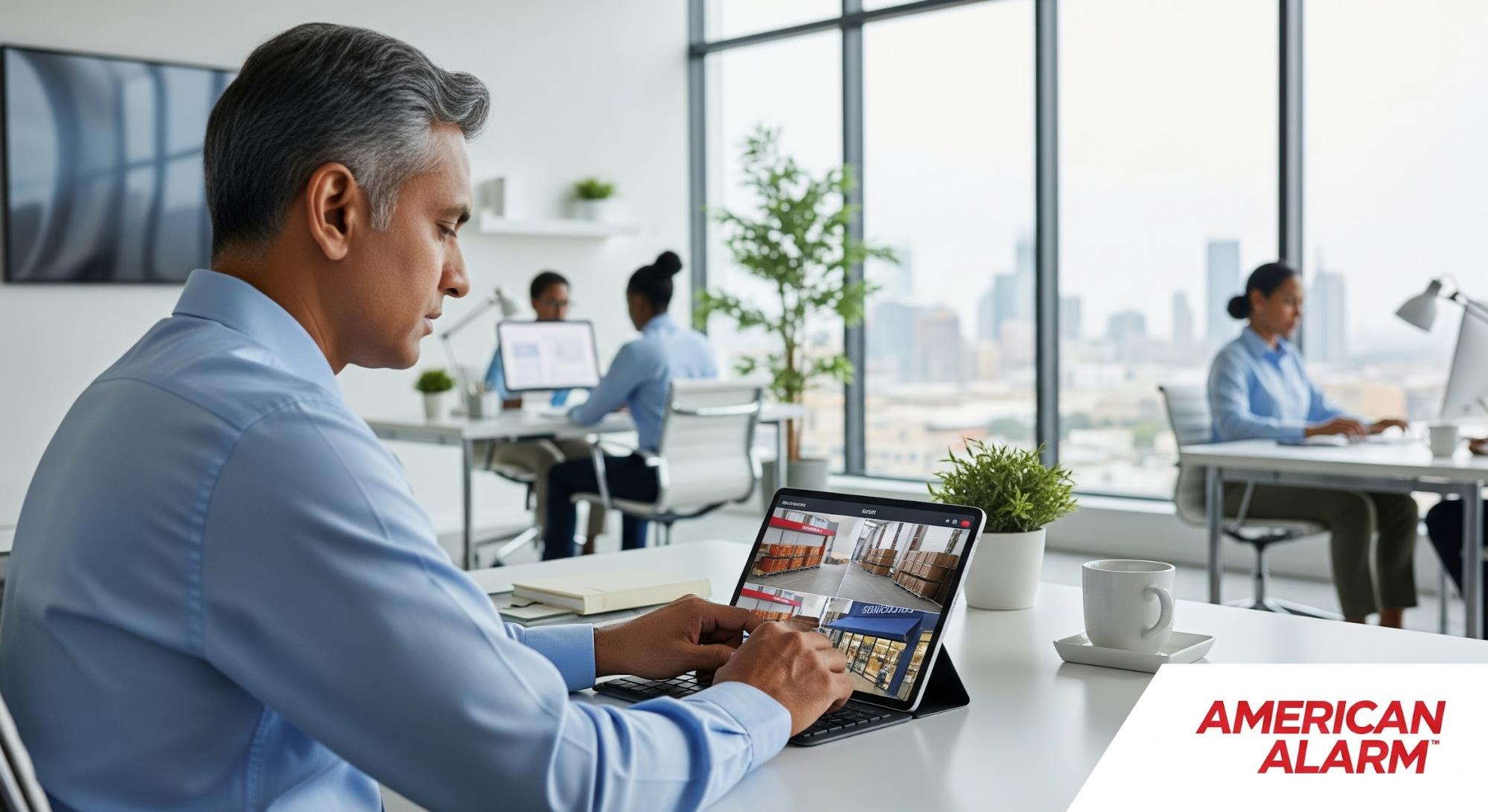
Key Components of a Modern System
The Central Smart Hub
A modern security system revolves around a central smart hub, which acts as the brain of your entire operation. Think of it as your command center. From this intuitive interface, you can arm or disarm your system, view live video feeds, and even communicate with our monitoring center if needed. This consolidation is a game-changer for busy business owners. Instead of managing multiple devices, you have one streamlined point of control that simplifies your daily security routine. Whether you’re on-site at your Roswell business or checking in remotely, the hub provides the information and control you need right at your fingertips, making comprehensive protection feel effortless.
Specialized Sensors for Business
While the hub is the brain, high-quality sensors are the nervous system, detecting activity throughout your property. Every effective system relies on a network of specialized sensors, including those for doors and windows, as well as advanced motion detectors. However, simply having these devices isn’t enough; their placement is critical. A professional installation ensures that every vulnerable point is covered without creating frustrating false alarms. Our technicians understand how to assess a building’s unique layout, from a storefront in Decatur to a large warehouse, ensuring sensors are positioned for optimal performance. This expert setup is a crucial part of our security services and makes all the difference in creating a reliable system.
Smart Locks and Access Control
Controlling who can enter your facility—and when—is fundamental to business security. This is where smart locks and access control come in. These systems replace traditional keys with electronic credentials like key cards, fobs, or even smartphone apps. You can grant or revoke access instantly and assign unique codes to employees to track who comes and goes. This gives you granular control, allowing you to restrict entry to sensitive areas like server rooms or inventory storage after hours. For any Atlanta business, an access control system is more than a security feature; it’s an operational tool that protects your most valuable assets and provides a clear record of activity on your premises.
Why Your Next Commercial Alarm System Should Be in the Cloud
Connectivity is the backbone of modern security, and the move to cloud-based platforms is revolutionizing how businesses protect their facilities. The cloud offers innovative alarm technology for business owners by untethering security management from a back-office computer. With a cloud-based system, you can access and control every aspect of your security from anywhere in the world with an internet connection. This provides ultimate accessibility and enhanced reliability. Cloud storage for video surveillance eliminates the risk of a thief destroying or stealing the on-site recorder, ensuring your evidence is always safe and secure. For a business in a rapidly growing area like Cumming or Peachtree City, scalability is effortless. Adding more cameras, doors with access control, or even new locations to your network is simple and cost-effective. Looking ahead, the expansion of 5G cellular technology will further enhance these capabilities, allowing for faster, higher-quality video transmission and making real-time security system monitoring more robust and dependable than ever before.
Ensuring Uptime with Backup Systems
A modern security system is only as strong as its weakest link. For many businesses, that weak link is a single point of failure: the power cord or the internet connection. A simple power outage, a construction crew accidentally cutting a line, or even a deliberate act of sabotage could render your entire security system useless. That’s why ensuring uptime with redundant backup systems isn’t just a feature; it’s a fundamental requirement for true commercial protection. A system that goes dark when the lights go out is no system at all. True security means having a plan for the unexpected, ensuring your system stays online and communicates alerts no matter what external conditions arise.
Cellular and Battery Backup
The one-two punch against system failure is a combination of battery and cellular backup. Think of the battery backup as your system’s immediate lifeline. When your building loses power, the battery instantly kicks in, keeping your control panel, sensors, and other essential components fully operational. However, a power outage often takes the internet router with it. This is where cellular backup becomes critical. It creates a separate, wireless communication channel, allowing your system to continue sending signals to the professional monitoring center over a secure cellular network. This dual-layer protection ensures that even if your power is out and your internet is down, your alarm system remains vigilant and ready to call for help.
Professional Monitoring vs. Self-Monitoring
Once you have a robust system in place, you face a critical decision: who responds when an alarm is triggered? The choice between professional and self-monitoring will define your day-to-day experience and the ultimate effectiveness of your security investment. Self-monitoring places the entire burden of response on you or your staff. Every alert, whether a genuine emergency or a false alarm, comes directly to your phone. While this may seem empowering, it requires you to be available and responsive 24/7/365. Professional monitoring, on the other hand, outsources that responsibility to a dedicated team of trained experts whose sole job is to watch over your business.
A professional team is always watching your alarms, ready to act at a moment’s notice. This constant vigilance provides a level of security and peace of mind that self-monitoring simply cannot match. When you partner with a professional monitoring service, you’re not just getting alerts; you’re getting an immediate, expert response. This team can verify the nature of the threat, filter out false alarms, and dispatch the appropriate emergency services—police, fire, or medical—according to established protocols. This ensures the fastest, most effective response possible, protecting your assets and your people without pulling you away from running your business.
The Role of a Professional Monitoring Center
A professional monitoring center is far more than a simple call center. It’s a high-tech command hub staffed by highly trained operators who specialize in emergency response. When your alarm signal is received, an operator immediately begins a verification process to assess the situation. For businesses in Atlanta, this can involve calling a list of contacts or, with advanced systems, using visual verification to confirm a threat. This process is crucial for ensuring a priority response from law enforcement, as verified alarms are treated with much greater urgency. These centers operate with multiple redundancies for power and communication, ensuring they are always online to protect your business, even during widespread outages or natural disasters.
The Limitations of Self-Monitoring
While the idea of getting alerts directly on your phone sounds appealing, the reality of self-monitoring for a business is fraught with risk. What happens if an alarm is triggered while you’re on a flight, in a meeting with poor cell service, or simply asleep? A missed notification could mean a significant delay in response, giving intruders more time and potentially leading to greater losses. Furthermore, self-monitoring puts you in the position of having to interpret every alert. Is that motion sensor alert a break-in or just an employee who forgot to disarm the system? This can lead to “alarm fatigue,” where constant, non-critical notifications cause you to ignore a real emergency, and it doesn’t provide the verified dispatch that police departments prioritize.
Understanding the Costs of a Commercial Alarm System
Determining the cost of a commercial alarm system can feel complicated, but it doesn’t have to be. It’s important to recognize that the first price you get often doesn’t cover everything. Many costs can be hidden or not included upfront, so it’s essential to understand the full financial picture before signing a contract. The total cost can be broken down into two main categories: the initial investment for hardware and installation, and the ongoing costs for monitoring and maintenance. By looking at both, you can create a realistic budget and find a solution that provides real value and protection for your business without any surprises down the road.
Initial Investment: Hardware and Installation
Your initial investment covers the physical components of your system and the professional labor to install them correctly. For a small business, the cost for basic equipment—like a control panel, door/window sensors, and motion detectors—and professional installation can range from $500 to $2,000. More complex systems for larger facilities in places like Roswell or Alpharetta, incorporating extensive video surveillance or access control, will naturally have a higher upfront cost. While it may be tempting to cut corners here, remember that this is a long-term investment in the security and stability of your business. Proper installation by trained technicians is critical to ensure every component works flawlessly from day one.
Ongoing Costs: Monitoring and Maintenance
After the initial setup, your primary recurring expense will be the monthly monitoring fee. This fee keeps your business connected to the 24/7 professional monitoring center. Standard monitoring services typically range from $40 to $75 per month. This is the service that ensures a trained professional is ready to respond to any alarm signal from your property. For businesses looking for an even higher level of security, video-verified monitoring is an option that can provide faster, more accurate emergency dispatch. These ongoing fees are what transform your collection of hardware into a living, breathing security solution that actively protects your business around the clock.
Standard vs. Video-Verified Monitoring
When choosing a monitoring plan, you’ll likely encounter two main types: standard and video-verified. Standard monitoring relies on signals from your sensors (door contacts, motion detectors) to trigger an alarm. Video-verified monitoring, which typically costs between $70 and $120 per month, integrates your visual surveillance devices. When an alarm is triggered, the monitoring center operator can immediately view video clips of the event. This allows them to confirm a real intrusion, providing police with verified, in-progress crime information that often results in a much faster dispatch. This verification also dramatically reduces the chances of fines from false alarms, making it a smart investment for many businesses.
Other Potential Expenses
Beyond hardware and monitoring, a few other potential expenses are important to factor into your budget. These often-overlooked costs can include municipal permits, potential fines for false alarms, and fees for service calls or maintenance. Understanding these possibilities from the start helps you get a complete and accurate picture of the total cost of ownership for your commercial security system. A transparent security partner will discuss these potential costs with you upfront, ensuring there are no surprises later on. This is a key part of the comprehensive service we believe every business deserves.
Permits and False Alarm Fines
Most cities and counties in the metro Atlanta area require businesses to obtain and maintain an alarm permit. This is a legal requirement, and failure to register your system can lead to significant fines, or even a refusal by police to respond to an alarm. These permits typically need to be renewed annually for a small fee. Additionally, most municipalities have ordinances that levy fines for excessive false alarms. A professionally installed and monitored system with features like video verification can drastically reduce the likelihood of false alarms, saving you money and maintaining a good relationship with local law enforcement.
Service Call Fees
Like any technology, your security system may occasionally require maintenance or repairs. It’s important to understand your security provider’s policy on service calls. Some companies include a certain level of maintenance in their monthly fee, while others charge a separate fee for each visit. Ask about the costs for routine check-ups, battery replacements, or troubleshooting potential issues. A clear service agreement will outline these costs, so you know exactly what to expect if you ever need a technician to visit your facility. This is an important part of the long-term partnership with your security provider.
Comparing System Costs to On-Site Guards
When evaluating the cost of a professional alarm system, it’s helpful to compare it to the alternative: hiring on-site guards. While guards can provide a physical presence, the cost is often prohibitive for most businesses. A single, round-the-clock security guard can cost between $3,000 and $5,000 per month, or even more. In contrast, a top-tier professional monitoring plan, even with video verification, costs only a small fraction of that. For the price of one guard, a business can implement a comprehensive, integrated security system that covers every door, window, and critical area of the facility 24/7, offering a far more scalable and cost-effective solution for protecting your assets.
A Look at the Security Provider Landscape
When you start searching for a commercial security system, you’ll quickly find that there are many different types of providers to choose from. The options can range from massive national brands with household names to smaller, specialized local experts. You’ll also encounter companies that focus almost exclusively on user-installed systems or video surveillance technology. Each type of provider has its own set of strengths and weaknesses, and the best fit for your business will depend on your specific needs, budget, and comfort level with technology. Understanding this landscape is the first step toward making an informed choice and finding a partner you can trust to protect your business.
National Brands
You’ve seen their commercials and recognize their logos. Large, national security companies offer widespread brand recognition and standardized packages. They often have massive call centers and can offer service across the country, which might be appealing for businesses with multiple locations in different states. However, this scale can sometimes come at a cost. You may find yourself dealing with a different person every time you call, and the technicians who service your system may not have an in-depth understanding of local codes and conditions in the Atlanta area. The one-size-fits-all approach may not be the best fit for a business with unique security challenges.
Flexible, User-Installed Options
A growing segment of the market consists of systems designed for self-setup. These providers typically ship you a box of equipment and guide you through the installation process via an app. The main appeal is a lower upfront cost and the flexibility to set up the system on your own schedule. While this can be a viable option for very small, simple applications, it places the responsibility for correct placement, setup, and maintenance squarely on the business owner. For a commercial environment with complex needs, liability concerns, and the necessity for flawless operation, relying on a self-installed system can introduce significant risks that may outweigh the initial savings.
Video-Focused Systems
Some companies specialize almost exclusively in video surveillance technology. They offer advanced imaging devices, powerful analytics, and sophisticated software for managing and reviewing footage. These systems are excellent for businesses where visual evidence and monitoring are the top priorities, such as retail stores concerned with shoplifting or warehouses tracking inventory. However, a system that only provides visual information is an incomplete security solution. Without integration into a monitored alarm system with sensors and professional dispatch capabilities, it remains a passive recording tool rather than an active deterrent and response system. True security comes from integrating these powerful visual tools into a comprehensive alarm and access control platform.
The Value of a Local Atlanta Expert
For businesses in the metro Atlanta area, partnering with a local security expert offers distinct advantages. A local provider, like American Alarm, has a deep understanding of the specific security challenges and regulatory requirements in communities from Marietta to Decatur. We know the local permitting processes and have established relationships with first responders. When you call for service, you’re speaking with a neighbor who is invested in the community, not a remote call center agent. We provide personalized consultations to design a system that truly fits your business, blending the latest technology with hands-on, reliable service. Choosing a local expert means choosing a long-term security partner dedicated to protecting your Atlanta business. If you’re ready to discuss your needs, we encourage you to contact us today.
Is Your Atlanta Business Ready for the Future of Security?
What do these advanced trends mean for your Georgia business? They represent an opportunity to build a security posture that is prepared for today’s threats and tomorrow’s challenges. Protecting your business from being vulnerable at night requires more than a loud bell. It requires an intelligent, integrated, and accessible solution. While preparing for these future advancements is crucial, it all starts with a robust strategy for protecting your Atlanta business today. The foundational principles of verified alarms and professional monitoring are the bedrock upon which these future technologies are built. An NFPA compliant fire alarm system and a reliable burglar alarm are non-negotiable. At American Alarm, we are committed to serving businesses all over Georgia, from Conyers to Kennesaw. We provide customized solutions that blend today’s best technology with a clear vision for the future, ensuring your investment in security is sound and scalable. Is your business’s security system ready for the future? Don’t wait for an incident to find out. The future of security is smart, proactive, and fully connected. Contact our team today for a free, no-obligation consultation. We’ll help you assess your current system and design a solution that protects your Atlanta-area business now and for years to come. 
FAQs
What is predictive security? Predictive security uses Artificial Intelligence (AI) to analyze data from cameras and sensors to identify unusual or threatening behavior before an incident like a break-in occurs. It learns the normal patterns of your business and alerts you to anomalies, shifting security from a reactive to a proactive model. How can an integrated system benefit my Atlanta business? An integrated system combines your alarm system, cameras, and access control into one manageable platform. This enhances security by allowing these components to work together (e.g., a bad card swipe triggers a camera), simplifies management through a single app, and provides greater overall control and operational efficiency. Is a cloud-based security system secure? Yes, reputable cloud-based security systems use advanced encryption and security protocols to protect your data. Storing video footage in the cloud is often more secure than an on-site recorder, as it cannot be physically stolen or damaged by an intruder or a fire, ensuring your critical evidence is preserved. Why is professional monitoring still important with AI technology? While AI drastically reduces false alarms, professional monitoring provides the essential human element. Trained professionals can verify AI-flagged events, dispatch emergency services immediately when necessary, and manage situations requiring human judgment, ensuring the fastest and most appropriate response to a real threat.


Leave a Reply
Want to join the discussion?Feel free to contribute!