

Your Guide to a Commercial Security Camera System
If you were building a house, you wouldn’t use the same tool for every single task. The same logic applies to protecting a large commercial facility. Securing a sprawling property requires a carefully selected toolkit of specialized surveillance technologies, not a one-size-fits-all solution. From wide-angle units covering your warehouse floor to long-range models monitoring your perimeter, each piece of hardware has a specific job. Just as important is the blueprint—the strategic placement that ensures every critical area is covered without any gaps. This guide breaks down the essential tools and design principles for building a layered and effective security camera system for your business.
Key Takeaways
- Large commercial properties require professional-grade, custom-designed security camera systems, not DIY solutions.
- Key camera types include PTZ, wide-angle, and long-range, strategically placed for comprehensive perimeter and interior coverage.
- High-resolution (4K), advanced night vision, and robust video management are crucial for effective surveillance of expansive areas.
- Seamless integration with commercial alarms and access control, along with professional 24/7 monitoring, maximizes security effectiveness.
- Scalability and local expertise ensure your system meets current needs and future expansion for properties across Atlanta and North Georgia.
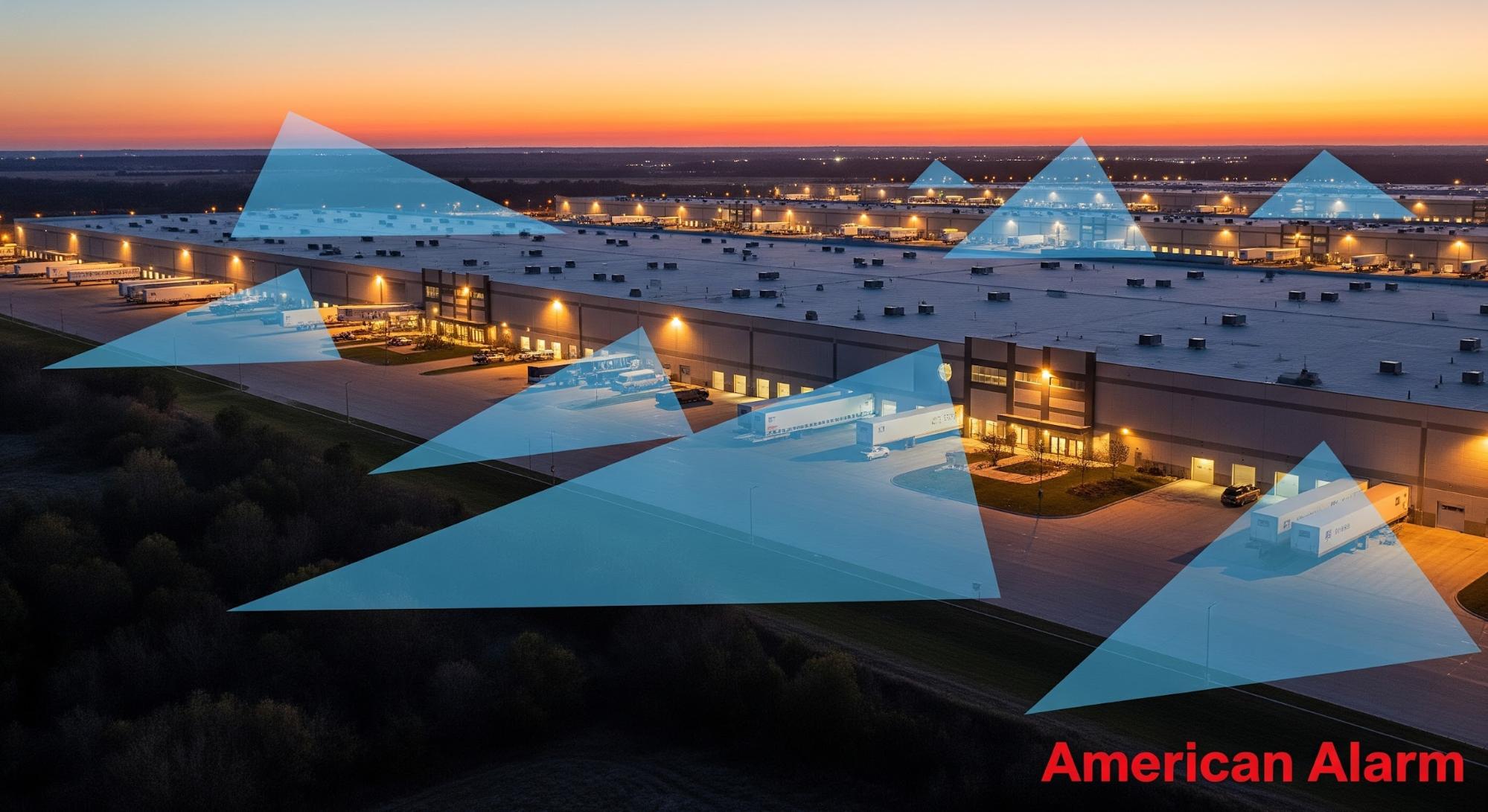
What Counts as a Large Commercial Property in Atlanta?
When we talk about commercial security camera systems for large properties, we’re referring to much more than a typical storefront or small office. In the context of Atlanta and North Georgia, a “large property” presents unique and complex security challenges that demand a specialized approach. These are not environments where a handful of cameras will suffice; they require a meticulously planned surveillance infrastructure.
From Warehouses to Corporate Campuses
The Atlanta metro area is a hub for commerce and industry, hosting a diverse range of large-scale facilities. These include sprawling corporate campuses in Alpharetta and Johns Creek, vast warehouses and distribution centers in Norcross and Peachtree Corners, and large-scale manufacturing plants in Marietta and Kennesaw. We also design systems for multi-building retail complexes, logistics hubs, and expansive industrial parks that are common throughout the region. Each of these properties has a significant footprint, multiple access points, and high-value assets that need protection.
Why Securing a Large Property is So Complex
Securing a large property involves more than just covering a lot of ground. The primary challenges include managing extensive perimeters, monitoring hundreds or thousands of daily movements from employees and vehicles, and protecting assets across multiple buildings or vast open spaces like parking lots. Blind spots are a major liability, and environmental factors like weather, lighting changes, and landscaping can compromise visibility. A professional video surveillance for businesses plan must account for all these variables to be effective.
CCTV vs. Security Systems: Understanding the Terms
When you start looking into video surveillance, you’ll quickly run into two terms: CCTV and security systems. While people often use them interchangeably, they aren’t quite the same thing, especially when we’re talking about protecting a large commercial property. Understanding the difference is the first step in choosing the right solution for your business. One is a more traditional, closed-off technology, while the other represents the connected, flexible approach needed for modern business security. Knowing which is which helps clarify what you need and what you should expect from a professional installation.
What is a Closed-Circuit Television (CCTV) System?
Think of CCTV as a private television station just for your property. The name says it all: “closed-circuit” means the video signal is not broadcast publicly. As security experts at Pelco explain, a CCTV setup sends footage to a specific, limited group of monitors. Traditionally, these systems were hard-wired and self-contained, with video feeds running directly from the recording devices to a central viewing station. This made them reliable and secure from outside tampering, but also limited in terms of remote access and integration with other technologies. They are a foundational technology in surveillance, but modern solutions have expanded far beyond this original concept.
How Modern Security Systems Differ
Today’s commercial security systems are a major evolution from traditional CCTV. Instead of a closed loop, these are networked systems that connect to the internet, allowing you to view live and recorded footage from anywhere on a smartphone or computer. This connectivity opens up a world of possibilities, including smart alerts for motion detection and seamless integration with commercial alarm systems and access control. While some consumer-grade products are designed for self-setup, a true commercial-grade system is professionally designed and installed to ensure there are no weak points, providing reliable coverage and features tailored to your business operations.
More Than Just Security: Operational Benefits of Surveillance
A well-designed video surveillance system does more than just catch intruders after the fact. For a large commercial property, it’s a powerful operational tool that provides valuable insights and helps you run your business more effectively. By giving you a clear view of your day-to-day activities, it can help you identify inefficiencies, enforce safety protocols, and protect your company from liability. This shifts the role of surveillance from a purely reactive security measure to a proactive management asset that contributes directly to your bottom line and the overall health of your organization.
Monitoring Daily Operations
Having eyes on your entire property helps you do more than just deter crime. As security specialists at Ajax Systems note, surveillance helps you “watch over your property… and react quickly to problems.” For a large facility, this could mean monitoring shipping and receiving docks to verify deliveries, observing production lines to ensure quality control, or confirming that employees are following safety procedures in a warehouse. This visual record can be invaluable for resolving operational disputes and identifying opportunities to streamline workflows, ultimately making your business more efficient and accountable.
Enhancing Employee Safety
A secure workplace is a productive workplace. The visible presence of surveillance equipment can make employees feel safer and less worried, creating a more positive environment. It acts as a deterrent against misconduct and provides an unbiased record if an incident, such as an accident or dispute, occurs. This footage is crucial for investigating what happened, protecting honest employees, and ensuring that safety claims are handled fairly. By fostering a culture of safety and accountability, a professional surveillance system becomes an essential part of your commitment to your team’s well-being.
Why Off-the-Shelf Security Fails on Large Properties
For facilities with significant assets and complex layouts, off-the-shelf or DIY security cameras are not just inadequate; they create a false sense of security. These consumer-grade products lack the durability, range, and advanced features needed for commercial applications. They often fail in challenging weather, provide poor image quality over long distances, and lack the robust data management and integration capabilities required for a true security solution. A professionally designed and installed system from experts who understand the Atlanta commercial landscape is essential. These systems are built with enterprise-grade hardware designed for 24/7 operation in demanding environments. More importantly, the system’s design and installation are tailored to your property’s specific vulnerabilities, ensuring complete and reliable coverage. This is a cornerstone of the American Alarm approach, and it’s why choose American Alarm is the right decision for protecting your investment.
The Power of Deterrence: A Statistical Look
One of the most significant advantages of a professional security installation is its ability to prevent incidents before they even start. It’s not just about capturing footage; it’s about sending a clear message to potential intruders. Research backs this up, with studies showing that a staggering 60% of burglars will actively avoid properties with visible video security systems. The simple presence of strategically placed surveillance equipment makes your facility a much harder target, encouraging criminals to move on to an easier opportunity. This proactive defense is a fundamental component of any effective commercial video surveillance strategy, turning your property from a potential target into a visibly protected fortress.
Building Your Surveillance Toolkit
A successful surveillance strategy for a large property uses a mix of specialized cameras, each chosen for a specific purpose. There is no one-size-fits-all camera; instead, a blend of technologies creates a layered and comprehensive security posture.
Stationary Surveillance: Your Foundational Layer
Fixed cameras are the workhorses of any system. Pointed at a specific location, they provide constant, unwavering surveillance of critical areas like building entrances, loading docks, sensitive storage areas, and key access gates. Their visible presence also acts as a powerful deterrent to potential intruders.
Wide-Angle Vision for Expansive Areas
For large open areas such as warehouses, production floors, or parking lots, wide-angle and panoramic cameras are incredibly efficient. A single panoramic camera can often cover an area that would otherwise require three or four fixed cameras, reducing hardware costs and simplifying monitoring while eliminating blind spots.
Fisheye Lenses
For truly massive open areas, fisheye lenses offer an incredible advantage. This specialized imaging technology uses a unique lens to capture an extremely wide field of view, often covering a full 180 or even 360 degrees in a single image. Think about the floor of a large warehouse or an expansive retail space—one fisheye unit can often provide complete coverage where you might otherwise need several traditional surveillance devices. This approach helps eliminate blind spots and can also simplify your overall system and reduce hardware costs. Security experts at Pelco confirm that these systems cover a lot of ground with fewer units, making them both discreet and easier to maintain. While the raw image can look a bit distorted, modern software corrects this for clear viewing, making them a powerful tool in a custom surveillance plan.
Active Tracking with Pan-Tilt-Zoom Technology
PTZ cameras are vital for active surveillance of large perimeters and open spaces. They allow security personnel to scan wide areas, zoom in with incredible detail to identify suspicious individuals or read license plates, and track moving targets. This dynamic capability is crucial for real-time incident response and investigation.
Seeing Further with Long-Range and Thermal Imaging
For the most expansive perimeters or properties in rural North Georgia, long-range and thermal cameras provide unmatched surveillance capabilities. Long-range cameras can identify threats from hundreds of yards away, while thermal cameras detect heat signatures, making them effective in complete darkness, fog, or through foliage where traditional analytic security cameras might struggle.
Choosing the Right Tool for the Job: Common Form Factors
Beyond the internal technology, the physical shape of a surveillance unit—its form factor—plays a critical role in its function. The design isn’t just about aesthetics; it determines how the unit can be mounted, how visible it is, and what kind of coverage it provides. Selecting the right mix of form factors is a key part of a custom surveillance plan. For large commercial properties, the most common and effective types are dome, bullet, and turret models. Each offers distinct advantages that a professional installer will leverage to maximize coverage and deterrence across your property.
Dome Models
Dome models are easily recognized by their circular, dome-shaped housing. Their primary advantage is discretion. Because the lens is protected behind a tinted cover, it’s difficult for onlookers to tell exactly where the unit is pointing. This ambiguity is a powerful psychological deterrent, as potential wrongdoers can’t be sure if they are being watched. Domes are ideal for indoor locations like office lobbies, retail showrooms, and warehouses where you want wide-angle coverage without an obtrusive device. Many models offer a full 360-degree view, allowing one unit to monitor an entire room effectively.
Bullet Models
Bullet models are long, cylindrical, and highly visible, resembling the shape of a rifle shell. Unlike the subtle dome, a bullet unit is meant to be seen. Its conspicuous design sends a clear message that the area is under surveillance, making it an excellent deterrent for outdoor applications. These are perfect for monitoring long, specific sightlines such as fence perimeters, loading docks, and the main entrances to parking lots. Their robust construction and built-in sun shields make them particularly well-suited for handling the elements and providing clear images over significant distances, day or night.
Turret Models
Turret models, sometimes called eyeball models, offer a smart blend of the best features from both dome and bullet designs. They have a ball-and-socket construction that allows for incredible flexibility in aiming the lens, making installation precise and straightforward. While still relatively discreet like a dome, the lens is not housed behind a tinted cover, which helps avoid issues with glare from infrared lights at night. This makes them a versatile choice for both indoor and outdoor use, providing high-quality imaging in a compact and adaptable form factor.
Specialized Functions for Specific Needs
A truly effective surveillance system goes beyond standard video capture. For large commercial properties, specialized technologies are often necessary to address unique security challenges. These advanced features turn a passive monitoring system into an active security tool that can provide detailed, actionable information. Functions like varifocal lenses allow for dynamic viewing, while License Plate Recognition (LPR) provides critical data for access control and investigations. Integrating these capabilities ensures your system is tailored to the specific risks and operational needs of your Atlanta-area facility.
Varifocal Lenses for Flexible Focus
Unlike fixed-lens models that have a set field of view, units with varifocal lenses allow you to manually or remotely adjust the zoom and focus. This means you can fine-tune the viewing area with precision after installation. For example, you can install a unit to get a general overview of a room and then zoom in to get a crystal-clear view of a cash register, a sensitive entryway, or a specific piece of equipment without losing image quality. This flexibility is invaluable for capturing specific details in critical zones, ensuring you get the evidence you need when it matters most.
License Plate Recognition (LPR)
License Plate Recognition (LPR) systems are a game-changer for any property with significant vehicle traffic. These specialized units use advanced software to automatically capture and record the license plate numbers of vehicles entering or leaving your premises. This technology is essential for monitoring parking lots, managing access at security gates, and tracking vendor or employee vehicles. The data collected can be invaluable for investigating incidents and can be integrated with access control systems to automate entry for authorized vehicles, streamlining operations while strengthening security.
Built to Last: The Difference Between Indoor and Outdoor Models
Not all surveillance equipment is created equal, and nowhere is this more apparent than in the distinction between indoor and outdoor models. Placing a unit designed for a climate-controlled office out in a Georgia summer is a recipe for failure. Outdoor models are specifically engineered to withstand harsh conditions, from torrential rain and high humidity to extreme temperatures and direct sunlight. They are housed in durable, weatherproof casings (often with an IP rating indicating their resistance to dust and water) to protect the sensitive electronics inside. Indoor models, by contrast, are typically smaller and more focused on aesthetics, as they don’t require the same level of rugged protection. Using the right systems and products for each environment is fundamental to the longevity and reliability of your entire security infrastructure.
A Blueprint for Flawless Surveillance Placement
The effectiveness of a camera system is determined as much by its design as by the hardware itself. Professional placement is critical to eliminating blind spots and maximizing the utility of every camera. This requires a thorough on-site assessment to map out a strategy that covers all key zones.
Start at the Edge: Securing Your Property Line
Your property line is your first defense. Cameras should be positioned to monitor fence lines, gates, and all potential entry points. This creates a virtual perimeter that can detect intruders before they ever reach a building.
Keeping an Eye on Every Door and Gate
Every door, loading bay, and access gate must be under surveillance. Integrating these cameras with Access Control Systems Atlanta allows you to visually verify every person and vehicle entering or leaving your facility, creating a detailed record of all activity.
How to Secure High-Risk Parking Areas
Parking lots are high-risk areas. Comprehensive camera coverage helps deter vehicle break-ins and vandalism while providing crucial evidence in the event of an accident or incident. PTZ and wide-angle cameras are especially effective in these large, open environments.
Protecting Your Assets on the Inside
Inside your facility, cameras should monitor high-value inventory, sensitive equipment, and common areas. This not only protects against external threats but also helps mitigate internal theft and ensures employee safety.
Does Your System’s Design Fit Its Surroundings?
A property in a dense urban area like Buckhead faces different challenges than a sprawling facility in a more remote part of North Georgia. Our designs consider local crime patterns, lighting conditions, and environmental factors to create a truly customized and effective surveillance plan.
Why Image Clarity is Crucial, Day or Night
For large properties, clarity is key. High-resolution video is non-negotiable for identifying critical details like faces, clothing, or license plates from a distance. While 1080p is a baseline, 4K resolution provides superior detail, which can be the difference-maker during an investigation. Equally important is night vision. Advanced infrared (IR) technology allows cameras to see clearly in complete darkness, ensuring your property is protected around the clock.
Wired vs. Wireless: Choosing the Right Connection
When designing a surveillance system for a large property, one of the most fundamental decisions is how your video devices will connect to the network. The choice between a wired or wireless infrastructure directly impacts your system’s reliability, scalability, and overall performance. While wireless technology offers convenience, the demands of a commercial environment—with its steel construction, machinery, and vast distances—often point toward a more robust solution. For most large-scale applications, a wired system provides the stability and consistent quality needed to protect significant assets, though wireless options can serve valuable, specific roles within a broader security strategy.
The Reliability of Wired Systems
For commercial properties, wired surveillance systems are the industry standard for a simple reason: unmatched reliability. Unlike wireless setups that can be disrupted by radio frequency interference from other equipment, a hardwired connection provides a closed, stable pathway for data. This ensures you receive a consistent, high-quality video feed without the risk of signal drops or lag, which is critical when monitoring sensitive areas. According to security experts, this stable connection is essential for properties where constant monitoring is non-negotiable, such as a distribution center in Norcross or a manufacturing plant in Kennesaw. A physical cable is simply less vulnerable to the external factors that can compromise a wireless signal.
Understanding IP Systems and Power over Ethernet (PoE)
Modern wired systems are built on IP (Internet Protocol) technology, which allows surveillance footage to be transmitted over a computer network. A key advantage of this approach is the use of Power over Ethernet (PoE). PoE technology allows a single ethernet cable to transmit both data and electrical power to each surveillance unit. This innovation dramatically simplifies installation, as it eliminates the need to run a separate power line to every device. For a large property, this means greater flexibility in placing imaging hardware exactly where it’s needed most, without being limited by the location of power outlets. This is a core component of the advanced systems & products we design for Atlanta businesses.
When to Consider Wireless Systems
While wired connections form the backbone of most commercial systems, wireless technology has its place. Wireless surveillance units offer incredible flexibility and are much easier to install in locations where running cables is impractical or prohibited. Think of a historic building with protected architecture, a detached gatehouse at the far end of a property, or a temporary need for surveillance at an on-site construction zone. In these scenarios, wireless provides a practical solution. However, it’s important to view it as a specialized tool rather than a foundation for your entire security network, as it may sacrifice some reliability. Determining the right mix is key, and a professional consultation can help map out the best approach for your unique layout.
How to Manage and Store Your Security Footage
A system with dozens or even hundreds of cameras generates an enormous amount of data. A robust Network Video Recorder and Video Management System are the brains of the operation. These systems provide scalable storage to retain footage for as long as needed and allow for intuitive searching and playback. Authorized personnel can access live and recorded video remotely from any device, giving them complete situational awareness at all times.
Local vs. Cloud Storage: Controlling Your Data and Costs
Deciding where to keep your video footage comes down to two primary options: local storage on a Network Video Recorder (NVR) or a cloud-based service. Cloud storage offers convenience and remote access but involves ongoing subscription fees, which can range from a few dollars to over $30 per month for each surveillance device. For a large property with many endpoints, this can quickly become a significant operational cost. In contrast, local storage is typically a one-time hardware investment, giving you direct control over your data without recurring charges. Both methods require a powerful management system to handle the data flow from modern IP systems, but the decision ultimately balances predictable monthly expenses against upfront capital and data ownership. We can help you evaluate which of our systems & products best fits your operational budget and security needs.
Potential Risks and How to Mitigate Them
A well-designed surveillance system is a powerful asset, but like any technology, it comes with responsibilities. Understanding the potential challenges from the start allows you to build a strategy that is not only effective but also responsible and resilient. Addressing privacy, cybersecurity, maintenance, and integration head-on ensures your system provides true peace of mind without introducing new vulnerabilities. It’s about being proactive rather than reactive, a philosophy that guides every system we design and install for our clients across Atlanta.
Addressing Privacy Concerns in the Workplace
It’s natural for employees to have concerns about privacy when a new surveillance system is installed. Building trust is essential, and that starts with transparency and thoughtful design. A professionally planned system focuses on securing assets and monitoring key operational areas, not intruding on personal space. We can strategically position surveillance devices to cover entrances, loading docks, and inventory storage while avoiding sensitive areas like break rooms. Modern systems can even be configured to watch only specific zones within a field of view. A clear, well-communicated policy that explains what is being monitored and why will help ensure your team understands the system is there to protect everyone.
Protecting Against Hacking and Cyber Threats
Any device connected to the internet carries a degree of cyber risk, and your security system is no exception. Consumer-grade products are often targeted by hackers due to weak default passwords and infrequent security updates. Professional-grade systems and products, however, are built with robust security features designed to counter these threats. Securing your system requires more than just strong hardware; it demands expert configuration. This includes setting up a secure network, using complex and unique passwords, and ensuring all software is kept up-to-date with the latest security patches. Working with a professional ensures your system is a security asset, not a liability.
The Importance of Ongoing Maintenance
Installing a surveillance system is not a one-and-done task. To ensure it operates reliably for years, regular maintenance is crucial. Over time, lenses can get dirty, connections can loosen, and growing landscaping can obstruct a device’s view. Regular physical checks are necessary to keep the hardware in optimal condition. Just as important are software and firmware updates, which often contain vital security patches and performance improvements. A proactive maintenance plan is the best way to prevent system failures and ensure your footage is clear and accessible when you need it most. This is why we offer comprehensive alarm repair and maintenance services to keep your investment working flawlessly.
Avoiding a False Sense of Security
While a surveillance system is a critical security component, it’s most effective when it’s part of a larger, integrated strategy. Relying on video monitoring alone can create dangerous blind spots in your overall security plan. True protection comes from a layered approach where different systems work together. For example, integrating your surveillance with a commercial alarm system ensures that when motion is detected in a restricted area after hours, an alarm is triggered and authorities can be notified. Combining video with access control provides visual verification for every entry event. This holistic approach turns individual components into a powerful, unified security solution.
Your Security System Shouldn’t Work Alone
The best Atlanta security camera systems do not operate in a vacuum. They become exponentially more powerful when integrated with other security solutions, creating a unified and responsive ecosystem. This is a core component of the comprehensive services that we offer.
Pairing with Alarms for a Faster Response
When a camera detects motion in a restricted area after hours, it can automatically trigger an alarm. This provides immediate visual verification of the event, allowing monitoring personnel to confirm a real threat and dispatch law enforcement faster. This synergy between commercial alarm systems and cameras drastically reduces false alarms.
See Who’s Coming and Going with Access Control
By linking cameras to your access control system, you can capture video of every card swipe or entry request. This helps ensure that the person using the credential is the authorized user and provides an invaluable audit trail for sensitive areas. It is an essential layer for any modern security plan, often paired with commercial fire alarm systems for total facility protection.
The Role of Professional Monitoring in Large Property Security
Even the most advanced camera system is only as good as the response it generates. Professional 24/7 security monitoring Atlanta provides the active oversight needed to turn passive recording into active protection. Trained operators watch over your property around the clock. When an alert is triggered, they can immediately access live video to assess the situation. This verification allows them to dispatch police in Atlanta, Sandy Springs, or anywhere in North Georgia with the critical information that a crime is in progress, ensuring a faster and more effective law enforcement response.
Will Your Security System Grow with Your Business?
Your business is not static, and your security system shouldn’t be either. A professionally designed system is built with scalability in mind. Whether you’re adding a new warehouse, expanding a parking lot, or simply adapting to new security challenges, your surveillance infrastructure should be able to grow with you. We design our systems on flexible platforms that make it easy and cost-effective to add cameras and expand coverage without overhauling your entire setup. To discuss a future-proof plan, contact American Alarm for a personalized consultation.
Ready to Secure Your Expansive Atlanta Property?
Don’t leave your large commercial assets vulnerable. Partner with American Alarm, Atlanta’s trusted security experts since 1995, to design a camera system tailored to your unique needs. Get a quote today.
FAQs
What is the average cost for a commercial security camera system for a large property in Atlanta? Answer: The cost of a commercial security camera system for a large property varies significantly based on property size, camera types, resolution, integration needs, and monitoring services. We provide custom quotes after a thorough on-site assessment. How long does it take to install a comprehensive security camera system on a large commercial property? Answer: Installation timelines depend on the system’s complexity and property size. A professional installation for a large commercial property can range from several days to a few weeks, ensuring minimal disruption to your operations. Can existing camera systems on a large commercial property be integrated into a new, more robust system? Answer: In many cases, components of an existing camera system can be integrated or upgraded to work with a new, more robust solution. Our experts can assess your current infrastructure to determine the best path forward for seamless integration. Are there specific regulations for commercial security camera systems in Atlanta that I should be aware of? Answer: While no universal regulations are dictating the type of cameras, privacy laws, data retention, and specific industry standards (like NFPA for fire-related systems or HIPAA for healthcare facilities) may apply. American Alarm ensures all installations comply with relevant local and industry guidelines.


Leave a Reply
Want to join the discussion?Feel free to contribute!