Commercial Fire Alarm Monitoring Atlanta: Questions to Ask
Choosing commercial fire alarm monitoring Atlanta businesses can rely on starts with more than a monthly fee. A property owner or facilities manager should understand which signals are supervised, how the monitoring center handles them, what happens when equipment or communications fail, and who maintains the system. Asking these questions before signing or changing service helps you compare providers on the details that matter to life safety and day-to-day operations.
Call (770) 645-0061 to discuss your fire alarm monitoring needs.
What Should Commercial Fire Alarm Monitoring Atlanta Include?
Answer: Ask the provider to identify the monitored fire alarm system, signal types, communication path, response procedures, and service boundaries in writing. Then compare that description with the building’s current system documents and operational needs.
Start by defining the monitoring service, not by assuming every provider handles every system the same way. A good conversation clarifies what equipment and signals are included, who receives event information, and which responsibilities remain with the building or its fire alarm service provider.
A commercial system may communicate events such as alarm, supervisory, and trouble conditions, but the configuration varies. Confirm exactly which signals are received and how they are identified. Do not assume a monitoring account includes inspection, repairs, system upgrades, or coordination with every local authority. Those items may be separate services or responsibilities.
Ask for an example of how each signal type is described in the account record. An alarm event, a supervisory condition, and a trouble condition may call for different follow-up by building staff, so the labels and instructions should be understandable to the people who receive them. Confirm whether the provider expects your team to call a service contact after certain events, and how that contact is reached outside normal business hours. Clear scope avoids a common misunderstanding: receiving a signal is not the same as diagnosing or repairing the equipment that generated it.
For a broader picture of the service options available, review American Alarm’s fire alarm monitoring service information for Atlanta and its overview of alarm and security services. Use those details as a starting point for a property-specific discussion, then request a written explanation of what would apply to your building.
How Does the Monitoring Center Handle Each Signal?
Monitoring is a process: a system sends a signal, the receiving center interprets it, and an established procedure guides the next action. A provider should be able to explain this sequence in plain language, including the information needed to respond correctly.
- Signal identification: Ask how the center distinguishes fire alarm events from supervisory and trouble signals, and what account or zone information appears to the operator.
- Contact sequence: Confirm which people are contacted, in what order, and how current contact details are maintained. Ask what happens if the first listed person cannot be reached.
- Emergency handling: Ask how an alarm signal is handled under the account’s procedure and what information is shared with emergency responders, where applicable.
- Escalation: Find out what happens when an event is unclear, repeated, or accompanied by a communication fault. Ask who can update the instructions and how changes take effect.
- Event records: Confirm whether the account contact can request an event history and what information those records contain.
Make sure the listed contacts are people who can make decisions and understand the site. A monitoring center cannot correct an outdated call list or interpret building procedures that were never provided. Establish an owner for account updates, and revisit the list when staff responsibilities or operating hours change.
American Alarm describes its monitoring operation as a 24/7 UL-certified central station. When comparing providers, ask what that means for the specific service being quoted and how the provider documents signal handling. You can also see how professional monitoring centers respond to alarms in a general overview.
Does the Signal Path Fit the Building?
The communication path connects the fire alarm system to the monitoring center. Its suitability depends on the installed equipment, available services, building conditions, and the project’s requirements. Ask the provider to inspect or verify the existing arrangement instead of assuming that a panel’s current connection is still dependable.
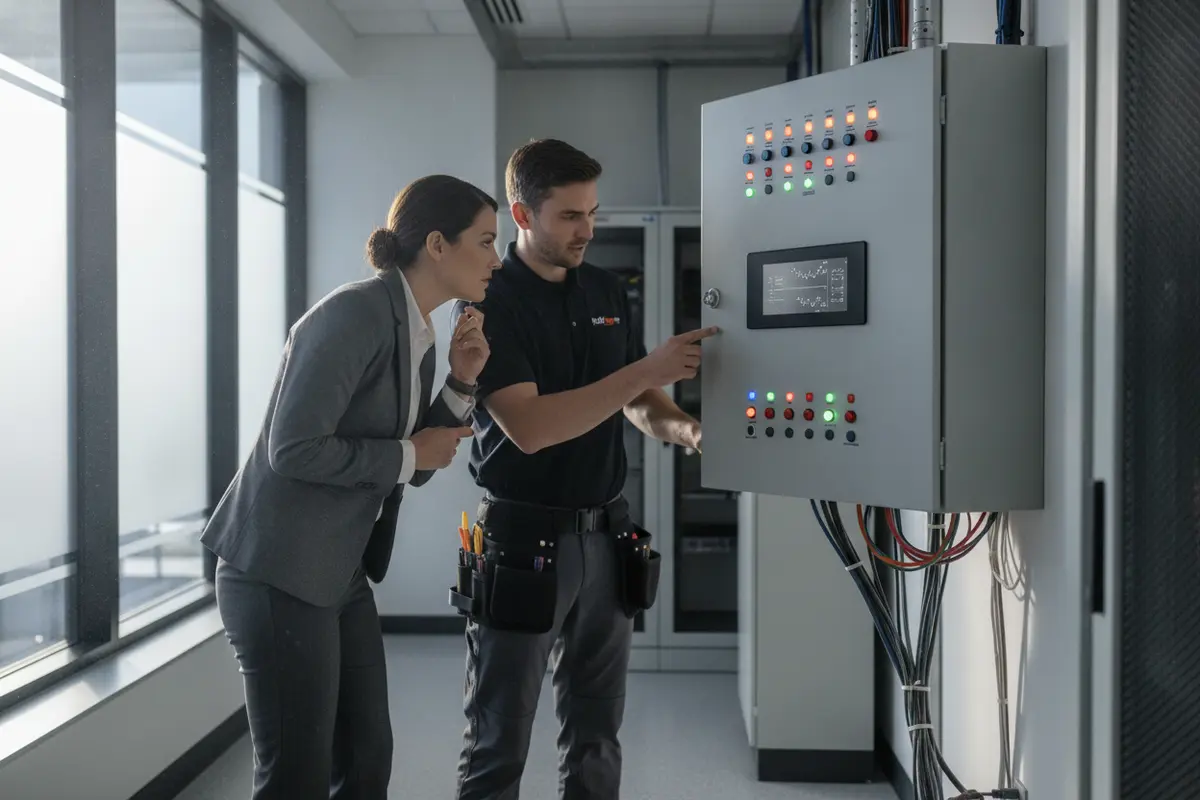
Discuss the following before activation or a change of provider:
- Existing equipment: Identify the panel, communicator, and any interface equipment. Ask whether the equipment is supported and compatible with the proposed monitoring arrangement.
- Primary and backup paths: Ask what path carries signals and whether a secondary path is included or required for the site. Request an explanation of what happens if communication is interrupted.
- Power and backup: Confirm how the fire alarm equipment is powered and what backup provisions are present. Ask who checks the condition of batteries and related components as part of maintenance.
- Building conditions: Discuss construction, location of equipment, signal availability, and any known areas where communication may be weak or disrupted.
- Change management: Ask whether network, telephone, or other building-service changes could affect the signal path and who should be notified before that work occurs.
Require a clear explanation of any proposed equipment changes and their purpose. If the scope includes fire alarm design or modification, determine who is responsible for reviewing the complete system and the applicable project requirements. For Atlanta-area businesses, American Alarm’s NFPA 72 compliance guide provides related context; confirm project-specific requirements with the appropriate professionals and authorities.
What Service, Testing, and Records Are Included?
Monitoring does not automatically mean that the system is inspected, tested, or repaired. Ask the provider to separate these responsibilities so that monitoring coverage does not create a false impression that every component is being routinely evaluated.
Use this comparison to organize conversations with prospective providers. The exact scope should be confirmed in the proposal and service documents.
| Topic | Question to ask | What to verify |
|---|---|---|
| Signal coverage | Which events and devices are included? | Written list of monitored conditions and account identifiers |
| Response procedure | What does the center do after each type of signal? | Contact order, escalation steps, and account instructions |
| Communication path | How does the system send signals, and what happens on failure? | Equipment, available backup, and fault notification process |
| Testing | Who coordinates tests and how are signals placed on test? | Scheduling steps, responsibilities, and restoration confirmation |
| Inspection and repair | Are these included or contracted separately? | Scope, frequency where applicable, service contact, and records |
| Documentation | What records can the property receive? | Event history, service records, test documentation, and account changes |
Ask how testing is coordinated so that authorized staff know when a test begins and ends. Clarify how the provider confirms that the system has been returned to normal monitoring afterward. The building’s own procedures and applicable requirements should guide who gives approval and what records are retained.
Before any scheduled test, identify the person who will request it, the person who will confirm the test window, and the person who will verify that normal operation has resumed. Ask how an unexpected signal during that window would be distinguished from the test and what steps staff should take if the planned test is delayed. Keep the confirmation with the building’s service records. These simple handoffs make responsibilities visible without treating a monitoring agreement as a substitute for the building’s testing and maintenance plan.
If a panel or related equipment needs service, confirm whether the monitoring provider performs that work or coordinates with a separate technician. American Alarm offers information about commercial fire alarm repair and its fire alarm design expertise. Ask for clear boundaries between monitoring, testing, maintenance, and repair before you agree to a scope.
How Should You Review Account Instructions and Records?
Accurate account information helps the monitoring provider follow the procedures your organization expects. Review these details during setup and whenever the building’s contacts or operations change.
- Contact list: Check names, roles, and current contact details. Identify who is authorized to change instructions.
- Site description: Verify the property name, address, access notes, and other information the provider needs to identify the account accurately.
- Operating context: Explain when the building is occupied, how access is managed, and any relevant site-specific procedures without assuming that a standard instruction fits every event.
- Change record: Ask how updates are submitted, acknowledged, and recorded, and how quickly they become active.
- Event and service history: Learn how to request account records and identify the contact who can explain an event or service entry.
Keep a copy of the monitoring instructions and the provider’s contact information with the property’s fire alarm records. If building management changes, include the monitoring account in the handoff checklist. A clear transition helps prevent old contacts, access information, or procedures from remaining on file.
Decide who owns the routine account review. That person can check whether contact details remain current, whether the site description still matches how the property operates, and whether recent changes were acknowledged by the provider. If the organization has more than one responsible contact, document who can approve instruction changes and who is an alternate. Keeping the process simple and assigning ownership makes it less likely that a change will be requested but never confirmed.
How Should Businesses Compare Commercial Fire Alarm Monitoring Atlanta Options?
Compare proposals on scope and accountability, not simply on a headline price. Ask each provider to state what is included, what is excluded, and what information or action the building must supply.
- Coverage: Match the proposal’s monitored signals and equipment to the property’s documented configuration.
- Response: Read the contact and escalation procedures. Confirm who maintains the instructions and how changes are approved.
- Communications: Understand the signal path, equipment requirements, fault reporting, and any backup arrangement.
- Service boundaries: Separate monitoring from inspections, testing, maintenance, repairs, and system changes.
- Costs and terms: Request a written breakdown of recurring monitoring fees, setup or equipment charges, contract term, renewal terms, and any fees for additional work. Do not assume that two differently scoped proposals are directly comparable.
- Records and transition: Ask what documentation is provided and how account ownership, contact details, and service history are handled if the provider changes.
For an existing building, gather the current panel information, available system documents, service history, and contact procedures before requesting a proposal. If you are changing providers, ask who coordinates the transition and how continuous signal handling will be verified. Avoid making assumptions about a switchover date until responsibilities and testing steps are agreed upon.
Include the people who manage the building, maintain the fire alarm system, and approve service agreements in the review where appropriate. Ask the provider to walk through the proposed sequence: account setup, equipment or programming work if needed, testing, confirmation of the correct account information, and the point at which the new service is considered active. Also clarify whether the existing provider must be notified and who is responsible for that communication. A written transition plan helps prevent assumptions about which party is handling a particular step.
American Alarm provides security and life-safety system design, installation, monitoring, and maintenance for Metro Atlanta customers. Learn more about the company’s local experience and service approach, or review its systems and product information as you prepare questions for a provider.
Why Does Local Technical Experience Matter?
Commercial fire alarm monitoring is connected to a larger life-safety system. Local technical experience can help a property team ask informed questions about equipment, documentation, service coordination, and the appropriate project contacts. It does not replace the building’s responsibility to confirm applicable requirements with qualified professionals and the authority having jurisdiction.
American Alarm has served homes and businesses in the Atlanta area since 1995, and its company information describes technical leadership with NICET IV certification and experience with NFPA 72 fire alarm systems. When speaking with any provider, ask who will evaluate the system, what qualifications are relevant to the work, and how proposed changes will be documented. The answer should connect the person’s role to the actual scope rather than rely on a general sales claim.
For a business in Roswell, Atlanta, Marietta, or another nearby community, also ask who coordinates service and how to reach support when an issue arises. Local service does not remove the need for clear procedures, but a direct understanding of responsibility and communication can make it easier for building staff to manage the account. American Alarm’s Atlanta fire alarm monitoring page is a useful starting point for a conversation about your site.
Call (770) 645-0061 to review monitoring questions for your property.
Frequently Asked Questions
These answers explain what to clarify with a provider; the right arrangement depends on the installed system and the building’s requirements.
Does fire alarm monitoring include inspections or repairs?
Not necessarily. Monitoring, inspection, testing, maintenance, and repair are distinct activities. Ask the provider to list what is included in writing and identify who is responsible for each item that is not.
What information should a business have ready for a monitoring quote?
Gather the building address, panel and communicator details if available, system documents, known service history, current contact procedures, and a description of the monitoring scope you need reviewed. The provider can then identify what else must be verified onsite.
How often should contact instructions be reviewed?
Review them during account setup and whenever staff, responsibilities, site access, or operating procedures change. It is also sensible to confirm the information periodically so outdated contacts do not remain the default.
Can an existing fire alarm system be monitored by a new provider?
Possibly, but compatibility and the signal path must be checked. Ask the prospective provider to identify supported equipment, any required changes, and the steps for testing and confirming the account before a transition is complete.
What should a monitoring proposal explain?
It should describe monitored signals, response instructions, communications, included services, exclusions, fees, contract terms, and available records. Ask the provider to resolve any unclear item before you approve the scope.
Take the Next Step for Your Atlanta Property
Clear answers help you compare providers and understand how monitoring fits into the wider fire alarm system. Before moving forward, confirm the signal path, response procedures, service boundaries, documentation, and transition plan for your specific building.
Call (770) 645-0061 to speak with American Alarm about commercial fire alarm monitoring.
A careful review gives your team a practical basis for choosing monitoring and keeping account information current.

Leave a Reply
Want to join the discussion?Feel free to contribute!