Georgia Commercial Fire Alarm Requirements for New Construction: A Comprehensive Guide
Key Takeaways
- New commercial construction in Georgia requires specific fire alarm systems governed by NFPA codes and local AHJ regulations.
- System design and installation must align with building occupancy, size, and use, integrating essential components from initial construction phases.
- Professional installation, monitoring, inspection, and certification are critical for compliance and occupancy approval.
- Effective fire alarm systems seamlessly integrate with comprehensive commercial security, access control, and camera systems.
Why Fire Alarm Systems Are Non-Negotiable for New Commercial Builds in Georgia
When planning a new commercial construction project in Georgia, from a high-rise in Buckhead to a warehouse in Kennesaw, the fire alarm system isn’t just another item on a checklist; it’s a foundational component of safety, compliance, and business continuity. For developers, architects, and business owners, understanding the gravity of these systems from day one is essential. The primary mandate is life safety; a properly designed and installed system provides early warning, enabling swift evacuation for employees and customers.
Beyond the critical human element, these systems are your first line of defense in property protection. A fire can devastate a new building, leading to catastrophic financial loss. An effective alarm system mitigates this risk by ensuring a rapid response from emergency services. Furthermore, compliance is not optional. Georgia’s building codes and insurance carriers require certified Commercial Fire Alarm Systems to be in place before an occupancy permit is issued. Failure to comply can result in project delays, fines, and significant legal and financial liabilities.
Navigating Georgia’s Fire Alarm Codes and Standards for New Construction
The regulatory landscape for commercial fire alarm systems in Georgia is governed by a hierarchy of codes and standards. At the top are national guidelines that the state has adopted, primarily the National Fire Protection Association (NFPA) codes. These are supplemented by state-level adoptions of the International Building Code (IBC) and International Fire Code (IFC). Finally, local municipalities have their own Authority Having Jurisdiction (AHJ), typically the local fire marshal, who has the final say on interpretation and enforcement. Building occupancy classifications, which define how the building will be used (e.g., office, retail, storage), are a major factor that dictates the specific requirements of the fire alarm system.
Key NFPA Standards and Georgia’s State-Specific Adoptions
The cornerstone of fire alarm regulations is NFPA 72, the National Fire Alarm and Signaling Code. This comprehensive document outlines the minimum requirements for the design, installation, inspection, and testing of fire alarm systems. It details everything from the proper placement of smoke detectors to the audibility levels of notification devices. Georgia adopts these codes, ensuring a consistent standard of safety across the state. Our Commercial Fire Safety Guide offers more insight into these crucial standards. Your construction team needs to work with a provider who is deeply familiar with both the national codes and any specific amendments adopted by the state of Georgia.
The Role of the Authority Having Jurisdiction (AHJ) in Your New Build
While the NFPA and IBC provide the rulebook, the local Authority Having Jurisdiction is the referee. The AHJ in your specific location, be it Atlanta, Roswell, or Marietta, is responsible for reviewing your fire alarm system plans, inspecting the installation, and giving the final approval. Their interpretation of the code is paramount. An experienced fire alarm partner will have established relationships with local AHJs throughout North Georgia, understanding their specific expectations and processes. This relationship is invaluable for streamlining the approval process and avoiding costly delays in your construction timeline.
Types of Commercial Fire Alarm Systems for New Buildings in Georgia
For new construction, two main types of fire alarm systems are typically considered: conventional and addressable. A conventional system is a more basic setup, dividing the building into broad zones. If a detector in “Zone 3” is triggered, the control panel indicates an alarm in that general area, but not the specific device. This is often suitable for smaller, simpler buildings. An addressable system, however, is more advanced. Each device (detector, pull station) has a unique “address.” When a device is activated, the control panel pinpoints the exact location of the alarm, providing first responders with precise information.
Conventional vs. Addressable Systems: Which is Right for Your Project?
For most new commercial builds in the Atlanta metro area, an addressable fire alarm system is the superior choice and often required by code for larger or more complex facilities. The ability to identify the exact point of an alarm drastically reduces emergency response times and helps pinpoint the source of a potential fire. While the initial investment may be higher, the advanced diagnostics, scalability, and detailed information provided by addressable systems offer greater safety and long-term value, making them the standard for new offices, healthcare facilities, and mixed-use properties.
Essential Components of a New Commercial Fire Alarm System
A compliant fire alarm system is a network of interconnected devices working in concert to detect and report a fire. Key components include:
- Fire Alarm Control Panel (FACP): The “brain” of the system, it monitors all connected devices, processes signals, and activates alarms.
- Initiating Devices: These are the sensors that detect signs of a fire. They include various types of smoke detectors (photoelectric, ionization), heat detectors, and manual pull stations.
- Notification Appliances: These devices alert building occupants of an emergency. They include audible alarms like horns and speakers, as well as visual alerts like strobe lights, which are crucial for ADA compliance.
- Monitoring Connections: This is the communication link, often using cellular or IP pathways, that transmits alarm signals from your FACP to a 24/7 monitoring station.
Tailored Requirements: Fire Alarms Based on Building Type and Occupancy
Fire alarm requirements are not one-size-fits-all. The system’s design is heavily influenced by the building’s specific use, or occupancy classification. A system designed for a retail store in Smyrna will differ significantly from one for a healthcare facility in Sandy Springs.
Specific Needs for Retail & Office Spaces
Business (Group B) and Mercantile (Group M) occupancies, such as office buildings and retail stores, typically require a comprehensive system that includes automatic smoke detection, manual pull stations at all exits, and both audible and visual notification devices to alert employees and the public. The focus is on ensuring a clear and orderly evacuation path.
Warehouses & Industrial Facilities: Unique Fire Alarm Challenges
Storage (Group S) and Factory (Group F) occupancies, like warehouses in Norcross or industrial plants, present unique challenges. Large open spaces, high ceilings, and the presence of combustible materials require specialized detection strategies. This may include beam smoke detectors for large areas or advanced flame detectors, depending on the specific hazards present. The system must be robust enough to overcome ambient noise and environmental conditions.
Healthcare & Institutional Buildings: Life Safety First
In Institutional (Group I) occupancies such as hospitals and assisted living facilities, life safety is the absolute priority. These systems are the most complex, often requiring voice evacuation capabilities that provide clear, spoken instructions during an emergency. They must also integrate with other building systems, such as HVAC, to control smoke spread and door holders to facilitate evacuation.
The Vital Role of Professional Fire Alarm Monitoring for New Businesses
An unmonitored fire alarm is only a local noisemaker. For true protection, your system must be connected to a professional central station. Professional Fire Alarm Monitoring for Businesses ensures that when an alarm is triggered, a signal is immediately sent to a 24/7/365 monitoring center. Trained operators verify the alarm and dispatch the appropriate fire department, whether it’s day or night. This immediate, professional response is crucial for minimizing damage and ensuring the safety of your property, especially when the building is unoccupied.
Inspection, Testing, and Certification: Gaining Occupancy Approval in Georgia
Before your new commercial building can open for business, the fire alarm system must pass a series of rigorous tests and inspections conducted by the local AHJ. This process verifies that every component is installed correctly and functions according to the approved design and NFPA standards. Upon successful completion, you will receive the necessary documentation, such as NFPA Certificates for Fire Alarms, which is a prerequisite for obtaining your Certificate of Occupancy. Working with a qualified partner ensures your system is built for compliance from the start, preventing costly failures at this final, critical stage.
Designing Your Fire Alarm System During the Initial Construction Phase
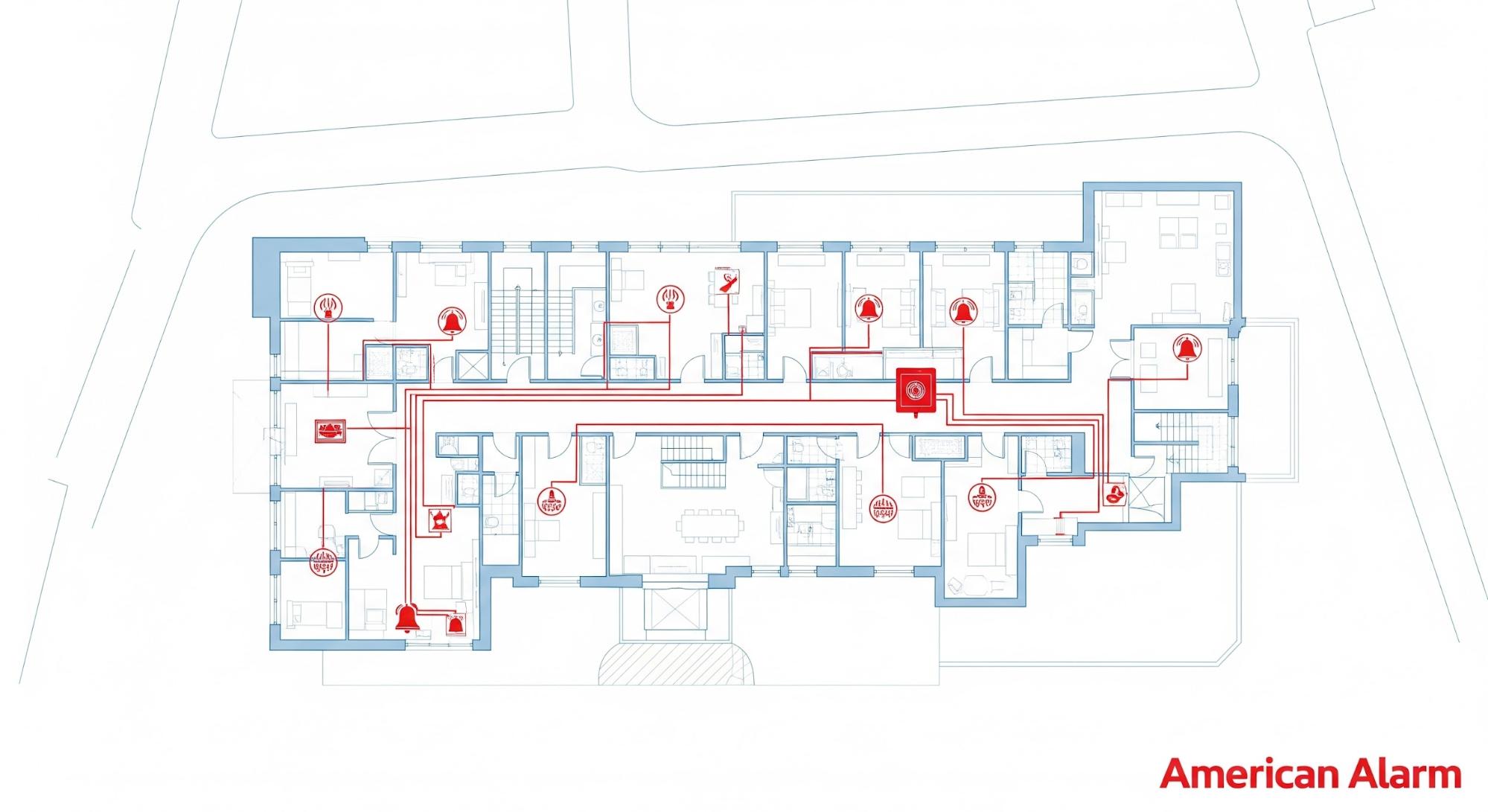
The single most effective way to ensure a smooth, cost-effective fire alarm installation is to integrate it into the project’s initial design phase. Planning the system alongside architectural, electrical, and mechanical plans prevents conflicts and costly retrofitting later. When fire alarm wiring, device placement, and power requirements are considered from the ground up, the installation becomes a seamless part of the construction process, rather than an afterthought. This proactive approach saves time, reduces expenses, and guarantees a more effective and compliant final product.
Seamless Integration: Fire Alarms with Commercial Security & Access Control
Modern safety is about a holistic approach. Your new building’s fire alarm system should not operate in a vacuum. It can and should be integrated with your other security infrastructure. For example, in the event of a fire alarm, the system can automatically unlock doors controlled by your Access Control Systems Atlanta to facilitate evacuation. Your Commercial Camera Systems can be programmed to display views of the alarm area, giving you immediate visual verification. Integrating these elements creates a powerful, unified safety solution. This is a core component of the comprehensive Atlanta commercial alarm solutions we provide, ensuring all your systems work together to protect your new investment.
Serving Georgia’s New Commercial Construction Landscape
From initial design consultation to final certification, navigating fire alarm requirements for new construction requires local expertise. At American Alarm, we have proudly served the commercial construction markets across Atlanta, Alpharetta, Roswell, Sandy Springs, Marietta, Johns Creek, Milton, Buckhead, Dunwoody, and Peachtree Corners since 1995. We understand the specific codes and AHJ expectations throughout North Georgia. If you are starting a new commercial build, it’s crucial to partner with experts who can deliver a compliant, effective, and reliable fire safety system. That’s a key reason Why Choose American Alarm. Contact American Alarm to discuss your project needs.
Secure Your New Georgia Commercial Build with Expert Fire Alarm Solutions
Don’t leave your new commercial property vulnerable. Partner with American Alarm for code-compliant fire alarm systems, designed and installed right from the start. Get a quote today and ensure your business is protected.
FAQs
What are the primary fire alarm codes for new commercial construction in Georgia?
Answer: New commercial construction in Georgia must comply with the International Building Code (IBC) and International Fire Code (IFC) as adopted by the state, alongside specific requirements from NFPA 72 (National Fire Alarm and Signaling Code). Local Authorities Having Jurisdiction (AHJ) may also impose additional regional mandates.
How does building occupancy classification affect fire alarm requirements for new builds in Georgia?
Answer: Building occupancy classification significantly impacts fire alarm system design. For example, assembly occupancies (A) have different requirements than business (B) or storage (S) occupancies, dictating the type, placement, and density of detectors and notification devices to ensure appropriate life safety measures for specific building uses.
Can a new commercial building in Georgia obtain an occupancy permit without a certified fire alarm system?
Answer: No, a new commercial building in Georgia cannot legally obtain an occupancy permit without a fully installed, tested, and certified fire alarm system that meets all applicable state and local codes. This certification ensures the system is operational and compliant for public safety.
When should fire alarm system design begin for a new commercial construction project?
Answer: Fire alarm system design should ideally begin during the very early architectural and planning stages of new commercial construction. Integrating the system design from the outset helps avoid costly revisions, ensures seamless installation, and guarantees compliance with all necessary codes and regulations.
Is ongoing monitoring required for fire alarm systems in new commercial buildings in Georgia?
Answer: While initial certification is required for occupancy, ongoing 24/7 professional monitoring is highly recommended and often a requirement for many commercial occupancies in Georgia. This ensures immediate dispatch of emergency services in case of an alarm, significantly enhancing safety and property protection.


Leave a Reply
Want to join the discussion?Feel free to contribute!